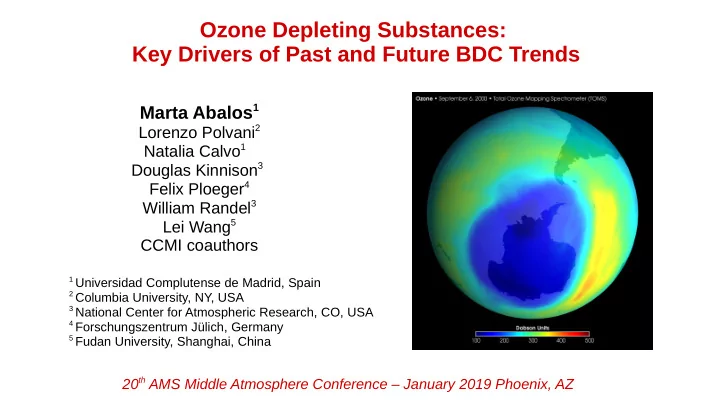
SLIDE 1 Ozone Depleting Substances: Key Drivers of Past and Future BDC Trends
Marta Abalos1
Lorenzo Polvani2 Natalia Calvo1 Douglas Kinnison3 Felix Ploeger4 William Randel3 Lei Wang5 CCMI coauthors
1 Universidad Complutense de Madrid, Spain 2 Columbia University, NY, USA 3 National Center for Atmospheric Research, CO, USA 4 Forschungszentrum Jülich, Germany 5 Fudan University, Shanghai, China
20th AMS Middle Atmosphere Conference – January 2019 Phoenix, AZ
SLIDE 2
2
ODS 50 hPa CO2 surface Monotonic increase Peak in ~2000
1960-2100 runs CESM-WACCM1 + CCMVal2 + CCMI models All forcing Fixed ODS Fixed GHG ODS + GHG varying ODS fixed to 1960, GHG varying GHG fixed to 1960, ODS varying
Anthropogenic emissions: the ODS fingerprint
RCP 6.0 WMO A1
SLIDE 3
3
Age of air trends WACCM
Polvani, Abalos et al. 2018 GRL
Fixed ODS Fixed GHG All forcing PAST
pre-2000
FUTURE
post-2000 annual mean
SLIDE 4
4
Results are consistent in 20 models (CCMI and CCMVal2)
Weaker AoA trends in the future (factor of ~2 for the MMM)
Polvani, Wang, Abalos et al. under review annual mean
PAST
pre-2000
FUTURE
post-2000
SLIDE 5
5
Change in past/future annual trends due to ODS in most models
All forcing Fixed ODS Fixed GHG
Polvani, Wang, Abalos et al. under review
SLIDE 6
6
Disentangling the radiative versus chemical effects of ODS
All forcing Fixed ODS No (HET) ozone depletion
Abalos et al. under review
SLIDE 7
7
Impact of Antarctic ozone hole on DJF SH downwelling accelerates tropical upwelling by mass continuity
SH Tropics NH
DJF net mass flux All forcing Fixed ODS No (HET) ozone depletion
Abalos et al. under review
SLIDE 8
8
Residual circulation trends
JRA-55 All forcings Impact of ODS
(All forcings minus Fixed ODS) DJF 1980-2000
WACCM
Abalos et al. under review
SLIDE 9 9
Isentropic mixing trends (Λeq)
JRA-55 All forcings Impact of ODS
(All forcings minus Fixed ODS) DJF 1980-2000
WACCM
~30 km ~10 km
Abalos et al. under review
SLIDE 10
10
Mean age of air trends
JRA-55 All forcings Impact of ODS
(All forcings minus Fixed ODS) DJF 1980-2000
WACCM
Abalos et al. under review
SLIDE 11 11
DJF SH trends are robust in reanalyses
Residual circulation Isentropic mixing Mean age
JRA-55 ERA-I
DJF 1980-2000 Abalos et al. under review
1984-2000
SLIDE 12 12
- Ozone depleting substances (ODS) are key drivers of past
and future Brewer-Dobson circulation (BDC) trends.
- This impact is mainly through ozone depletion, the
greenhouse effect contribution of ODS to the BDC is negligible.
- The ozone hole is the cause of the most robust BDC trend
features in reanalyses over the last decades of 20th century.
Conclusions
SLIDE 13 13
Published:
- Polvani L., Abalos M., Garcia R., Kinnison D. and Randel W.: Significant weakening of
the Brewer-Dobson circulation trends over the 21st century as a consequence of the Montreal Protocol. Geophysical Research Letters (2017), doi: 10.1002/2017GL075345. Under Review:
- Polvani L., Wang L., Abalos M., M.P. Chipperfield, M. Deushi, S.S. Dohmse, P. Jöckel,
- D. Kinnison, M. Michou, O. Morgenstern, L.D. Oman, D.A. Plummer, K.A. Stone:
Large impacts, past and future, of ozone depleting substances on Brewer-Dobson circulation trends: A multi-model assessment. Under Review.
- Abalos M., Polvani L., Calvo N., Kinnison D., Ploeger F., Randel W.: New insights on
the impact of ozone depleting substances on the Brewer-Dobson circulation. Under Review.
Thank you!
SLIDE 14
14
NH polar downwelling SH polar downwelling
All forcing Fixed ODS Fixed GHG
annual DJF
Residual circulation: ODS signal dominated by austral summer
Polvani, Abalos et al. 2018 GRL
Tropical upwelling
SLIDE 15 15
JRA-55 ERA-I Residual circulation Isentropic mixing Mean age
Annual mean trends 1980-2000
SLIDE 16
16
w*Q w*m w* 1980-2000 DJF: Most robust reanalysis trends in residual circulation