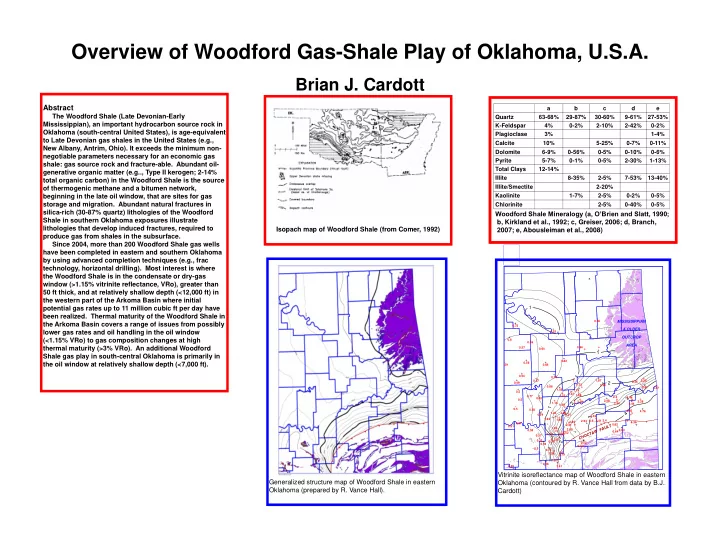

Generalized structure map of Woodford Shale in eastern Oklahoma (prepared by R. Vance Hall).
Overview of Woodford Gas-Shale Play of Oklahoma, U.S.A.
Brian J. Cardott
Abstract
The Woodford Shale (Late Devonian-Early Mississippian), an important hydrocarbon source rock in Oklahoma (south-central United States), is age-equivalent to Late Devonian gas shales in the United States (e.g., New Albany, Antrim, Ohio). It exceeds the minimum non- negotiable parameters necessary for an economic gas shale: gas source rock and fracture-able. Abundant oil- generative organic matter (e.g.., Type II kerogen; 2-14% total organic carbon) in the Woodford Shale is the source
- f thermogenic methane and a bitumen network,
beginning in the late oil window, that are sites for gas storage and migration. Abundant natural fractures in silica-rich (30-87% quartz) lithologies of the Woodford Shale in southern Oklahoma exposures illustrate lithologies that develop induced fractures, required to produce gas from shales in the subsurface. Since 2004, more than 200 Woodford Shale gas wells have been completed in eastern and southern Oklahoma by using advanced completion techniques (e.g., frac technology, horizontal drilling). Most interest is where the Woodford Shale is in the condensate or dry-gas window (>1.15% vitrinite reflectance, VRo), greater than 50 ft thick, and at relatively shallow depth (<12,000 ft) in the western part of the Arkoma Basin where initial potential gas rates up to 11 million cubic ft per day have been realized. Thermal maturity of the Woodford Shale in the Arkoma Basin covers a range of issues from possibly lower gas rates and oil handling in the oil window (<1.15% VRo) to gas composition changes at high thermal maturity (>3% VRo). An additional Woodford Shale gas play in south-central Oklahoma is primarily in the oil window at relatively shallow depth (<7,000 ft). Isopach map of Woodford Shale (from Comer, 1992) Vitrinite isoreflectance map of Woodford Shale in eastern Oklahoma (contoured by R. Vance Hall from data by B.J. Cardott)
MISSISSIPPIAN & OLDER OUTCROP AREA CHOCTAW FAULT
1 1 1 1 4 3 3 2 2 2 1 1
1.31 0.56 0.79 0.59 0.78 2.19 0.64 0.64 2 1.73 2.09 1.37 1.79 1.98 1.87 0.57 1.23 1.05 0.86 0.74 1 0.72 3.32 2.69 0.52 2.94 0.58 0.5 0.55 0.57 0.58 0.83 0.77 1.14 1.23 0.79 2.53 0.57 0.56 0.6 1.69 0.82 3.46 2.4 2.44 2.48 3.41 3.4 3.6 3.36 3.44 4.85 6.36 4.76 0.59 0.56 0.54 0.49 0.57 0.5 0.5 0.5 0.56 2.81 3.47 2.25 2.26 1.88 0.52 0.64 0.62 0.63 1.88 1.89 2.52 2.51 0.49 0.51 1.15 1.66 1.62 2.85 0.94 1.61 2.01 1.58 2.31 1.03
PETRA 8/10/2007 11:30:29 AMWoodford Shale Mineralogy (a, O’Brien and Slatt, 1990; b, Kirkland et al., 1992; c, Greiser, 2006; d, Branch, 2007; e, Abousleiman et al., 2008)
a b c d e Quartz 63-68% 29-87% 30-60% 9-61% 27-53% K-Feldspar 4% 0-2% 2-10% 2-42% 0-2% Plagioclase 3% 1-4% Calcite 10% 5-25% 0-7% 0-11% Dolomite 6-9% 0-56% 0-5% 0-10% 0-6% Pyrite 5-7% 0-1% 0-5% 2-30% 1-13% Total Clays 12-14% Illite 8-35% 2-5% 7-53% 13-40% Illite/Smectite 2-20% Kaolinite 1-7% 2-5% 0-2% 0-5% Chlorinite 2-5% 0-40% 0-5%