Overview of the workshop Exploring Mindfulness What does it really - - PDF document

overview of the workshop
SMART_READER_LITE
LIVE PREVIEW

Overview of the workshop Exploring Mindfulness What does it really - - PDF document

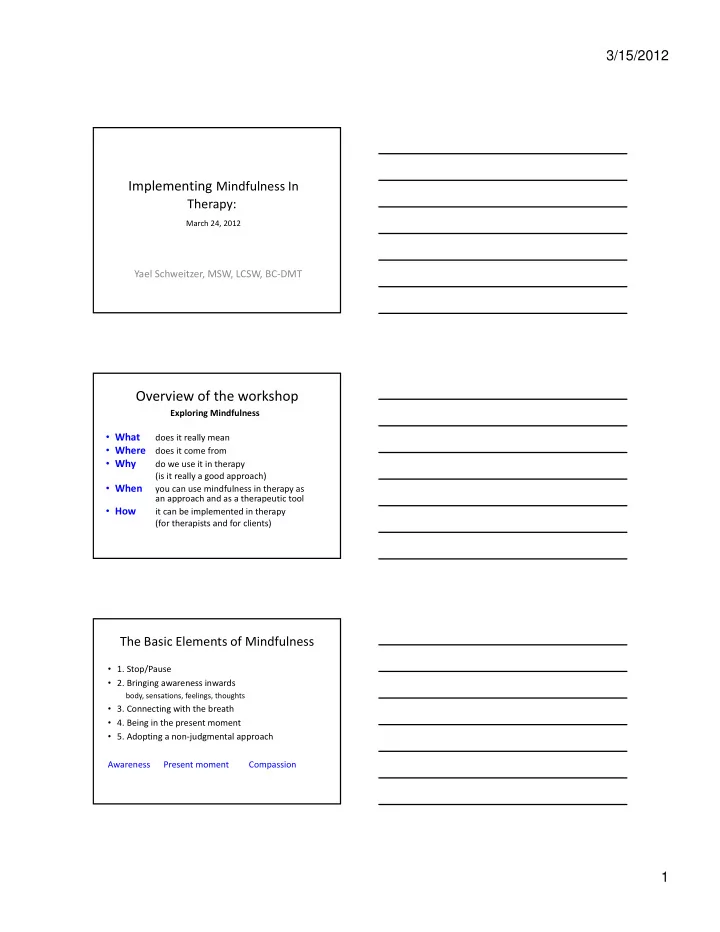
3/15/2012 Implementing Mindfulness In Therapy: March 24, 2012 Yael Schweitzer, MSW, LCSW, BC DMT Overview of the workshop Exploring Mindfulness What does it really mean Where does it come from Why do we use it in therapy (is it


slide-1
SLIDE 1

3/15/2012 1

Implementing Mindfulness In

Therapy:

March 24, 2012

Yael Schweitzer, MSW, LCSW, BC‐DMT

Overview of the workshop

Exploring Mindfulness

  • What

does it really mean

  • Where

does it come from

  • Why

do we use it in therapy (is it really a good approach)

  • When

you can use mindfulness in therapy as an approach and as a therapeutic tool

  • How

it can be implemented in therapy (for therapists and for clients)

The Basic Elements of Mindfulness

  • 1. Stop/Pause
  • 2. Bringing awareness inwards

body, sensations, feelings, thoughts

  • 3. Connecting with the breath
  • 4. Being in the present moment
  • 5. Adopting a non‐judgmental approach

Awareness Present moment Compassion

slide-2
SLIDE 2

3/15/2012 2

About Mindfulness

  • Mindfulness is about being fully aware in
  • ur lives. It is about perceiving the

exquisite vividness of each moment. When we feel more alive we gain immediate access to our own inner resources for coping effectively with stress.

– Jon Kabat‐Zinn, Wherever You Go, There You Are

About mindfulness

Mindfulness is a non elaborative, nonjudgmental, present‐ centered awareness in which each thought, feeling, or sensation that arises in the attentional field is acknowledged and accepted as it is. There are two components in the operational definition of "mindfulness". 1) Self‐regulation of attention so that it is maintained on immediate experience, thereby allowing for increased recognition of mental events in the present moment. 2) Adopting a particular orientation toward one’s experiences in the present moment, an orientation that is characterized by curiosity, openness, and acceptance. Bishop et al. (2004:232)

The Buddha

slide-3
SLIDE 3

3/15/2012 3

The Four Noble Truths

  • 1. Life means suffering.
  • 2. The origin of suffering is attachment.
  • 3. The cessation of suffering is attainable.
  • 4. The path to the cessation of suffering.

The Noble Eightfold Path

  • 1. Right View

Wisdom

  • 2. Right Intention
  • 3. Right Speech

Ethical Conduct

  • 4. Right Action
  • 5. Right Livelihood
  • 6. Right Effort

Mental Development

  • 7. Right Mindfulness
  • 8. Right Concentration

Formal Practice

“Mini”

slide-4
SLIDE 4

3/15/2012 4

The question

(to ask yourself or your client)

What did you notice?

Breathing ( the “mini” exercise)

A short mindfulness practice with a focus on the breath

  • Preparation
  • Assume a comfortable sitting position with a straight back and

maintain the head in a straight line with the spine.

  • Close your eyes or focus them gently on a spot on the floor in

front of you.

  • Awareness of body and breath
  • Bring awareness to the body.
  • Bring awareness to the flow of the breath as it is, focusing on

each inhalation and each exhalation.

Breathing ( the “mini” exercise) – contd.

  • Anchoring awareness in the breath
  • Whenever you find yourself being carried by thoughts,

acknowledge them, and shift awareness back to the breath.

  • If emotions or body sensations arise, acknowledge them and

shift awareness back to the breath.

  • The moment of recognizing thoughts, emotions or sensations

– is a moment of mindfulness.

  • The practice is about coming back to the breath again and

again.

  • Ending
  • Practice for 5 ‐ 10 minutes.
  • Acknowledge your intentions and efforts to be mindful.
  • End the practice and continue with your daily activities.
slide-5
SLIDE 5

3/15/2012 5

The Physiological Changes of the Stress Response: Fight or Flight (or Freeze) Response

  • Heart Rate
  • Blood Pressure
  • Breathing Rate
  • Muscle Tension
  • Metabolism
  • Oxygen Consumption

The Physiological Changes of Relaxation: The Relaxation Response

  • Heart Rate
  • Blood Pressure
  • Breathing Rate
  • Muscle Tension
  • Metabolism
  • Oxygen consumption
slide-6
SLIDE 6

3/15/2012 6

Informal Practice

Mindfulness in everyday life

Mindfulness in Research

  • Progress in the field of mindfulness has advanced

from pilot studies to formal research

  • Most research focuses on effects of mindfulness

meditation

  • The research is mostly on the effectiveness of

psycho‐educational programs like MBSR or MBCT and individual mindfulness practice. There is a need for research on the effectiveness of mindfulness in therapy.

slide-7
SLIDE 7

3/15/2012 7

Mindfulness in Therapy /con.

There is research on effectiveness of mindfulness practice from a wide variety of perspectives:

  • Improvement of physical symptoms (chronic pain, heart

disease, recovery time)

  • Improvement of emotional symptoms (anxiety, depression,

stress)

  • Influence on brain activity (identifying responsive areas)
  • Influence on immune system & hormones
  • Influence on general wellness.

Results show improvement in all areas due to mindfulness practice

Formal Practice

Sitting Meditation

What did you notice?

slide-8
SLIDE 8

3/15/2012 8

The two pillars of MBT

“Since we cannot change reality, let us change the eyes that see reality”. Nikos Kazantzakis/ Report to Grecco.

Focus on the process – perception, reactions, choices, non attachment, being in the present, body awareness

“In the midst of winter, I finally learned that there was in me an invincible summer”. Albert Camus

Focus on cultivating positive content /qualities– compassion, acceptance, inner strength and virtues

The thought manifests as the word; The word manifests as the deed; The deed develops into habit; And habit hardens into character. So watch the thought and its ways with care, And let it spring from love Born out of concern for all beings. The Buddha

Compassion: Lovingkindness Meditation

Loving‐kindness is a meditation practice, which brings about positive attitudinal changes as it systematically develops the quality of 'loving‐acceptance'. It acts, as it were, as a form of self‐psychotherapy, a way of healing the troubled mind to free it from its pain and confusion. Of all Buddhist meditations, loving‐kindness has the immediate benefit of sweetening and changing old habituated negative patterns

  • f mind.

Ven.Pannyavaro

slide-9
SLIDE 9

3/15/2012 9

Interpersonal Mindfulness

There are 6 Guidelines for Mindful Interactions

Pause Relax Open Trust Emergence Speak the Truth – Listen Deeply

Based on Insight Dialogue and Interpersonal Mindfulness programs, developed by Gregory kramer, PhD

Pause

Guidelines for Mindful Interaction

Pause

  • A way of slowing down
  • Directing awareness inward
  • Creating a space between what we hear, see, think and say
  • Noticing any tension of the body and the turmoil of the mind
  • Stepping out of reaction
  • Stepping out of conditioned response ‐ Choosing the right

response

slide-10
SLIDE 10

3/15/2012 10

Relax (Accept)

Guidelines for Mindful Interaction

Relax (Accept)

  • Loosen the grip of tensed muscles
  • Release habitual thoughts
  • Relax into emotions that arise.
  • Be present with whatever presents itself in the

moment

  • Meet the experience with acceptance

Open

slide-11
SLIDE 11

3/15/2012 11

Guidelines for Mindful Interaction

Open

  • Open the field of awareness to encompass
  • ther people and the environment
  • Extend the internal to the external.
  • The awareness gets wider.

Trust Emergence

Guidelines for Mindful Interaction

Trust Emergence

  • Dive into the unfolding present
  • Uncertainty what will unfold
  • Fluid and impermanent nature of experience
  • Each moment comes alive with possibility
slide-12
SLIDE 12

3/15/2012 12

Speak the Truth – Listen Deeply

Speak The Truth

Guidelines for Mindful Interaction

Speak the truth

  • Know the subjective truth of your experience

in the present moment

  • Examine not only the truth but also what is

useful

  • Confidence is balanced with inquiry
slide-13
SLIDE 13

3/15/2012 13

Listen Deeply

Guidelines for Mindful Interaction

Listen Deeply

  • Receive fully what is said
  • Explore the nonverbal channels of

communication

  • Listening with the whole body
  • An investigative process ‐ gathering meaning

with intellectual precision and intuitive depth

What is Mindfulness‐Based Therapy?

Mindfulness‐Based Therapy is an approach in which the principles of mindfulness are applied for therapeutic purposes. Mindfulness‐Based Therapy involves the practice of focused attention, bringing awareness to every sensation, emotion and thought as they unfold in the moment. This practice allows a shift from having our mental health defined by the content of our thoughts to having it defined by our relationship to that content ‐ relationship that is supported by developing acceptance and compassion. In Mindfulness‐ Based Therapy one moves beyond language to change fundamental psychological processes.

slide-14
SLIDE 14

3/15/2012 14

Who can benefit from Mindfulness‐Based Therapy? Mindfulness‐Based Therapy fits everyone who seeks therapy for medical, personal and interpersonal reasons. It can be helpful to people coping with conditions such as: Anxiety /Stress / Depression Chronic pain Low self esteem Grief &Loss Sleep disorders Transitions and adjustment Relationship/social issues Couple and family challenges Cardiac dysfunction Life threatening diseases Search for meaning – seeking spiritual growth

Mindfulness in Therapy – How to work with clients

  • Introduce to the client formal and informal mindfulness practices.
  • Help clients identify patterns of (negative) thoughts without

engaging/believing in them (diffusion).

  • Explore emotions as they express themselves in the body.
  • Bring experience to the present (how do you feel now when you

talk about that.. )

  • Acknowledge the good – Connect to your client’s strengths.
  • Help your clients cultivate compassion acceptance and kindness to

themselves.

  • Working with couples – Incorporate the Six IM Guidelines
  • Create and give home practice – formal and informal – be creative

to fit you client’s needs.

Implementing Mindfulness in Therapy – for

the therapist

  • Most important ‐ Establish your own

practice!

Formal Practice Everyday practice, retreats, courses, Sangha

slide-15
SLIDE 15

3/15/2012 15

“Minis”

Informal Practices

Additional suggestions for Implementing Mindfulness in Therapy Be mindful in therapy ‐ follow the guidelines for interpersonal mindfulness

slide-16
SLIDE 16

3/15/2012 16

Additional suggestions for Implementing Mindfulness in Therapy for the therapist ‐ CONTD

  • Remember ‐ the MBT is an approach to therapy
  • Acknowledge your intentions and be clear about what you are
  • ffering.
  • Bring curiosity to the process, don’t expect a certain outcome,

practice with the client.

  • Start implementing mindfulness in therapy with small steps

(using “minis”, staying in the present, connecting to the body)

  • Develop and arsenal of practices to fit your clients need.
  • Get support: seek supervision or join/establish a peer

group of therapists interested in Implementing mindfulness in Therapy

  • Be patient – it takes a lot of slow to grow…

Mindfulness in Therapy

Suggested Reading List

  • Benson, Herbert: The Relaxation Response Avon Books, NY 1975
  • Chodron Pema, When Things Fall Apart: Heart Advice for Difficult Times.

Shambhala Publications, 1997

  • Germer Christopher, Siegel Ronald, Fulton Paul (editors): Mindfulness and
  • Psychotherapy. The Guilford Press, NY 2005
  • Hanson Rick, Mendius Richard, Buddha’s Brain: Happiness, love & Wisdon. New

Harbinger Publication, Inc, 2009

  • Kabat‐Zinn, Jon, Full Catastrophe Living: Using the wisdom of your body and mind

to face stress, pain and illness. Delta Books, NY 1990

  • Kabat‐Zinn, Jon, Wherever You Go There You Are: Mindfulness Meditation in

Everyday Life. Hyperion, NY 1994

  • Kabat‐Zinn, Jon, Mindfulness for Beginners: Reclaiming the Present Moment‐‐and

Your Life. SoundTrue Boulder, Colorado, 2012

Mindfulness in Therapy

Suggested Reading List

  • Kissel Wegela Karen; The courage to be present – Buddhism, Psychology and the

Awakening of Natural Wisdom, Shambhala Boston& London 2010

  • Kramer, G., Moleo‐Meyer, F., & Turner, M.L. Cultivating Mindfulness in Relationship.

In Hick,S.F., and Bien, T., (2008). Mindfulness and the Therapeutic Relationship (pp 185‐214). New York: Guilford Press, 2008.

  • Kramer Gregory, Insight Dialogue – The Interpersonal Path to Freedom. Shambhala

Publications, Boston, 2007

  • Salzberg, Sharon, Lovingkindness: The Revolutionary Art of Happiness. Shambhala

Publication, 1997

  • Santorelli, Saki, Heal Thy Self; Lessons on Mindfulness in Medicine. Bell Tower NY

1999

Websites: Center for Mindfulness: (Jon Kabat‐Zinn PhD) http://www.umassmed.edu/cfm/index.aspx Metta foundation: (Gregory Kramer PhD) http://www.metta.org/ Mind/Body institute: (Herbert Benson, MD) http://www.massgeneral.org/bhi/
slide-17
SLIDE 17

3/15/2012 17