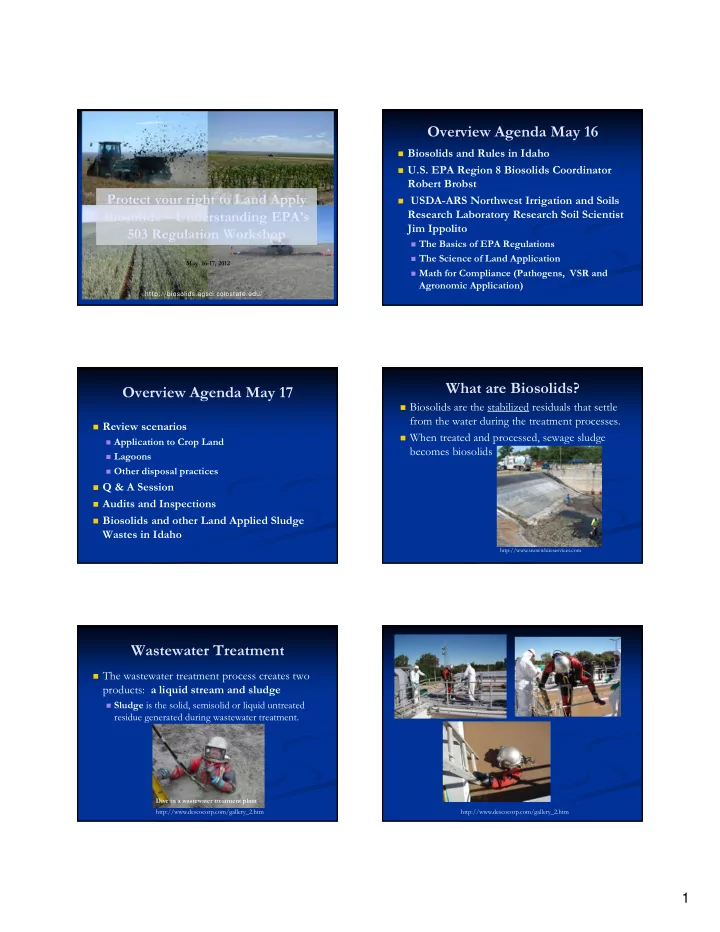
Overview Agenda May 16 Biosolids and Rules in Idaho U.S. EPA Region - - PDF document

overview agenda may 16
SMART_READER_LITE
LIVE PREVIEW

Overview Agenda May 16 Biosolids and Rules in Idaho U.S. EPA Region - - PDF document

Overview Agenda May 16 Biosolids and Rules in Idaho U.S. EPA Region 8 Biosolids Coordinator Robert Brobst Protect your right to Land Apply USDA-ARS Northwest Irrigation and Soils Research Laboratory Research Soil Scientist Biosolids


slide-1
SLIDE 1

1 Protect your right to Land Apply Biosolids – Understanding EPA’s 503 Regulation Workshop

http: / / biosolids.agsci.colostate.edu/ May 16-17, 2012

Overview Agenda May 16

 Biosolids and Rules in Idaho  U.S. EPA Region 8 Biosolids Coordinator

Robert Brobst

 USDA-ARS Northwest Irrigation and Soils

Research Laboratory Research Soil Scientist Jim Ippolito

 The Basics of EPA Regulations  The Science of Land Application  Math for Compliance (Pathogens, VSR and

Agronomic Application)

Overview Agenda May 17

 Review scenarios

 Application to Crop Land  Lagoons  Other disposal practices

 Q & A Session  Audits and Inspections  Biosolids and other Land Applied Sludge

Wastes in Idaho

What are Biosolids?

 Biosolids are the stabilized residuals that settle

from the water during the treatment processes.

 When treated and processed, sewage sludge

becomes biosolids

http://www.snowwhiteservices.com

Wastewater Treatment

 The wastewater treatment process creates two

products: a liquid stream and sludge

 Sludge is the solid, semisolid or liquid untreated

residue generated during wastewater treatment.

http://www.descocorp.com/gallery_2.htm Dive in a wastewater treatment plant http://www.descocorp.com/gallery_2.htm

slide-2
SLIDE 2

2

Biosolids Treatment

 Biosolids treatment is designed to kill pathogens

and stabilize organic matter. This is also treatment to reduce odors and vector attraction.

 Biosolids can be safely

used to sustainably improve and maintain productive soils and stimulate plant growth.

Biosolids Generation and Use

Land applied, composted or used as landfill cover, 60% Incinerated, 22% Disposed in Landfills, 18.0%

 EPA estimates that publicly owned wastewater

treatment works in US generate > 7 million tons (dry weight) of sewage sludge annually.

Wastewater Treatment Plant Sewage Hazardous waste

Biosolids Flowchart

Effluent Biosolids Beneficial Use Disposal Industrial waste Storm water Sludge Domestic Sources

Composition of Biosolids

 Water  Nitrogen  Phosphorus  Other nutrients and organic matter  Trace amounts of metals and organic compounds

http://www.cipotato.org/urbanharvest/photos/urbanwasteproducts_ghana.htm

Biosolids Benefits

 EPA and state of Idaho considers biosolids a

beneficial resource.

 Nutrients and organic matter in biosolids can be

recycled as a fertilizer and used for soil augmentation.

Cross-section of popular trees showing how sludge application increases tree growth. Both cross sections are 8 years old; the larger is

  • aprox. 8 inches in diameter.

(Photo courtesy of Mike VanHam, British Columbia, Canada)

Biosolids Benefits

Taken from Biosolids Brochure at http://www.kingcounty.gov/environment/wastewater/Biosolids/DocumentsLinks.aspx

slide-3
SLIDE 3

3

Constituents of Concern

 Nutrients  Pathogens  Odors and bio-aerosols  Pollutants

 Trace elements  Organic and Inorganic Toxins

http://www.water.siemens.com

Biosolids Regulated Community

 Biosolids are subject to federal, state, and local

regulations

 Biosolids must be treated to meet standards for

pathogens, vectors, and metals.

 This applies to anyone who:

 Generates treated sewage sludge (biosolids)  Derives a material from treated sewage sludge

(biosolids)

 Applies biosolids to the land

 Federal Regulations (40 CFR Part 503)

 Anyone who the law applies to, has to follow it

whether or not they have a permit

 State (IDAPA 58.01.16 “Wastewater Rules”)

 58.01.16.650 Sludge can be utilized as soil augmentation  Separate enforcement authority in Idaho

Biosolids Regulations

http://lancaster.unl.edu/enviro/biosolids/overvew.shtml

 Federal Regulations (40 CFR Part 503)  State (IDAPA 58.01.16.650)

 Be Aware, Familiar and Compliant with both

Biosolids Regulations 40 CFR Part 503

 Biosolids Treatment

 Stabilization and Dewatering

 Pathogen Reduction

 Class A  Class B

 VAR: Vector Attraction Reduction  Pollution Limits and other requirements

http://www.flickr.com/photos

Biosolids Land Application

 Beneficial use is for soil augmentation  EPA, WERF, NACWA have demonstrated that the

beneficial land application of biosolids poses a negligible risk to human health (National Academy of Sciences,

2002 Study)

slide-4
SLIDE 4

4

Biosolids Application Methods

Slinger Spray Injection

Biosolids Management Plan

 IDAPA 58.01.16.650 requires approved Plans  Plans should accurately reflect activities  Requires DEQ approval and includes:

 Biosolids characterization and stabilization through 503  Site selection criteria, including soil types, geology, ground

water characteristics, land use, topography, and climate

 Management for application process, nutrient loading and

public and environmental safety (buffer zones)

Protect your right to Land Apply Biosolids – Understanding EPA’s 503 Regulation Workshop Presenters

 U.S. EPA Region 8 Biosolids Coordinator

Robert Brobst, P.E.

 USDA-ARS Northwest Irrigation and Soils

Research Laboratory Research Soil Scientist Jim Ippolito, Ph.D.