OUTLOOK Rain Overcast Sunny TRANSPORTATION LESSON NO Uncovered - - PDF document

outlook
SMART_READER_LITE
LIVE PREVIEW

OUTLOOK Rain Overcast Sunny TRANSPORTATION LESSON NO Uncovered - - PDF document

Learning the concept Go to lesson OUTLOOK Rain Overcast Sunny TRANSPORTATION LESSON NO Uncovered Covered Theoretical Practical NO YES NO YES Decision trees encode logical formulas A decision tree represents a disjunction of


slide-1
SLIDE 1

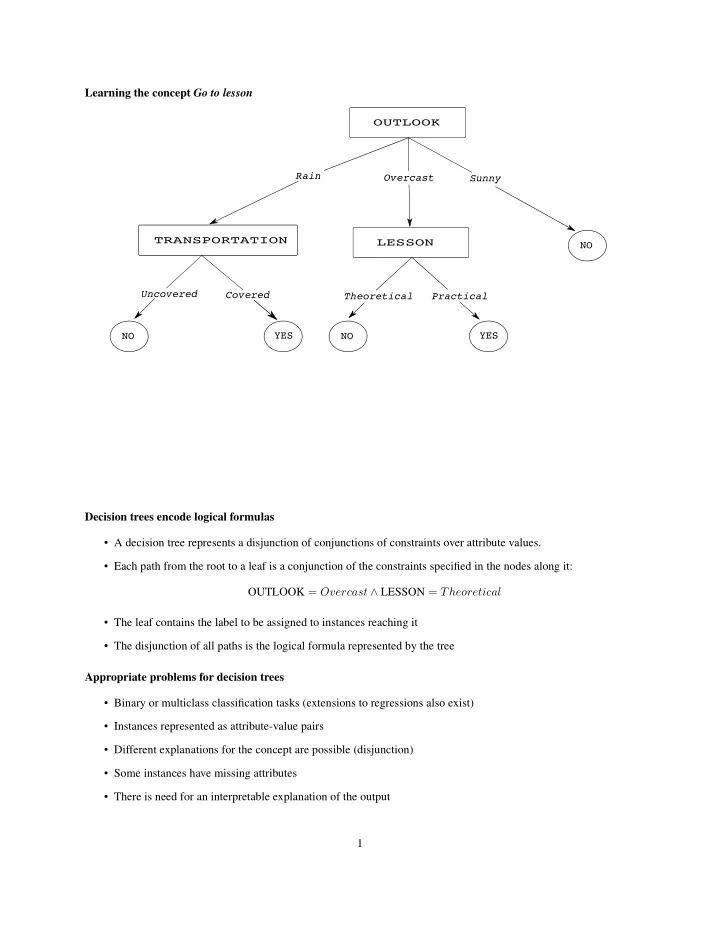
Learning the concept Go to lesson

OUTLOOK LESSON TRANSPORTATION

Rain Overcast Sunny Covered Uncovered Theoretical Practical NO YES YES NO NO

Decision trees encode logical formulas

  • A decision tree represents a disjunction of conjunctions of constraints over attribute values.
  • Each path from the root to a leaf is a conjunction of the constraints specified in the nodes along it:

OUTLOOK = Overcast ∧ LESSON = Theoretical

  • The leaf contains the label to be assigned to instances reaching it
  • The disjunction of all paths is the logical formula represented by the tree

Appropriate problems for decision trees

  • Binary or multiclass classification tasks (extensions to regressions also exist)
  • Instances represented as attribute-value pairs
  • Different explanations for the concept are possible (disjunction)
  • Some instances have missing attributes
  • There is need for an interpretable explanation of the output

1

slide-2
SLIDE 2

Learning decision trees

  • Greedy top-down strategy (ID3 - Quinlan 1986, C4-5 - Quinlan 1993)
  • For each node, starting from the root with full training set:
  • 1. Choose best attribute to be evaluated
  • 2. Add a child for each attribute value
  • 3. Split node training set into children according to value of chosen attribute
  • 4. Stop splitting a node if it contains examples from a single class, or there are no more attributes to test.
  • Divide et impera approach

Chosing the best attribute Entropy

  • A measure of the amount of information contained in a collection of instances S which can take a number c of

possible values. H(S) = −

c

  • i=1

pilog2pi where pi is the fraction of S taking value i.

  • In our case instances are training examples and values are class labels
  • The entropy of a set of labelled examples measures its label inhomogeneity

Chosing the best attribute Information gain

  • Expected reduction in entropy obtained by partitioning a set S according to the value of a certain attribute A

IG(S, A) = H(S) −

  • v∈V alues(A)

|Sv| |S| H(Sv) where V alues(A) is the set of possible values taken by A and Sv is the subset of S taking value v at attribute A.

  • The second term represents the sum of entropies of subsets of examples obtained partitioning over A values,

weighted by their respective sizes.

  • An attribute with high information gain tends to produce homogeneous groups in terms of labels, thus favouring

their classification. 2

slide-3
SLIDE 3

Issues in decision tree learning Overfitting avoidance

  • Requiring that each leaf has only examples of a certain class can lead to very complex trees.
  • A complex tree can easily overfit the training set, incorporating random regularities not representative of the full

distribution, or noise in the data.

  • It is possible to accept impure leaves, assigning them the label of the majority of their training examples
  • Two possible strategies to prune a decision tree:

pre-pruning decide whether to stop splitting a node even if it contains training examples with different labels. post-pruning learn a full tree and successively prune it removing subtrees. Reduced error pruning

  • Post-pruning strategy
  • Assumes a separate labelled validation set for the pruning stage.

The procedure

  • 1. For each node in the tree:
  • Evaluate the performance on the validation set when removing the subtree rooted at it
  • 2. If all node removals worsen performance, STOP.
  • 3. Choose the node whose removal has the best performance improvement
  • 4. Replace the subtree rooted at it with a leaf
  • 5. Assign to the leaf the majority label of all examples in the subtree
  • 6. Return to 1

Issues in decision tree learning Dealing with continuous-valued attributes

  • Continuous valued attributes need to be discretized in order to be used in internal nodes tests
  • Discretization threshold can be chosen in order to maximize the attribute quality criterion (e.g. infogain)
  • Procedure:
  • 1. Examples are sorted according to their continuous attribute values
  • 2. For each pair of successive examples having different labels, a candidate threshold is placed as the average
  • f the two attribute values.
  • 3. For each candidate threshold, the infogain achieved splitting examples according to it is computed
  • 4. The threshold producing the higher infogain is used to discretize the attribute

3

slide-4
SLIDE 4

Issues in decision tree learning Alternative attribute test measures

  • The information gain criterion tends to prefer attributes with a large number of possible values
  • As an extreme, the unique ID of each example is an attribute perfectly splitting the data into singletons, but it

will be of no use on new examples

  • A measure of such spread is the entropy of the dataset wrt the attribute value instead of the class value:

HA(S) = −

  • v∈V alues(A)

|Sv| |S| log2 |Sv| |S|

  • The gain ratio measure downweights the information gain by such attribute value entropy

IGR(S, A) = IG(S, A) HA(S) Issues in decision tree learning Handling attributes with missing values

  • Assume example x with class c(x) has missing value for attribute A.
  • when attribute A is to be tested at node n:
  • the complex solution implies that at test time, for each candidate class, all fractions of the test example which

reached a leaf with that class are summed, and the example is assigned the class with highest overall value Random forests Training

  • 1. Given a training set of N examples, sample N examples with replacement (i.e. same example can be selected

multiple times)

  • 2. Train a decision tree on the sample, selecting at each node m features at random among which to choose the

best one

  • 3. Repeat steps 1 and 2 M times in order to generate a forest of M trees

Testing

  • 1. Test the example with each tree in the forest
  • 2. Return the majority class among the predictions

4