Outline Background and Motivations Trust Conceptualization - - PDF document

outline
SMART_READER_LITE
LIVE PREVIEW

Outline Background and Motivations Trust Conceptualization - - PDF document

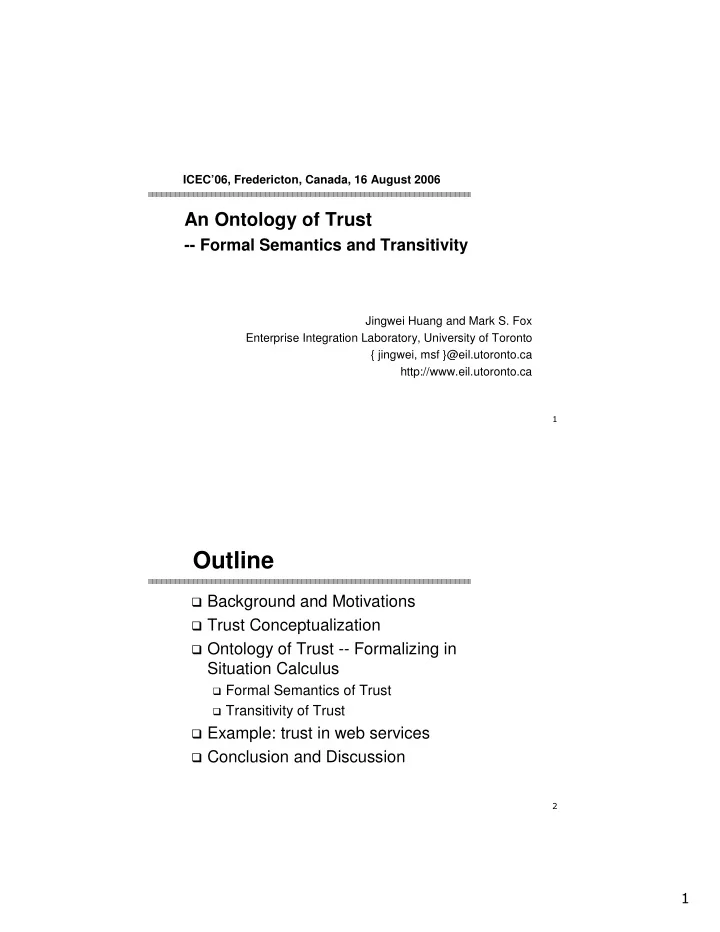
ICEC06, Fredericton, Canada, 16 August 2006 An Ontology of Trust -- Formal Semantics and Transitivity Jingwei Huang and Mark S. Fox Enterprise Integration Laboratory, University of Toronto { jingwei, msf }@eil.utoronto.ca


slide-1
SLIDE 1
  • An Ontology of Trust
  • - Formal Semantics and Transitivity

Jingwei Huang and Mark S. Fox Enterprise Integration Laboratory, University of Toronto { jingwei, msf }@eil.utoronto.ca http://www.eil.utoronto.ca ICEC’06, Fredericton, Canada, 16 August 2006

  • Outline

Background and Motivations Trust Conceptualization Ontology of Trust -- Formalizing in

Situation Calculus

Formal Semantics of Trust Transitivity of Trust

Example: trust in web services Conclusion and Discussion

slide-2
SLIDE 2
  • Problems
  • Web activities need people to interact with “strangers”
  • Each person only has a finite number of interpersonal trust relationships,

which cannot meet the needs of various web activities

  • A solution: Social Networks based trust
  • Is trust transitive ? What types of trust transitive? Why?
  • -- No theories & models answer the questions.
  • Trust is context-dependent
  • -- few models address context of trust in a formal manner
  • Research Objective

Construct a logical theory of trust

to have formal semantics of trust to study transitivity to support social networks based trust.

slide-3
SLIDE 3
  • Specific Background: KP

Our specific interest in trust is from Knowledge

Provenance (KP)

Anyone can publish information on internet Web info may be true, false, or outdated Need tools to discern the difference KP is an approach to determining the origin and

validity of web information by modeling and maintaining information sources, information dependencies, and trust structures.

  • Trust and KP
  • Wilson (1983): “we can

trust a text if it is the work

  • f an individual or group of

individuals whom we can trust”.

  • KP uses trust model to

determine the trustworthiness of information sources.

  • KP different to trust models:

KP considers not only

trust but also info dependency

KP targets web info Trust targets people

Static KP

  • - basic concepts of KP
  • - certain and static information

Static KP

  • - basic concepts of KP
  • - certain and static information

Dynamic KP

  • - temporal truth values
  • - temporal trust relationships

Dynamic KP

  • - temporal truth values
  • - temporal trust relationships

Uncertainty KP

  • - uncertain truth values
  • - uncertain trust relationships

Uncertainty KP

  • - uncertain truth values
  • - uncertain trust relationships

Trust Judgment Model

  • - interpersonal trust /direct trust
  • - social networks based trust
  • - system trust (e.g. professional membership based trust)

Trust Judgment Model

  • - interpersonal trust /direct trust
  • - social networks based trust
  • - system trust (e.g. professional membership based trust)
slide-4
SLIDE 4
  • Our View of Trust

Trust is a psychological state comprising:

Expectancy: expect that a trustee will behave in a particular

manner in a specific context

Belief: trustor believes the expectancy to be true; Willingness to be vulnerable: trustor is willing to take risk for that

belief.

  • !"

#$ % %

  • &

Types of Trust

Trust in performance

trust what trustee performs in a context

e.g. trust ftd.com to deliver a bouquet as

  • rdered.

Trust in belief

trust what trustee believes in a context

e.g. trust the opinion of a wine expert regarding the quality of wine products

slide-5
SLIDE 5
  • '

Contexts of Trust

Context of trustee

Context of creating a piece of information Context of performing an action

Context of trustor

Context of expectancy

Context to use the information Context in which trustor needs the action from trustee

Context of willingness (the situation to make trust decision)

These two contexts may be in the same situation, but

trustor and trustee usually have different utilities regarding the expectancy.

e.g. in expectancy “drive me to airport”, my utility and driver’s utility is different.

(

Sources of Trust

Inter-individual Trust (direct trust): how trust is built up and

evolves

Most of studies, e.g. Rotter(1967), Deutsch(1962) Luhmann (1973): personal trust; Zucker(1986):process based trust

Social Networks based Trust (indirect trust via friends): how trust

propagates

Social reality: Convention of using references/recommendation Trust needs to be transitive

System Trust (indirect trust via systems): how to evaluate trust

Luhmann (1973): trust in the function of a system Barber (1983): expectations on professionals Zucker(1986): characteristic based, institutional based Minsky (2003): regularity-based trust Reputation-based

slide-6
SLIDE 6
  • Logical Theory of Trust

Goal: to construct a logical theory of trust

to have formal semantics of trust to derive transitivity to support social networks based trust.

Approach:

formalizing trust in Situation Calculus

Represent fluents as reified (Pinto 1994) Use functions to mimic logical operators among fluents Remain form of state constraints

using Gruninger&Fox’s ontology development

method

  • Terminology

trust_b(d,e,x,k): fluent

d trusts e on x, which is believed by e, in context k x: a fluent, representing a thing e believes

trust_p(d,e,x,k): fluent

d trusts e on x created by e in context k x: fluent, info created by e set x = perform(e,a) to represent “e performs action a”

believe(d, x): fluent, d believes x believe(d, k->x): d believes x in context k made(x,e,q): fluent, x made by e in context q entail(q,k): predicate, context q implies context k holds(f,s): predicate, fluent f holds in situation s

slide-7
SLIDE 7
  • Formal Semantics of Trust (1)

Trust in belief

Trustor (d) believes a thing (x) believed by trustee (e) in

a context (q) entailing the trustor’s context of trust (k).

Axiom:

holds(trust_b(d,e,x,k),s) <=> for-all q, (holds(believe(e,q ->x),s) ^ entail(q,k)

  • > holds(believe(d, k->x),s) )

entail(q,k)<=> for-all s, holds(q,s) -> holds(k,s)

  • Formal Semantics of Trust (2)

Trust in performance

Trust in information: Trustor (d) believes in information (x)

created by trustee (e) in a context (q) entailing trustor’s context

  • f trust (k);

Axiom:

holds(trust_p(d,e,x,k),s) <=> for-all q, (holds(made(x,e,q),s) ^ entail(q,k)

  • > holds(believe(d, k->x),s) )

Trust in action: Trustor (d) believes in the performance

committed by trustee (e) in a context (q) entailing trustor’s context of trust (k);

  • in above axiom, x is replaced by perform(e,a)
slide-8
SLIDE 8

&

  • Conditions of Trust Propagation (1):

Transitivity of Trust

if entity d trusts entity c on everything which c believes in context

k, and c trusts entity e on everything which e believes in context q, then d trusts e on everything which e believes in the conjunction of the contexts k and q.

Theorem 8(b):

(for-all x)(holds(trust_b(d,c,x,k),s) ^ (for-all x)(holds(trust_b(c,e,x,q),s) => (for-all x)(holds(trust_b(d,e,x,k^q),s) Ed Ec Ee b b b (b) trust in belief + trust in belief => trust in belief

  • Conditions of Trust Propagation (2)

If entity d trusts entity c on everything which c believes in

context k, and c trusts entity e on everything which e performs in context q, then d trusts e on everything which e performs in the conjunction of contexts k and q.

Theorem:

(for-all x)(holds(trust_b(d,c,x,k),s) ^ (for-all x)(holds(trust_p(c,e,x,q),s) => (for-all x)(holds(trust_p(d,e,x,k^q),s)

Ed Ec Ee b p p (a) trust in belief + trust in performance => trust in performance

slide-9
SLIDE 9

'

  • Conditions of Trust Propagation (3)
  • - System Trust

if trustor trusts in the performance of a system (e.g.

an organization, or a group whose members have a common set of characteristics related to the trust) in a context, then the entity trusts in the performance

  • f the members of the system in that context.

Axiom 4:

holds(trust_p(d,o,x,k),s) ^ holds(memberOf(e,o),s) => holds(trust_p(d,e,x,k),s)

E d E o E e E c ... p h a s _ m e m b e r p h a s _ m e m b e r p (c ) tr u st in p e r fo r m a n c e + m e m b e r s h ip = > tru s t in p e r fo rm a n c e

&

Example: trust in web services

)* + $ ,-. #% $ + ,/. ,-0$*. /,. ,/0$*. / 1 ,2. % % * *

  • '
  • &

34 5 #4045

  • 6**!

4 74!

slide-10
SLIDE 10

(

'

Example (2)

  • Process:

Gift store (F) do not have “tea set” and find a product by web services, but

not sure the quality;

F has a number of trust relationships in social networks, in which P is a

long term business partner specialized in porcelain, and F has “trust in belief” type of inter-individual trust relationship with P regarding porcelain quality;

P has “trust in belief” relationship with a supplier (S); and S has “trust in

performance” relationship with manufacture J;

By social networks based trust, F indirectly trusts J regarding the quality of

J’s porcelain products

  • Formal representation:

F trusts in P’s belief on porcelain quality

holds(has_b_tr(F,P,x,inTopic(x,Porc_Qual),s)

P trusts in S’s belief on porcelain quality

holds(has_b_tr(P,S,x,inTopic(x,Porc_Qual),s)

S trusts J’s performance on high quality porcelain manufacture

holds(has_b_tr(S,J,perform(J,mk_HQ_porcel(x), inTopic(perform(J,mkHQ_porcel(x),Porc_Qual),s) (

Conclusion

Trust in belief is transitive In the media of “trust in belief” relation, trust propagates in social

networks.

Contributions

To formal trust models: An ontology of trust with formal semantics of trust Proof of transitivity of trust in belief Conditions of trust propagation Theoretical evidence supporting trust propagation in social networks. Formalization of the context of trust Structure of trust decision To Situation Calculus: Trust representation in Situation Calculus Potential use in web agents
slide-11
SLIDE 11
  • Further Discussion: Trust Decision

to trust not to trust expectancy occurs expectancy doesn't occurs utility of gain utility of loss utility of not trusting (utility of other options) Situation

When belief is uncertain, make decision : willing to be vulnerable or not ? Condition to choose trusting (Huang&Fox,2005): expected utility of trusting > expected utility of not trusting p(“expectancy occurs”) > (UD – UL) / (UG – UL) trust degree := p(“expectancy occurs”) This model revises:

Deutsch (1962)’s model Colemon(1990)’s model

  • Future Work

To complete social networks based trust

To include uncertainty To include distrut To aggregate trusted friends’ opinions Efficient methods to search web-based social

networks

To integrate inter-individual trust models To further model system trust