Outline Corpus Evidence and Compound Structure: The Case of Italian - - PowerPoint PPT Presentation

outline corpus evidence and compound structure the case
SMART_READER_LITE
LIVE PREVIEW

Outline Corpus Evidence and Compound Structure: The Case of Italian - - PowerPoint PPT Presentation

Introduction Introduction Candidate compound extraction and classification Candidate compound extraction and classification Typology of Italian NN compounds Typology of Italian NN compounds Distributional analysis 1: properties of compounds


slide-1
SLIDE 1 Introduction Candidate compound extraction and classification Typology of Italian NN compounds Distributional analysis 1: properties of compounds Distributional analysis 2: connector patterns Conclusion

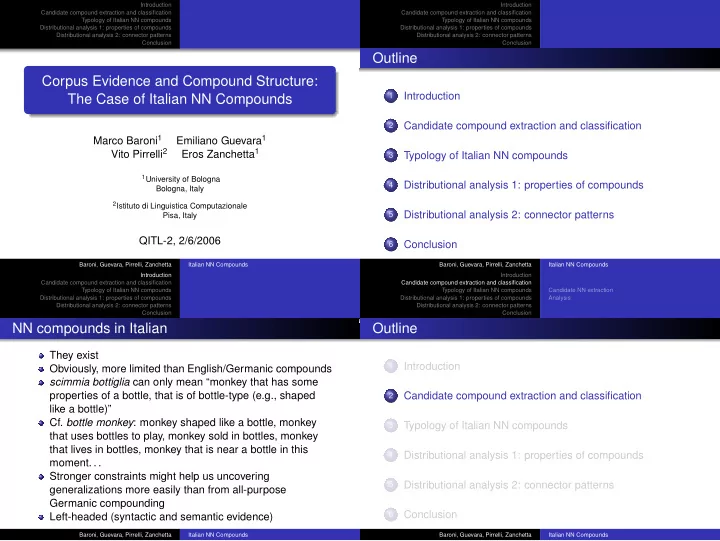
Corpus Evidence and Compound Structure: The Case of Italian NN Compounds

Marco Baroni1 Emiliano Guevara1 Vito Pirrelli2 Eros Zanchetta1

1University of Bologna Bologna, Italy 2Istituto di Linguistica Computazionale Pisa, Italy

QITL-2, 2/6/2006

Baroni, Guevara, Pirrelli, Zanchetta Italian NN Compounds Introduction Candidate compound extraction and classification Typology of Italian NN compounds Distributional analysis 1: properties of compounds Distributional analysis 2: connector patterns Conclusion

Outline

1

Introduction

2

Candidate compound extraction and classification

3

Typology of Italian NN compounds

4

Distributional analysis 1: properties of compounds

5

Distributional analysis 2: connector patterns

6

Conclusion

Baroni, Guevara, Pirrelli, Zanchetta Italian NN Compounds Introduction Candidate compound extraction and classification Typology of Italian NN compounds Distributional analysis 1: properties of compounds Distributional analysis 2: connector patterns Conclusion

NN compounds in Italian

They exist Obviously, more limited than English/Germanic compounds scimmia bottiglia can only mean “monkey that has some properties of a bottle, that is of bottle-type (e.g., shaped like a bottle)”

  • Cf. bottle monkey: monkey shaped like a bottle, monkey

that uses bottles to play, monkey sold in bottles, monkey that lives in bottles, monkey that is near a bottle in this

  • moment. . .

Stronger constraints might help us uncovering generalizations more easily than from all-purpose Germanic compounding Left-headed (syntactic and semantic evidence)

Baroni, Guevara, Pirrelli, Zanchetta Italian NN Compounds Introduction Candidate compound extraction and classification Typology of Italian NN compounds Distributional analysis 1: properties of compounds Distributional analysis 2: connector patterns Conclusion Candidate NN extraction Analysis

Outline

1

Introduction

2

Candidate compound extraction and classification

3

Typology of Italian NN compounds

4

Distributional analysis 1: properties of compounds

5

Distributional analysis 2: connector patterns

6

Conclusion

Baroni, Guevara, Pirrelli, Zanchetta Italian NN Compounds
slide-2
SLIDE 2 Introduction Candidate compound extraction and classification Typology of Italian NN compounds Distributional analysis 1: properties of compounds Distributional analysis 2: connector patterns Conclusion Candidate NN extraction Analysis

Candidate NN contexts

Extracted from ∼1.9 billion word Web-derived corpus [pos="DET:.*|ART|NUM|ADJ|PRE|ARTPRE|CHE|CON|WH"] [pos="NOUN"] [pos="NOUN"] [pos!="NOUN|NPR|VER.*|AUX:.*|ADJ|PRE|ARTPRE|CLI|CHE|CON|WH"] [pos="VER.*" & pos!="VER:ppa.*"] [pos="ADV.*|NEG"]{0,3} [pos="NOUN"] [pos="NOUN"] [pos!="NOUN|NPR|VER.*|AUX:.*|ADJ|PRE|ARTPRE|CLI|CHE|CON|WH"] [pos!="NOUN|NPR"] [pos="NOUN"] [pos="NOUN"] [pos="ADV.*|NEG"]{0,3} [pos="VER.*|AUX:.*|ADJ|PRE|ARTPRE|CLI|CHE|CON|WH"]

Baroni, Guevara, Pirrelli, Zanchetta Italian NN Compounds Introduction Candidate compound extraction and classification Typology of Italian NN compounds Distributional analysis 1: properties of compounds Distributional analysis 2: connector patterns Conclusion Candidate NN extraction Analysis

Sampling from 4 frequency ranges

range types sample 1 699,659 300 2-5 329,270 300 6-3000 113,147 300 >3000 109 109 all 1,142,185 1,009

Baroni, Guevara, Pirrelli, Zanchetta Italian NN Compounds Introduction Candidate compound extraction and classification Typology of Italian NN compounds Distributional analysis 1: properties of compounds Distributional analysis 2: connector patterns Conclusion Candidate NN extraction Analysis

Classification of compounds

Manual filtering leaves us with 252 true compounds (about 1/4 of sample) 4 main types emerge (named after function of modifier): Coordinative (COOR): 34 (13.49%) Attributive (ATTR): 41 (16.27%) Argumental (ARGU): 51 (20.24%) Grounding (GROU): 118 (46.82%) Residual of 8 compounds (3.17%) that will require further analysis Similar to Scalise and Bisetto (2005)

Baroni, Guevara, Pirrelli, Zanchetta Italian NN Compounds Introduction Candidate compound extraction and classification Typology of Italian NN compounds Distributional analysis 1: properties of compounds Distributional analysis 2: connector patterns Conclusion Coordinative compounds Attributive compounds Argumental compounds Grounding compounds

Outline

1

Introduction

2

Candidate compound extraction and classification

3

Typology of Italian NN compounds

4

Distributional analysis 1: properties of compounds

5

Distributional analysis 2: connector patterns

6

Conclusion

Baroni, Guevara, Pirrelli, Zanchetta Italian NN Compounds
slide-3
SLIDE 3 Introduction Candidate compound extraction and classification Typology of Italian NN compounds Distributional analysis 1: properties of compounds Distributional analysis 2: connector patterns Conclusion Coordinative compounds Attributive compounds Argumental compounds Grounding compounds

Coordinatives

Head and modifier denote similar or compatible entities, and compound has coordinative interpretation (the referent

  • f HM is both H and M)

E.g., viaggio spedizione “trip-expedition” mago alchimista “magician-alchemist”, bambino autista “child-driver”

Baroni, Guevara, Pirrelli, Zanchetta Italian NN Compounds Introduction Candidate compound extraction and classification Typology of Italian NN compounds Distributional analysis 1: properties of compounds Distributional analysis 2: connector patterns Conclusion Coordinative compounds Attributive compounds Argumental compounds Grounding compounds

Attributives

Interpretation of M is reduced to some iconic properties of its full semantic representation, and these properties are attributed to H E.g., progetto pilota “pilot project”, presidente fantoccio “puppet president”, brano cardine “pivot track” Often attributive modifiers display adjective-like behavior: pilota “pilot” occurs in post-N position about 1/4 of the times (13727/52641); fantoccio “puppet” occurs in post-N position about 1/3 of the times (722/2314)

Baroni, Guevara, Pirrelli, Zanchetta Italian NN Compounds Introduction Candidate compound extraction and classification Typology of Italian NN compounds Distributional analysis 1: properties of compounds Distributional analysis 2: connector patterns Conclusion Coordinative compounds Attributive compounds Argumental compounds Grounding compounds

Argumental compounds

Heads typically deverbal nominalizations, or other nouns able to project “verb-like” arguments; modifier is internal argument of corresponding verb I.e., objects of transitives: protezione persone “people protection”, raccolta fondi “fund collection”, gestione priorità “priority management”; subjects of unaccusatives: arrivo documenti “document arrival”, caduta massi “stone fall” Modifier can never be subject/agent of transitive verb – controllo Senato is only attested/acceptable as “control exerted over the Senate”, not as “control exerted by the Senate”

Baroni, Guevara, Pirrelli, Zanchetta Italian NN Compounds Introduction Candidate compound extraction and classification Typology of Italian NN compounds Distributional analysis 1: properties of compounds Distributional analysis 2: connector patterns Conclusion Coordinative compounds Attributive compounds Argumental compounds Grounding compounds

Grounding compounds

Head does not have verb-like argument structure, but general meaning that needs to be contextualized/specialized by modifier (modifier “grounds” meaning of head) Typical grounding heads: containers, aggregators/ions, (information) carriers, pointers, measurable properties, locations E.g., stanza server “server room”, associazione ambientalisti “environmentalists’ association”, fondo pensioni “pension fund”, centro città “city center”, altezza righe “line height”, posto auto “car place (parking space)”

Baroni, Guevara, Pirrelli, Zanchetta Italian NN Compounds
slide-4
SLIDE 4 Introduction Candidate compound extraction and classification Typology of Italian NN compounds Distributional analysis 1: properties of compounds Distributional analysis 2: connector patterns Conclusion Repeated head/modifier types Number

Outline

1

Introduction

2

Candidate compound extraction and classification

3

Typology of Italian NN compounds

4

Distributional analysis 1: properties of compounds

5

Distributional analysis 2: connector patterns

6

Conclusion

Baroni, Guevara, Pirrelli, Zanchetta Italian NN Compounds Introduction Candidate compound extraction and classification Typology of Italian NN compounds Distributional analysis 1: properties of compounds Distributional analysis 2: connector patterns Conclusion Repeated head/modifier types Number

Proportion of heads occurring in more than one compound

ATTR: 0 (0%) COOR: 1 (3%) ARGU: 6 (14%) GROU 15 (18.5%)

Baroni, Guevara, Pirrelli, Zanchetta Italian NN Compounds Introduction Candidate compound extraction and classification Typology of Italian NN compounds Distributional analysis 1: properties of compounds Distributional analysis 2: connector patterns Conclusion Repeated head/modifier types Number

Proportion of modifiers occurring in more than one compound

ATTR: 4 (12%) COOR: 1 (3%) ARGU: 2 (4%) GROU 10 (9.71%)

Baroni, Guevara, Pirrelli, Zanchetta Italian NN Compounds Introduction Candidate compound extraction and classification Typology of Italian NN compounds Distributional analysis 1: properties of compounds Distributional analysis 2: connector patterns Conclusion Repeated head/modifier types Number

Number of modifier

When head is singular:

cat s only p only both ATTR 27 (77.14%) 0 (0.00%) 8 (22.86%) COOR 20 (83.33%) 0 (0.00%) 4 (16.67%) ARGU 18 (37.50%) 17 (35.42%) 13 (27.08%) GROU 56 (50.00%) 24 (21.43%) 32 (28.57%)

When head is plural:

cat s only p only both ATTR 18 (72.00%) 1 (4.00%) 6 (24.00%) COOR 0 (0.00%) 18 (72.00%) 7 (28.00%) ARGU 4 (30.77%) 6 (46.15%) 3 (23.08%) GROU 26 (50.98%) 13 (25.49%) 12 (23.53%)

Baroni, Guevara, Pirrelli, Zanchetta Italian NN Compounds
slide-5
SLIDE 5 Introduction Candidate compound extraction and classification Typology of Italian NN compounds Distributional analysis 1: properties of compounds Distributional analysis 2: connector patterns Conclusion Connector patterns Conjunctions Prepositional patterns

Outline

1

Introduction

2

Candidate compound extraction and classification

3

Typology of Italian NN compounds

4

Distributional analysis 1: properties of compounds

5

Distributional analysis 2: connector patterns

6

Conclusion

Baroni, Guevara, Pirrelli, Zanchetta Italian NN Compounds Introduction Candidate compound extraction and classification Typology of Italian NN compounds Distributional analysis 1: properties of compounds Distributional analysis 2: connector patterns Conclusion Connector patterns Conjunctions Prepositional patterns

Connector patterns

E.g., server room/room with servers Not a new idea: Levi (1978), Lauer (1995). . .

Baroni, Guevara, Pirrelli, Zanchetta Italian NN Compounds Introduction Candidate compound extraction and classification Typology of Italian NN compounds Distributional analysis 1: properties of compounds Distributional analysis 2: connector patterns Conclusion Connector patterns Conjunctions Prepositional patterns

Automated extraction and selection of connector patterns

Conjunctions: e “and”, o “or”, . . . Prepositional patterns: di “of” Pooled “contentful” prepositions: a “∼to”, in “in”, per “for”, con “with”, su “on/about” Past part + prep patterns: dedicato a “dedicated to”, basato su “based on”, destinato a “intended for/destined to”, finalizzato a “aimed at”

Baroni, Guevara, Pirrelli, Zanchetta Italian NN Compounds Introduction Candidate compound extraction and classification Typology of Italian NN compounds Distributional analysis 1: properties of compounds Distributional analysis 2: connector patterns Conclusion Connector patterns Conjunctions Prepositional patterns

Attraction

Frequency of H+M pair with a connector pattern must be weighted by unigram frequency of head and mod (connector patterns and source corpora are kept constant across compared items) Attraction score: rank count(H CONN M) count(H)+count(M) Dice-coefficient-like score; similar results with MI-like score Rank computed across classes, over all pairs with count(H CONN M) > 0

Baroni, Guevara, Pirrelli, Zanchetta Italian NN Compounds
slide-6
SLIDE 6 Introduction Candidate compound extraction and classification Typology of Italian NN compounds Distributional analysis 1: properties of compounds Distributional analysis 2: connector patterns Conclusion Connector patterns Conjunctions Prepositional patterns

Conjunctions

Distribution of attraction of H-M pairs to pattern

type min 1st qu. med mean 3d qu. max COOR 16.00 106.50 134.00 117.40 153.00 162.00 ATTR 5.00 49.25 81.00 79.25 102.30 146.00 ARGU 3.00 32.25 78.00 77.25 118.80 163.00 GROU 1.00 38.50 71.50 74.78 112.30 159.00

Baroni, Guevara, Pirrelli, Zanchetta Italian NN Compounds Introduction Candidate compound extraction and classification Typology of Italian NN compounds Distributional analysis 1: properties of compounds Distributional analysis 2: connector patterns Conclusion Connector patterns Conjunctions Prepositional patterns

di (del) “of”

Distribution of attraction of H-M pairs to pattern

type min 1st qu. med mean 3d qu. max ARGU 2.00 66.00 106.00 105.60 154.00 187.00 GROU 8.00 62.50 110.00 104.00 143.50 185.00 ATTR 1.00 21.00 43.50 58.42 78.75 170.00 COOR 5.00 26.00 43.00 45.23 65.00 85.00

Baroni, Guevara, Pirrelli, Zanchetta Italian NN Compounds Introduction Candidate compound extraction and classification Typology of Italian NN compounds Distributional analysis 1: properties of compounds Distributional analysis 2: connector patterns Conclusion Connector patterns Conjunctions Prepositional patterns

Contentful prepositions

Distribution of attraction of H-M pairs to pattern

type min 1st qu. med mean 3d qu. max GROU 1.00 51.50 93.50 89.75 130.30 160.00 ATTR 12.00 52.00 80.50 83.36 112.80 147.00 COOR 9.00 58.50 76.50 68.63 81.75 118.00 ARGU 2.00 24.50 51.00 61.56 97.50 161.00

Baroni, Guevara, Pirrelli, Zanchetta Italian NN Compounds Introduction Candidate compound extraction and classification Typology of Italian NN compounds Distributional analysis 1: properties of compounds Distributional analysis 2: connector patterns Conclusion Connector patterns Conjunctions Prepositional patterns

Past-participle+preposition patterns

basato su “based on/upon”: 3 ARGU, 4 GROU dedicato a “dedicated to”: 1 ARGU, 8 GROU destinato a “intended for/destined to”: 8 GROU finalizzato a “aimed to”: 2 ARGU, 4 GROU

Baroni, Guevara, Pirrelli, Zanchetta Italian NN Compounds
slide-7
SLIDE 7 Introduction Candidate compound extraction and classification Typology of Italian NN compounds Distributional analysis 1: properties of compounds Distributional analysis 2: connector patterns Conclusion Summary Future work References

Outline

1

Introduction

2

Candidate compound extraction and classification

3

Typology of Italian NN compounds

4

Distributional analysis 1: properties of compounds

5

Distributional analysis 2: connector patterns

6

Conclusion

Baroni, Guevara, Pirrelli, Zanchetta Italian NN Compounds Introduction Candidate compound extraction and classification Typology of Italian NN compounds Distributional analysis 1: properties of compounds Distributional analysis 2: connector patterns Conclusion Summary Future work References

Summary

Qualitative analysis of corpus-mined Italian NN compounds suggests 4-way classification: ATTR, COO, ARGU, GROU Distributional evidence (head and modifier repetition, modifier number, connector patterns) supports 4-way distinction

Baroni, Guevara, Pirrelli, Zanchetta Italian NN Compounds Introduction Candidate compound extraction and classification Typology of Italian NN compounds Distributional analysis 1: properties of compounds Distributional analysis 2: connector patterns Conclusion Summary Future work References

Future work

Use (more) cues in supervised/unsupervised machine learning tasks Experimental evidence Extend analysis to other ways to express relationship between nouns

Baroni, Guevara, Pirrelli, Zanchetta Italian NN Compounds Introduction Candidate compound extraction and classification Typology of Italian NN compounds Distributional analysis 1: properties of compounds Distributional analysis 2: connector patterns Conclusion Summary Future work References

References

  • M. Baroni and M. Ueyama (2006). Building general- and special-purpose

corpora by Web crawling. Proc. NIJL Workshop.

  • A. Bisetto and S. Scalise (2005). The classification of compounds. Lingue e

linguaggio 4, 319-332.

  • R. Jackendoff (2002). Foundations of language. OUP

, Oxford.

  • M. Johnston and F

. Busa (1996). Qualia structure and the compositional interpretation of compounds. Proceedings of ACL SIGLEX 1996.

  • M. Lauer (1995). Designing statistical language learners: Experiments on

noun compounds. PhD thesis, Macquarie University, Sydney.

  • R. Lees (1960). The grammar of English nominalizations. Indiana University

Press, Bloomington.

  • J. Levi (1978). The syntax and semantics of complex nominals. New York:

Academic Press.

  • B. Rosario, M. Hearst and Ch. Fillmore (2002). The descent of hierarchy, and

selection in relational semantics. Proceedings of ACL 2002.

  • L. Vanderwende (1994). Algorithm for automatic interpretation of noun
  • compounds. Proceedings of COLING 1994, 782-788.
Baroni, Guevara, Pirrelli, Zanchetta Italian NN Compounds