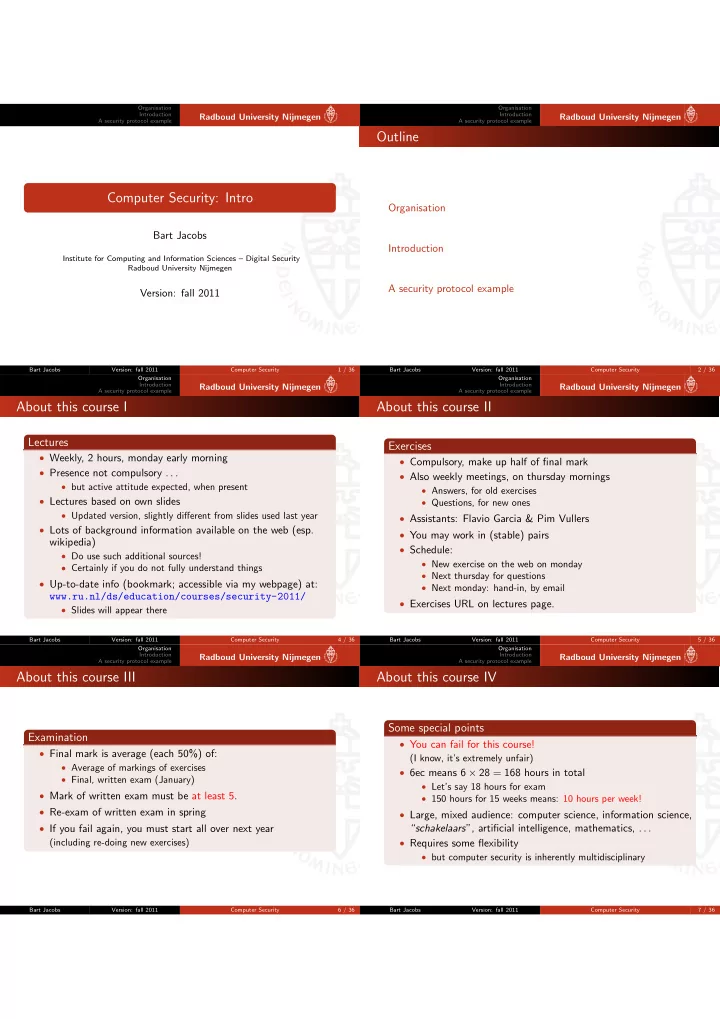
Outline Computer Security: Intro Organisation Bart Jacobs - - PDF document

outline computer security intro
SMART_READER_LITE
LIVE PREVIEW

Outline Computer Security: Intro Organisation Bart Jacobs - - PDF document

Organisation Organisation Introduction Introduction Radboud University Nijmegen Radboud University Nijmegen A security protocol example A security protocol example Outline Computer Security: Intro Organisation Bart Jacobs Introduction


slide-1
SLIDE 1

Organisation Introduction A security protocol example

Radboud University Nijmegen

Computer Security: Intro

Bart Jacobs

Institute for Computing and Information Sciences – Digital Security Radboud University Nijmegen

Version: fall 2011

Bart Jacobs Version: fall 2011 Computer Security 1 / 36 Organisation Introduction A security protocol example

Radboud University Nijmegen

Outline

Organisation Introduction A security protocol example

Bart Jacobs Version: fall 2011 Computer Security 2 / 36 Organisation Introduction A security protocol example

Radboud University Nijmegen

About this course I

Lectures

  • Weekly, 2 hours, monday early morning
  • Presence not compulsory . . .
  • but active attitude expected, when present
  • Lectures based on own slides
  • Updated version, slightly different from slides used last year
  • Lots of background information available on the web (esp.

wikipedia)

  • Do use such additional sources!
  • Certainly if you do not fully understand things
  • Up-to-date info (bookmark; accessible via my webpage) at:

www.ru.nl/ds/education/courses/security-2011/

  • Slides will appear there

Bart Jacobs Version: fall 2011 Computer Security 4 / 36 Organisation Introduction A security protocol example

Radboud University Nijmegen

About this course II

Exercises

  • Compulsory, make up half of final mark
  • Also weekly meetings, on thursday mornings
  • Answers, for old exercises
  • Questions, for new ones
  • Assistants: Flavio Garcia & Pim Vullers
  • You may work in (stable) pairs
  • Schedule:
  • New exercise on the web on monday
  • Next thursday for questions
  • Next monday: hand-in, by email
  • Exercises URL on lectures page.

Bart Jacobs Version: fall 2011 Computer Security 5 / 36 Organisation Introduction A security protocol example

Radboud University Nijmegen

About this course III

Examination

  • Final mark is average (each 50%) of:
  • Average of markings of exercises
  • Final, written exam (January)
  • Mark of written exam must be at least 5.
  • Re-exam of written exam in spring
  • If you fail again, you must start all over next year

(including re-doing new exercises)

Bart Jacobs Version: fall 2011 Computer Security 6 / 36 Organisation Introduction A security protocol example

Radboud University Nijmegen

About this course IV

Some special points

  • You can fail for this course!

(I know, it’s extremely unfair)

  • 6ec means 6 × 28 = 168 hours in total
  • Let’s say 18 hours for exam
  • 150 hours for 15 weeks means: 10 hours per week!
  • Large, mixed audience: computer science, information science,

“schakelaars”, artificial intelligence, mathematics, . . .

  • Requires some flexibility
  • but computer security is inherently multidisciplinary

Bart Jacobs Version: fall 2011 Computer Security 7 / 36

slide-2
SLIDE 2

Organisation Introduction A security protocol example

Radboud University Nijmegen

About this course V

Sensitivity of the topic

  • Not everything is publicly known (like e.g. in algebra)
  • Some things are simply illegal: don’t try this at home!
  • Moral compass/fibre/backbone required in this field
  • Lectures are deliberately not recorded!
  • some inside stories will be told
  • they can be misinterpreted, out of context

Bart Jacobs Version: fall 2011 Computer Security 8 / 36 Organisation Introduction A security protocol example

Radboud University Nijmegen

About this course VI

Topics

  • Basic notions: confidentiality, integrity, availability

(jointly known as: CIA of information security)

  • Basic techniques: encryption, both symmetric (shared secret

key) and asymmetric (public key)

  • Basic protocols for achieving security goals
  • Basic technologies (PGP, SSL, certificates, etc)
  • Underlying mathematics (cryptography) is used as tool box,

not topic of study in itself

  • But very basics are included (substitution, transposition, RSA,

El Gamal)

Bart Jacobs Version: fall 2011 Computer Security 9 / 36 Organisation Introduction A security protocol example

Radboud University Nijmegen

Beyond this course

More about computer security

  • There is a lot of interesting reading
  • Historical
  • Military/intelligence
  • Societal (eg. about privacy)
  • and technical, of course
  • Reading a bit more is strongly encouraged
  • Many conncections with legal issues
  • Esp. information science students are encouraged to follow the

“computer law” course in the Law Faculty

Bart Jacobs Version: fall 2011 Computer Security 10 / 36 Organisation Introduction A security protocol example

Radboud University Nijmegen

Computer security @Nijmegen

Research

  • Security important research topic at Nijmegen
  • Focus on smart cards, in various forms
  • Much theoretical research, eg. on protocol correctness
  • Also many societal issues: involvement with
  • e-voting
  • e-passports and

identity cards

  • bankcards (eg. EMV

issues)

  • e-ticketing
  • smart (electricity)

metering

  • road pricing
  • electronic patient

records

  • cyber security

Teaching

  • A special Kerckhoffs master programme
  • Jointly between Nijmegen, Twente and Eindhoven
  • Also open to Math. & AI students

Bart Jacobs Version: fall 2011 Computer Security 11 / 36 Organisation Introduction A security protocol example

Radboud University Nijmegen

What is computer Security about? Computer Security is about regulating access to (digital) assets

Key issues

  • assets: the valuables that need protection
  • regulating access: involves
  • identification: who are you? / what are your attributes?
  • authentication: how do you prove this?
  • authorisation: what are you allowed to do
  • Implicit there is an attacker that is trying to get unintended

access

  • Attacker model: what can the bad guys do?

Bart Jacobs Version: fall 2011 Computer Security 13 / 36 Organisation Introduction A security protocol example

Radboud University Nijmegen

Attacker example

KPMG Amsterdam has a good computer security group Some time ago, KPMG was approached by a large firm that had its own secure facilty, with sensitive and strategic data. It had:

  • strong physical & electronic security measures
  • strict operational security guidelines
  • well-trained staff

KPMG was asked/challenged to try and obtain access, either physically or electronically (“red teaming”) They managed to get in as Santa Claus

(an attack known as: Trojaanse Schimmel)

Bart Jacobs Version: fall 2011 Computer Security 14 / 36

slide-3
SLIDE 3

Organisation Introduction A security protocol example

Radboud University Nijmegen

Yes, indeed . . .

✓ ✒ ✏ ✑ ✎ ✍ ☞ ✌

Computer security is the nicest part of computer science!

Bart Jacobs Version: fall 2011 Computer Security 15 / 36 Organisation Introduction A security protocol example

Radboud University Nijmegen

Serious, difficult questions

1 How do you protect against a deliberate, well-motivated,

malicious, resourceful, technically competent, intelligent, creative, socially skilful, patient attacker?

2 Assume you think you have such protection, how do you test

/ verify it?

  • How do you formalise the attacker?
  • How to incorporate out-of-the-box

thinking and geeky sick minds into your validation? methods

3 Formalization only makes your assumptions explicit

  • There is no reason an attacker will do what is assumed

Bart Jacobs Version: fall 2011 Computer Security 16 / 36 Organisation Introduction A security protocol example

Radboud University Nijmegen

Security requires a mix

Protection of digital assets requires a mix of:

  • Technical measures
  • Cryptography, as mathematical basis
  • Computers, to run cryptographic algorithms

(and to break them)

  • Tamper-resistant/proof hardware
  • Organisational measures
  • Examples: chipknip, banking, rocket launch (eg. from

submarine)

  • three B’s: burglary, blackmail, bribery
  • Legal measures
  • Penal law: computer criminality laws
  • Civil law: user agreements (eg. for bank/travel cards)

Bart Jacobs Version: fall 2011 Computer Security 17 / 36 Organisation Introduction A security protocol example

Radboud University Nijmegen

Legal relevance

Important distinction

  • Computer science for law (rechtsinformatica)
  • Eg. knowledge representation, formal reasoning
  • Strong AI flavour
  • Law for computer science (informaticarecht)
  • The laws governing the use of computers
  • European origins
  • Strongly related to cyber crime
  • Part of penal law (wetboek van strafrecht, Sr)
  • Most relevant here

Bart Jacobs Version: fall 2011 Computer Security 18 / 36 Organisation Introduction A security protocol example

Radboud University Nijmegen

Computer crime laws, in Dutch

  • art. 138a, Sr: computervredebreuk

No computer intrusion

  • art. 139a, Sr: afluisteren

No eavesdropping (for confidentiality)

  • art. 161sexies, Sr: stoornis

No computer disruption (for hardware and software integrity & availability)

  • art. 350a, Sr: wijzigen of vernietigen van opgeslagen gegevens

No data corruption (for data integrity).

Bart Jacobs Version: fall 2011 Computer Security 19 / 36 Organisation Introduction A security protocol example

Radboud University Nijmegen

Example legal text snippet

No eavesdropping: Hij die door middel van een openbaar telecommunicatienetwerk, of door middel van daarop aangesloten randapparatuur overgedragen gegevens die niet voor hem, mede voor hem of voor degeen in wiens

  • pdracht hij handelt, zijn bestemd, opzettelijk met een

technisch hulpmiddel aftapt of opneemt, wordt gestraft met gevangenisstraf van ten hoogste een jaar of geldboete van de vierde categorie.

Bart Jacobs Version: fall 2011 Computer Security 20 / 36

slide-4
SLIDE 4

Organisation Introduction A security protocol example

Radboud University Nijmegen

Intrusion schematics

Generally: Alice & Bob are good guys, who stick to the protocol; Eve is evil Eve

  • Alice
  • Bob

(Check out: http://downlode.org/Etext/alicebob.html )

Bart Jacobs Version: fall 2011 Computer Security 21 / 36 Organisation Introduction A security protocol example

Radboud University Nijmegen

Aspects of intrusion

The intrusion of Eve may involve various aspects:

  • Passive eavesdropping: read and/or store data, whether

encrypted or not, possibly for future use

  • Active intervention: delete and/or insert data

Also relevant:

  • The nature of the connection between Alice and Bob (copper,

fibre, electromagnetic) influences the possibilities and the effort that is required.

  • Alice may emit unknowingly, eg. via
  • tempest: emmission security is a big thing in the military

(but also killed voting machines in NL)

  • covert channels, eg. power consumption of smart cards, or

deliberate leaking via malicious software.

Bart Jacobs Version: fall 2011 Computer Security 22 / 36 Organisation Introduction A security protocol example

Radboud University Nijmegen

Main security goals (important slide!)

  • Confidentiality: Eve cannot read the content of what Alice

and Bob are communicating.

  • Integrity: Eve cannot alter the content of the communication.
  • Authenticity: Alice and Bob are certain about each other’s
  • identies. In particular, Alice (say) is not talking to Eve, while

she thinks she is taking to Bob.

  • Availability: Eve cannot prevent the communication between

Alice and Bob.

  • Non-repudiation: (onloochenbaarheid) Alice and Bob can

not deny what they have communicated.

  • Accountability: There is a reliable log of the communication

history (of Alice, Bob, Eve, et al)

Bart Jacobs Version: fall 2011 Computer Security 23 / 36 Organisation Introduction A security protocol example

Radboud University Nijmegen

Security & safety

  • Important conceptual distincition. In Dutch more subtle
  • beveiliging

(German: Schutz)

  • veiligheid

(German: Sicherheit)

  • Security is about protection against an active, malicious

attacker that deliberately wants to undermine a (computer) system

  • Safety is about protection against unintended accidents or

errors

  • Think about the difference between eg.
  • Nuclear safety / security
  • Food safety / security

Bart Jacobs Version: fall 2011 Computer Security 24 / 36 Organisation Introduction A security protocol example

Radboud University Nijmegen

Importance/relevance of computer security

  • When you read about computers in the press, probably more

than 80% of the reporting is security related

  • Security issues can make or break large public ICT-projects:
  • E-ticketing (Mifare problems, in OV-chip, Oyster, etc)
  • Electronic Health care files (EPD, in Dutch)
  • Road pricing
  • E-voting
  • etc.
  • Relevance for companies:
  • Protection of their assets (intellectual property, stock-related

info, strategy, . . . )

  • Protection of e-commerce transactions
  • Privacy & data protection regulation
  • Profiling customers & behavioural targeting (“CRM”)

Bart Jacobs Version: fall 2011 Computer Security 25 / 36 Organisation Introduction A security protocol example

Radboud University Nijmegen

Interdisciplinary character of Security

Core disciplines

  • Mathematics, esp. cryptography
  • Computer science, esp. security protocols, operating systems,

networking, formal methods, . . .

Some related/overlapping discplines

  • Law esp. wrt. cyber crime
  • Management / organisation
  • Security economics: what kind of economic stimulus improves

security?

  • Psychology of security: what triggers people to behave

(in)securely: social engineering / pretexting

Bart Jacobs Version: fall 2011 Computer Security 26 / 36

slide-5
SLIDE 5

Organisation Introduction A security protocol example

Radboud University Nijmegen

Main security stakeholders (or: future employers!)

  • Banks / financial institutions
  • Main concern: not confidentiality, but integrity of transactions
  • Also: non-repudiation of orders (esp. in e-banking)
  • Telecom / internet operators
  • Concerns . . . ??
  • Health care sector
  • Much focus on confidentiality / privacy
  • But also integrity & availability of electronic patient files
  • Note: integrity breach can be repaired, in principle, but

confidentiality breach not

  • Intelligence / Military / Diplomats

Bart Jacobs Version: fall 2011 Computer Security 27 / 36 Organisation Introduction A security protocol example

Radboud University Nijmegen

Intelligence services

Double task

  • Defensive: protecting own assets / communication
  • Aggressive: uncovering secrets of others

Common distinction

  • Humint: intelligence from human sources

(slow, rather unreliable, small volumes, local)

  • Sigint: signals intelligence

(non of the above; often crucial in world history, like in Enigma, Zimmerman Telegram, etc.)

Bart Jacobs Version: fall 2011 Computer Security 28 / 36 Organisation Introduction A security protocol example

Radboud University Nijmegen

Some organisations

  • USA
  • Internal: FBI, can also make arrests!
  • External: CIA, mostly humint
  • Sigint: NSA ≥ FBI + CIA
  • UK
  • Internal: MI5
  • External: MI6 (aka. SIS), mostly humit
  • Sigint: GCHQ ≥ MI5 + MI6
  • NL
  • General: AIVD

(includes NBV = Nationaal Bureau voor Verbindingsbeveiliging)

  • Military: MIVD
  • Sigint: NSO

All these organisations work in secrecy — and secrecy carries the risk to be a cover-up for failure and incompetence. But they are under independent oversight.

Bart Jacobs Version: fall 2011 Computer Security 29 / 36 Organisation Introduction A security protocol example

Radboud University Nijmegen

Intelligence services & computer security

  • High-tech users, often with their own research departments
  • NSA is biggest employer of mathematicians, worldwide
  • At GCHQ public key crypto was first invented (but not

published)

  • Setting / pushing of security standards

(Green book, common criteria, etc.)

  • Strong operational security culture

(including clearances/background checks)

  • Slowly getting more open, relying on COTS, open source etc.

Bart Jacobs Version: fall 2011 Computer Security 30 / 36 Organisation Introduction A security protocol example

Radboud University Nijmegen

Towards proper protection in five steps

1 Make a list of your assets that need protection

  • include the relevant security goals (like CIA)
  • possibly with an informal ranking of required protection levels

(like high, medium, low)

2 Make a threat analysis

  • who may wish try to do undermine which security goal?

(attack trees may be useful tool)

  • what attack resources are assumed? (eg. funding, strength)
  • what are the risks? (eg. risk = probability * impact)
  • non-technical approach, so far

3 Design a security architecture, describing how to counter the

identified threats

  • Still at a high level of abstraction
  • Eg. use strong authentication for employees

Bart Jacobs Version: fall 2011 Computer Security 31 / 36 Organisation Introduction A security protocol example

Radboud University Nijmegen

Towards proper protection in five steps

5 Get your architecture implemented

  • At this stage the technicalities really matter
  • Software correctness/security often more critical than

cryptography

  • Modular approach to be preferred (for easy updates and avoiding

lock-ins)

  • Distrust closed/proprietary solutions

6 Assessment of all of the above points 1-4

  • by an independent party
  • repeated regularly: “security is like fruit: it goes off quickly”
  • what guarantees can you reasonably expect?

☛ ✡ ✟ ✠

Security is not a static state of affaires, but is dynamic (More on this in master course “security in organisations”)

Bart Jacobs Version: fall 2011 Computer Security 32 / 36

slide-6
SLIDE 6

Organisation Introduction A security protocol example

Radboud University Nijmegen

Simple protocol examples: electronic car keys

The aim is to give an idea of what security protocols are all about. In each case, ask yourself: is this secure? What is a possible attack? C = Car, CK = Car Key, K{M} = M encrypted with key K, in: (1) Identification number (2) Encrypted version of (1) CK − → C : IdNr CK − → C : K{IdNr} (K is shared crypto key) (3) Sequence number (4) Challenge-response CK − → C : K{N + 1} (N is last used number) CK − → C : “open” C − → CK : K{N} CK − → C : K{N + 1} (Look for Keeloq for more information on actual attacks)

Bart Jacobs Version: fall 2011 Computer Security 34 / 36 Organisation Introduction A security protocol example

Radboud University Nijmegen

What you need to learn in this course

☛ ✡ ✟ ✠ ☛ ✡ ✟ ✠

Paranoia!

  • Professional paranoia, not personal
  • For instance, when you receive an email ask yourself:
  • Do I know for sure who it comes from (authenticity)?
  • Who may have seen this email (confidentiality)?
  • Is this the version that the author sent (integrity)?
  • Is the sender bound by this message (non-repudiaton)?

Bart Jacobs Version: fall 2011 Computer Security 35 / 36 Organisation Introduction A security protocol example

Radboud University Nijmegen

Further introductory material

  • Read yourself: Ross Anderson’s 2nd edition: Chapter 2:

Usability and Psychology

  • www.cl.cam.ac.uk/~rja14/Papers/SEv2-c02.pdf
  • Part of the first assignment is to read this chapter!
  • And watch Bruce Schneier at TED:
  • http://www.ted.com/talks/bruce_schneier.html

Bart Jacobs Version: fall 2011 Computer Security 36 / 36