OUR GOAL: Verbal TO HELP YOU FIND WAYS IN YOUR DAY TO NATURALLY - - PDF document

our goal
SMART_READER_LITE
LIVE PREVIEW

OUR GOAL: Verbal TO HELP YOU FIND WAYS IN YOUR DAY TO NATURALLY - - PDF document

4/9/2016 A GENDA S IMPLIFYING AAC IN THE C LASSROOM TO D EVELOP E ARLY L ITERACY S KILLS Modeling Core Vocabulary Meghan Conover Implementation through Literacy Assistive Technology Consultant, Saltillo Corp. Resources Gretchen


slide-1
SLIDE 1

4/9/2016 1

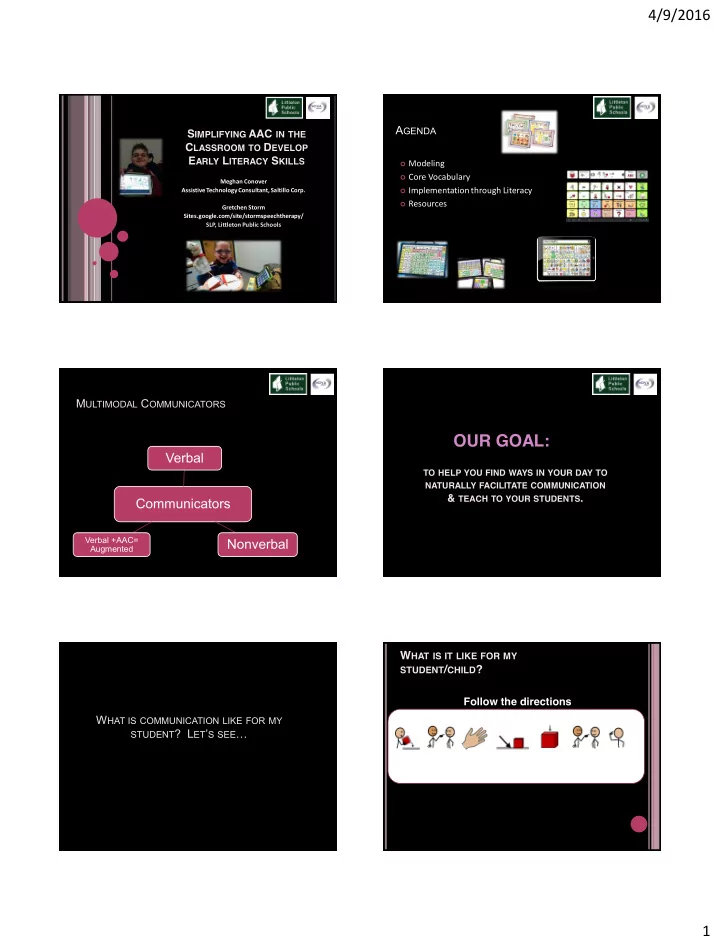
SIMPLIFYING AAC IN THE CLASSROOM TO DEVELOP EARLY LITERACY SKILLS

Meghan Conover Assistive Technology Consultant, Saltillo Corp. Gretchen Storm Sites.google.com/site/stormspeechtherapy/ SLP, Littleton Public Schools

AGENDA

Modeling Core Vocabulary Implementation through Literacy Resources

MULTIMODAL COMMUNICATORS

Communicators Verbal Nonverbal

Verbal +AAC= Augmented TO HELP YOU FIND WAYS IN YOUR DAY TO NATURALLY FACILITATE COMMUNICATION

& TEACH TO YOUR STUDENTS.

OUR GOAL:

WHAT IS COMMUNICATION LIKE FOR MY

STUDENT? LET’S SEE…

WHAT IS IT LIKE FOR MY

STUDENT/CHILD?

Follow the directions

slide-2
SLIDE 2

4/9/2016 2

WHAT IS IT LIKE FOR MY

STUDENT/CHILD?

Follow the directions

放 您的 手 上 最佳 您的 頭

Follow the directions

Put your hand

  • n

top your head

WHAT IS IT LIKE FOR MY

STUDENT/CHILD?

WHAT IS MODELING?

WHAT ABOUT A DIFFERENT LANGUAGE?

SIGNING

slide-3
SLIDE 3

4/9/2016 3

WHAT HAPPENS WHEN YOUR LANGUAGES DON’T MATCH?

WHAT CAN WE DO?

When you look at a typically developing child, who do you think plays the biggest role in their language development?

BE REALISTIC

Speech Pathologist cannot be the

  • nly person teaching language.

84 Years…amount of time it would take a

child who has a communication system receiving speech /language therapy 2 times per week for 20-30 minute sessions to reach the same amount

  • f language exposure the typically developing 18

month old child has been exposed to over 4380 hours of oral language at a rate of 8 hours per day from birth.

Jane Korsten: http:atto.buffalo.edu/registered/ATBasics/populations/aac/consider.php

HOW DOES THE SLP THEN REACH ALL THE

LAYERS BELOW?

Start Simple

Provide concrete, step-by-step directions Do not assume facilitating communication through a communication device is natural or easy Empower the people with the most contact with the student to model Provide continued support for questions and frequently ask for feedback on how things are going

slide-4
SLIDE 4

4/9/2016 4

CORE VOCABULARY

WHAT IS CORE VOCABULARY?

Messages and words that are frequently used by

many individuals across many contexts. This vocabulary typically consists of "functor" words such as "is, was, he, she" and common nouns and primary verbs (e.g. person, like, want). (Beukelman

& Mirenda, 1992)

Core Vocabulary

250-400 words make up 75-85% of the words

we say.

Same words across

Gender Age Topic Setting Disability

What are these words?

CORE VOCAB!

Vanderheiden and Kelso (1987)

CLASSES OF WORDS – CORE VOCABULARY

VERBS: Go, get, do, want, like, make, play, stop ADJECTIVES: Big, little, red, funny, wet, dry, PREPOSITONS: Under, over, on, off, in, out PRONOUNS: I, my, you, yourself, his, her, she, it INTERJECTIONS: Yes, no, please, all done, cool, hey QUESTION WORDS: What, where, when, why ADVERBS Here, there, always, never, not

What class of words is missing? NOUNS

Fringe Vocabulary

More specific than core vocabulary May be different for different people Mostly nouns

TRANSCRIPT OF M&M COMMERCIAL

So then I said Mr. Prime Minister, I'm flattered that you

love chocolate, but I'm here strictly in a professional…

What's wrong with him? He thinks you're naked. My shell is brown, it just looks like my milk chocolate is

  • showing. Only a fool would think I'd actually show up

naked.

So it's that kind of party?? Hit it!

57 words 11 fringe (19%) 46 core (81%)
slide-5
SLIDE 5

4/9/2016 5

333 MOST FREQUENTLY OCCURRING PRESCHOOL WORDS: THE MARVIN SAMPLING

“VOCABULARY-USE PATTERNS IN PRESCHOOL CHILDREN: EFFECTS OF CONTEXT AND TIME SAMPLING” about after again ah all almost already also an and another ant any are aren't around as at away baby back bad bad ball bathroom be bean because before being bet better big bird birds

Christine A. Marvin, David R. Beukelman, Denise Bilyeu AAC, Vol. 10, Dec., 1994

bite black blue both box boy bugs but buy by bye call came can can't candy car catch cause chair come comes cookie corn could couldn't cup cut day did didn't different do does doctor doesn't dog doing don't done door down drink duck eat eating else even everybody everything face fall find finger fire first five fixed fly foot for from found get gets getting girl girls give go goes going gonna good great green guys had hair hand hands has have haven't he he's her head hear hello help here here's hi high hill him his hold home horse hot house how huh hum I I'll I'm if in inside is isn't it it's juice jump jumped jumping just kind know last leaves let let's lift like little long look looking lot lunch made make man many may maybe me mean messy middle mine mom mommy more most move much must my myself Name name named need never new next nice no not

  • f
  • ff
  • h
  • ther
  • k
  • ld
  • n
  • ne
  • nly
  • pen
  • r
  • ur
  • urs
  • ut
  • ver

paint people pet name pick piece play please push put ready really red remember ride right room run said same saw say see she she's show shut side sit so still some somebody someone something sometimes somewhere stop stuff swing tape tell than that that's the their them then there there's there's these they they'll they're thing things this those three threw through time to today together too top toys trees try trying turn turtles two um up us use used very wait want wanted was wasn't watch water way we we'll we're well went were what what's when where where's which while who who whole why with won't would ya yes yet you you'll you're your yours

Developed by Isabel Beck

Tier 1 Core Words – Known, common words; rarely requiring instruction to their meaning Tier 2 Academic Curriculum Words – used by mature language users Tier 3 Technical Words – frequency of use is low and limited to specific domains

3-Tier Model for Choosing Vocabulary

CORE VOCABULARY AND AAC

climatology Rain forest, humid Wet Hot Dry Cold

CORE VOCABULARY – AAC USERS

It’s the “lowest common denominator” of language Tree: big thing outside Jump: go high Run: go fast It can be used in multiple situations Play doh/ legos/ iPads/stories/academics/social

Do core words support sight words?

SIGHT WORDS

Sight words, often also called high frequency

sight words, are commonly used words that young children are encouraged to memorize as a whole by sight, so that they can automatically recognize these words in print without having to use any strategies to decode (Ravitch, Diane. (2007).

Sight words account for a large percentage (up to

75%) of the words used in beginning children's print materials.(Kear, D. J., & Gladhart, M. A. (1983).

FRY’S INSTANT 100 SIGHT WORDS VS. 100 CORE WORDS

slide-6
SLIDE 6

4/9/2016 6

WHY USE/TEACH CORE?

Overlaps with academic vocabulary Supports literacy

LET’S DISCUSS IMPLEMENTATION

ROLE OF SLP IN READING, WRITING,

COMMUNICATION IMPLEMENTATION

Integrated Therapy- Modeling Teachers Paras Students Reading Writing

MODELING - WHY ARE WE DOING THIS?

Meghan Video

MODELING - TEACHING OTHERS TO USE THE

DEVICE

Can’t model if they don’t know the device Encourage everyone to use “Word Finder” or “Word

Search” if that is a function on the device the student is using

Teach paras/parents/teachers through shared

reading and structured errorless activities

Doesn’t matter the symbol set but have to

specifically teach icon location in each device

slide-7
SLIDE 7

4/9/2016 7

READING

HOW TO START READING IN THE CLASSROOM? TARGETED BOOK FOR TEACHING VOCABULARY

Bike Book: Adjectives

PERSONAL INFORMATION TO SHARE SOMETHING ABOUT THE WEEKEND PARA INTERVIEW: COURTNEY

slide-8
SLIDE 8

4/9/2016 8

WHERE DO YOU GO FROM HERE?

Moving into more structured and unstructured

activities which don’t always include the exact pathway.

STRUCTURED ERRORLESS ACTIVITIES

Phrase boards to use with activities in the

classroom

Question boards with icon sequences Games/Activities with specified phrases

PHRASE BOARDS

Give specific instructions written on the board Something like “Pick one or two phrases that apply

to an activity. Flip the board over and Velcro only the target phrase/s to the back.”

Use these phrases yourself and encourage _____ to

use the phrase to participate as well.

MODIFIED BOOKS QUESTION BOARDS WITH ICON SEQUENCES

Develop question boards with the icon sequences I like to start with morning routine type questions

and expand from there

What is for lunch? What did you do last night?

What special do we have today.

Encourage peers to do this with the student Teach peers to gesture prompt if needed and then

also to answer the questions using the communication device

MORNING QUESTIONS

slide-9
SLIDE 9

4/9/2016 9

PARA INTERVIEW: ZOE BACK AND FORTH COMMUNICATION WITH

SYMBOLS

GAMES WITH PHRASES GAME WITH PHRASES

Simple matching game Identify if “same” or “different”

CLASSROOM ACTIVITIES

Target speech-language goals just as you would for

a speaking student, just include the communication device whenever possible.

Look at it as extra visuals to support the language

strategies you are teaching.

CLASSROOM BEAVER ACTIVITY (2 VIDEOS)

slide-10
SLIDE 10

4/9/2016 10

WRITING

There are no prerequisites to writing. Don’t wait! Students don’t need to be ready to

  • write. No one is “too…anything” to begin

writing with an alternative pencil.

Tips created by The Center for Literacy & Disability Studies, UNC-Chapel Hill

SAMPLE WRITING FROM TODDLER SAMPLE WRITING FROM A PRESCHOOLER ALTERNATIVE PENCIL SCRIBBLING ALTERNATIVE PENCIL SCRIBBLING

slide-11
SLIDE 11

4/9/2016 11

ALTERNATIVE PENCIL SCRIBBLING

WRITING BOOK EXAMPLE

ONE WAY TO DO THE ALTERNATE PENCIL: LITERACY

Set Up times and activities in the daily schedule Make symbol access available to the students on their

schedules, recall sheets, etc.

Books: Check with your literacy coach for leveled books that

are repetitive (only need 1 sentence strip for these)

Create loan Library – use TarheelReader to make books or

take classroom books and put symbols on the bottom

Paras – have them read to students using the device Homework – use a shared Google Drive to give parents

access to read books using symbols

slide-12
SLIDE 12

4/9/2016 12

RESOURCES

FREE SOFTWARE AVAILABLE

Chat Editor from Saltillo Corporation Pass Software from PRC Snipping Tool from Microsoft

CHATEDITOR OFFERS CAPTURE FEATURE

Go to Saltillo.com Download “Chat Editor” Once in editor: Select CAPTURE As you select a

button it will put that icon in your “Button Capture” window.

CAPTURE

Paste into document

CHAT EDITOR CAN BE USED WITH CLASSROOM SMART BOARD

Model vocabulary Encourage participation Assess other potential students

https://www.youtube.com/user/saltillocorp

CLASSROOM CORE BOARDS – LOW TECH

OPTION

slide-13
SLIDE 13

4/9/2016 13

VIDEO OF GROUP: ME AND JESSICA (2

VIDEOS)

PASS SOFTWARE

PASS http://www.prentrom.com/ “support” at the top PASS demo software Can also be pulled up

  • n the Smartboard

OTHER FREE AVAILABLE ONLINE RESOURCES

Snipping tool This is part of any Microsoft Word package Cut and past anything that is on your computer screen

OTHER LITERACY RESOURCES

AAC Language Lab ReadWorks Tarheelreader.com

WHEN SELECTING DEVICES CONSIDER OPTIONS

FOR TRAINING OTHERS ON THE VOCAB

Do they have a free software where you can write

with icons or capture button sequences?

Do they provide a free version for the SLP to use

that mirrors the child’s device?

Are there other training websites that have

materials that go with the device?

Is there a resource sharing website?

*The device must meet the needs of the child and family first and foremost. Some devices may be appropriate for a child but don’t have these resources and in that case you may need to get more creative with materials.

QUESTIONS?

Thank you!

slide-14
SLIDE 14

4/9/2016 14

CONTACT INFORMATION

Gretchen Storm gretchenstorm@gmail.com Local Representatives

Meghan Conover meghan@saltillo.com Jean Walsh jean@saltillo.com

Saltillo Operational or Technical Support

  • 1-800-382-8622
  • support@saltillo.com or service@saltillo.com