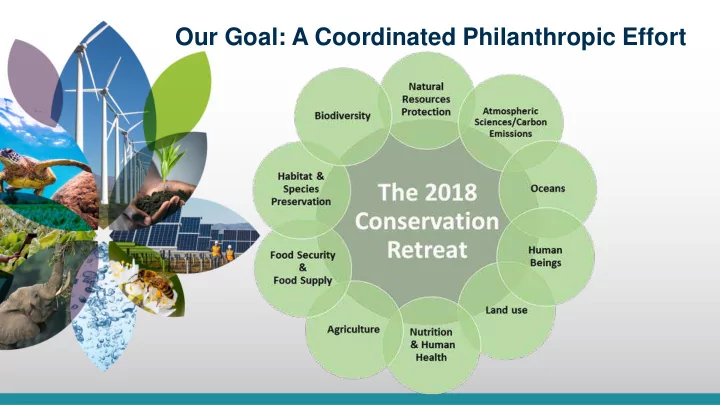
Our Goal: A Coordinated Philanthropic Effort Most-Effective Actions - - PowerPoint PPT Presentation

our goal a coordinated philanthropic effort most
SMART_READER_LITE
LIVE PREVIEW

Our Goal: A Coordinated Philanthropic Effort Most-Effective Actions - - PowerPoint PPT Presentation

Our Goal: A Coordinated Philanthropic Effort Most-Effective Actions to Reverse Global Warning CO2 Reduction (gigatons) Refrigerant management 89.7 1. Wind turbines (onshore) 84.6 2. Reduced food waste 70.5 3. Plant-rich diet 66.1 4.


slide-1
SLIDE 1

Our Goal: A Coordinated Philanthropic Effort

slide-2
SLIDE 2

Most-Effective Actions to Reverse Global Warning

Source: Drawdown (edited by Paul Hawken, 2017)

1.

Refrigerant management 89.7

2.

Wind turbines (onshore) 84.6

3.

Reduced food waste 70.5

4.

Plant-rich diet 66.1

5.

Tropical forests 61.2

6.

Educating girls 59.6

7.

Family planning 59.6

8.

Solar farms 36.9

9.

Silvopasture 31.2

  • 10. Rooftop solar

24.6

CO2 Reduction (gigatons)

slide-3
SLIDE 3

Leading Solutions for Food Security

Source: Drawdown (edited by Paul Hawken, 2017)

1.

Reduced food waste

2.

Plant-rich diet

3.

Silvopasture

4.

Regenerative agriculture

5.

Tropical staple trees

6.

Conservation agriculture

7.

Clean cookstoves

8.

Farmland restoration

9.

Improved rice cultivation

  • 10. Multistrata agroforestry
  • 11. System of rice intensification
  • 12. Composting
  • 13. Nutrient management
  • 14. Farmland irrigation
  • 15. Biochar
slide-4
SLIDE 4

U.S. Meat Production

10 20 30 40 50 60 70 80 90 100

1970 1980 1990 2000 2010

Billion pounds

Beef and Pork Poultry

Source: USDA.

slide-5
SLIDE 5

Food and Beverage Brands of the Future

Source: CBInsights

slide-6
SLIDE 6

July 13, 2018 – WeWork Cos. will no longer allow employees to expense meals with meat, and it won’t pay for any red meat, poultry or pork at WeWork events.

WeWork Removes the Meat

slide-7
SLIDE 7

July l6, 2017 – German drugmaker Merck KGaA and a Swiss firm, Bell Food Group, have invested $8.8 million in Netherlands-based Mosa Meat to produce beef from cattle cells. Mosa hopes to supply beef products in 2021 at $10 per burger.

Race to Produce Cell-Culture Beef Accelerates

Mark Post, a Maastricht University physiologist, unveiled the world’s first lab-grown burger in London in 2013. It cost $330,000 to produce.

slide-8
SLIDE 8

“Tyson Isn’t Chicken”

–Cover article, August 20, 2018

slide-9
SLIDE 9

Tyson Isn’t Chicken

Tyson Today

  • 20% of all U.S. meat
  • 1.8B animals per year
  • $15B of beef
  • $11B of chicken
  • $5B of pork
  • $8B in prepared foods

(Hillshire Farm, Jimmy Dean, Ball Park Franks)

Tyson: The Future

  • Antibiotics-free chickens
  • Reduce green house gases by 30%
  • Improved animal conditions
  • Investments in:
  • Future Meat Technologies
  • Memphis Meats
  • Beyond Meat
  • “Discovery Center” developing

alternative proteins

Source: Bloomberg BusinessWeek, August 20, 2018

slide-10
SLIDE 10

“Plant-based protein is growing almost, at this point, faster than animal-based, so I think the migration may continue in that direction.”

— Tom Hayes, CEO, Tyson Foods

slide-11
SLIDE 11
  • Nestle acquires Sweet Earth, giving it

access to the plant-based foods segment.

  • By 2025, PepsiCo aims to have 2/3 of

its global beverage portfolio products contain fewer than 100 calories from added sugars (12-ounce serving).

  • Cargill, the largest private U.S.

company, has invested in Memphis Meats and partnered with PURIS to expand pea protein production.

Companies See the Value of Healthier Products

Sources: The Globe and Mail; Wall Street Journal

slide-12
SLIDE 12

“Nestle Sells U.S. Candy Business”

“Nestle has agreed to sell its U.S. confectionery business to Italy’s Ferrero for $2.8 billion … a small step

  • n its path toward

healthier products.”

Source: Reuters, January 16, 2018

slide-13
SLIDE 13

The Impossible Burger at Fatburger

  • Veggieburger
  • Vegan Boca burger
  • No mayo
  • No bun

Source: VegNews, October 10, 2017

Launched October 2017

slide-14
SLIDE 14
slide-15
SLIDE 15

Focus on Nutrition

slide-16
SLIDE 16

Pharmacy of the 21st Century

slide-17
SLIDE 17

Hydroflurocarbons (HFCs) – a staple

  • f every refrigerant – can warm the

atmosphere 1000x – 9000x faster than carbon dioxide.

Refrigerants: Implementing Best Practices

Source: Drawdown (Paul Hawken) 2017

Air-conditioning units in Singapore

90% of refrigerant emissions happen at the end of a product’s life. Proper destruction practices can stop nearly 90% of HFC emissions, eliminating 89.7 gigatons of carbon dioxide over the next 30 years.

slide-18
SLIDE 18

AeroFarms in Newark, New Jersey, turns out up to two million pounds of harvest per

  • year. The crops – mostly salad

greens – are grown in 12 vertical layers in a 70,000 square-foot former warehouse.

Vertical Farming

slide-19
SLIDE 19

What a Waste!

Methane from food in landfills is 21 times more damaging than CO2.

Source: “Fixing Food,” report by the Barilla Center for Food & Nutrition and The Economist Intelligence Unit

The carbon footprint of food waste accounts for about

  • ne-third of annual emissions from fossil fuels.
slide-20
SLIDE 20

A $165 Billion Waste

In the United States, 40% of all food is wasted – an estimated $165 billion. In the United Kingdom, each family discards, on average, 700 pounds, or $1,170 worth

  • f food each year; that equals

$US 31.7 billion.

Sources: Natural Resources Defense Council; New York Times, “The Economic and Environmental Costs of Wasted Foods”, April 24, 2014

slide-21
SLIDE 21

Silvopasture (combining forestry and grazing)

slide-22
SLIDE 22
  • Prevents erosion and flooding
  • Recharges groundwater
  • Restores degraded land/soils
  • Supports biodiversity
  • Absorbs and stores significant

amounts of carbon dioxide By adopting 46 million acres by 2050, 9.3 gigatons of carbon dioxide would be sequestered.

Multistrata Forestry

Source: Drawdown (Paul Hawken) 2017

slide-23
SLIDE 23

Precision Irrigation

Source: The Economist, September 2016

  • California grows 80% of

world’s almonds. It’s an $11B industry.

  • Each almond requires roughly
  • ne gallon of water.
  • Precision irrigation systems

dose the exact amount of water and fertilizer every 30 minutes.

  • Water use reduced by 20%.
slide-24
SLIDE 24

Better water pressure management and active leakage control could reduce water losses by 20% globally by 2050. The emissions reduction could be nearly one gigaton of carbon dioxide. Infrastructure cost = $137 billion Cost savings = $903 billion

Water Distribution

Source: Drawdown (Paul Hawken) 2017