OSSE-DC Healthy Tots Division 2 nd Annual Health and Wellness - - PowerPoint PPT Presentation

osse dc healthy tots division 2 nd annual health and
SMART_READER_LITE
LIVE PREVIEW

OSSE-DC Healthy Tots Division 2 nd Annual Health and Wellness - - PowerPoint PPT Presentation

OSSE-DC Healthy Tots Division 2 nd Annual Health and Wellness Symposium Role Modeling Healthy Lifestyle Choices Within Child Care Facilities Deborah Archer, Ed.D. August 17, 2017 Role Modeling Healthy Lifestyle Choices To: Improve

slide-1
SLIDE 1

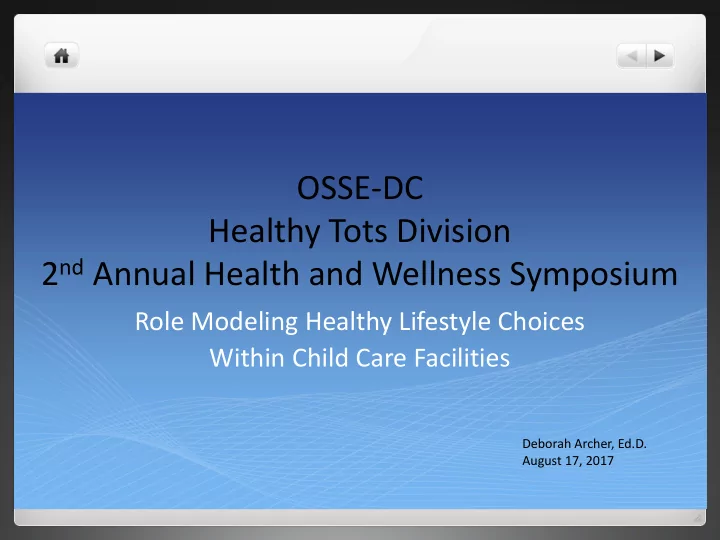
OSSE-DC Healthy Tots Division 2nd Annual Health and Wellness Symposium

Role Modeling Healthy Lifestyle Choices Within Child Care Facilities

Deborah Archer, Ed.D. August 17, 2017

slide-2
SLIDE 2

Role Modeling Healthy Lifestyle Choices To:

Improve self-efficacy around nutrition principals Provide recommendations to improve staff wellness Identify ways to create a staff wellness policy

slide-3
SLIDE 3

Benefits of Creating Healthier Child Care Environments

 Medical costs associated with obesity is estimated to be approximately $147

billion and expected to increase to $210 billion by 2020. According to the Centers for Disease Control, two out of three adults are overweight or

  • bese.
slide-4
SLIDE 4

Impact of Role Modeling on Child Health

 Evidence-based research verifies

that healthy, active children learn

  • better. More than one in three

children is at risk for developing diabetes, heart disease, and cancer later in life. Since children spend many of their waking hours and eat up to half their daily calories at school, schools play a critical role in cultivating healthy nutrition and physical activity habits.

slide-5
SLIDE 5

Why Should You Be a Role Model?

Although children make up 25 percent of the US population, the share of federal spending dedicated to children is just 8 percent of the federal budget

https://www.youtube.com/watch?v=IkoC3HZwe7Q

First Focus Advocacy Organization

slide-6
SLIDE 6

Determining Needs

 Conduct a workplace wellness assessment  •Analyze program evaluations  •Distribute an employee interest survey  •Offer a health risk assessment (HRA) and/or health screening  •Analyze data (medical, pharmacy, demographics)

slide-7
SLIDE 7

Developing a Wellness Team

  • Formally appoint team members and a leader
  • Promote the wellness team within the organization
  • Include employees from all levels and areas of the child care organization
  • If multi-location, name a Wellness Champion per worksite
  • Meet on a regular schedule with a formal agenda
  • Communication is the key

Bev Losey, CLU

slide-8
SLIDE 8

What is a Policy?

A policy is a written course of action that is enforced.

Policies are established to guide and determine present and future decisions.

slide-9
SLIDE 9

Creating a Staff Wellness Policy

 Obtain support/Gain Buy-In  Create a mission statement/ brand your child care program  Create a long-term strategic plan. Consult with other child care centers

(comparable in size) to learn about successful and unsuccessful implementation strategies

slide-10
SLIDE 10

Key Components of a Wellness Policy

Nutrition

  • Competitive Foods
  • Nutrition Promotion
  • Nutrition Education
  • Food and Beverage Marketing
  • Physical Activity/PE

Health Education Community and Family

Engagement

Staff Wellness and

Health Promotion

slide-11
SLIDE 11

Developing An Action Plan

 Address individual, environmental, policy and cultural factors affecting health and productivity  Target several health areas simultaneously  Tailoring programs to address specific needs of the population  Generate interest to attain high participation rates  Evaluate outcomes  Effectively communicating those outcomes to key stakeholders  AnnuRev Public Health. 2008;29:303-23. The health and cost benefits of work site health-promotion

  • programs. GoetzelRZ, OzminkowskiRJ. Department of Health and Productivity Research, Thomson

Healthcare, Washington, DC 20008, USA. Ron.Goetzel@Thomson.com

slide-12
SLIDE 12

Role Modeling Healthy Behaviors

Walking Programs Yoga-Stress Management Biking to Work Healthy Recipe Swaps Healthy Cooking Competitions

slide-13
SLIDE 13

Make Half Your Plate Fruits and Vegetables?

slide-14
SLIDE 14

Healthy Food and Beverage Options

 Do Not Skip Meals-

Family Style

 Choose a Variety of

Colors-Vitamins and Minerals

 Limit Your Intake of

Sugars

 Plan Your Meals and

Snacks

 Water-Preferred

Beverage-Water Bottle

  • n Desk

 Limit Caffeine-2:00 pm

Rule*

PAndrea Hart, RD, CDN

slide-15
SLIDE 15

Benefits of Staff Wellness Programs

2.2 Million People Work in Child Care and Education

Settings

Health and Wellness is Often Overlooked Child Care Staff are Role Models and Can Provide

Knowledge and Healthy Behaviors

  • National Head Start Association
slide-16
SLIDE 16

Benefits of Staff Wellness Programs

Reduces the Rate of

Employee Absenteeism

Lowers Health Care

Costs

Increases Productivity Improves Morale Lowers Workers

Compensation

National Head Start Association

slide-17
SLIDE 17

Action Plan Tips for Sustainability

Contact Insurance

Companies and Broker Available Services

Contact Local

Department of Parks and Recreation to Request Resources

Apply for Small

Wellness Grants

Annual Health

Fairs/Screenings- Department of Health and Other Community Resources

slide-18
SLIDE 18

Let’s Move, Jump, and Play!

slide-19
SLIDE 19

Best Practices When Developing a Staff Wellness Policy

 Get senior level support. Successful wellness programs start at the top.  Remember, creating a culture of health takes passionate leadership from all

levels of the organization.

 Use data to drive wellness initiatives. Employers often struggle with what

wellness initiatives have to offer. A survey, assessment checklist, and health risk appraisal approach guides employers where to focus your efforts.

 No program is successful without a plan. Develop an annual workplace

wellness operating plan, starting with a vision statement.

www.shrm.org/templatestools/howtoguides/howtoestablishandesignawellnessprogra m

slide-20
SLIDE 20

FINAL THOUGHTS…

1.

Choose appropriate health initiatives. Collecting data will help you decide what wellness initiatives to promote. Note a variety of lower cost resources and activities exist.

2.

Create a corporate environment that supports wellness. Support a culture

  • f health, from top to bottom and bottom to top.

3.

Evaluate the outcome of workplace wellness initiatives. Determine what works and what doesn’t so you can plan for the next year.

slide-21
SLIDE 21

Thank You