ORIGINAL ARTICLE PATTERN OF PRESENTATION OF ROAD TRAFFIC ACCIDENT - - PDF document

original article
SMART_READER_LITE
LIVE PREVIEW

ORIGINAL ARTICLE PATTERN OF PRESENTATION OF ROAD TRAFFIC ACCIDENT - - PDF document

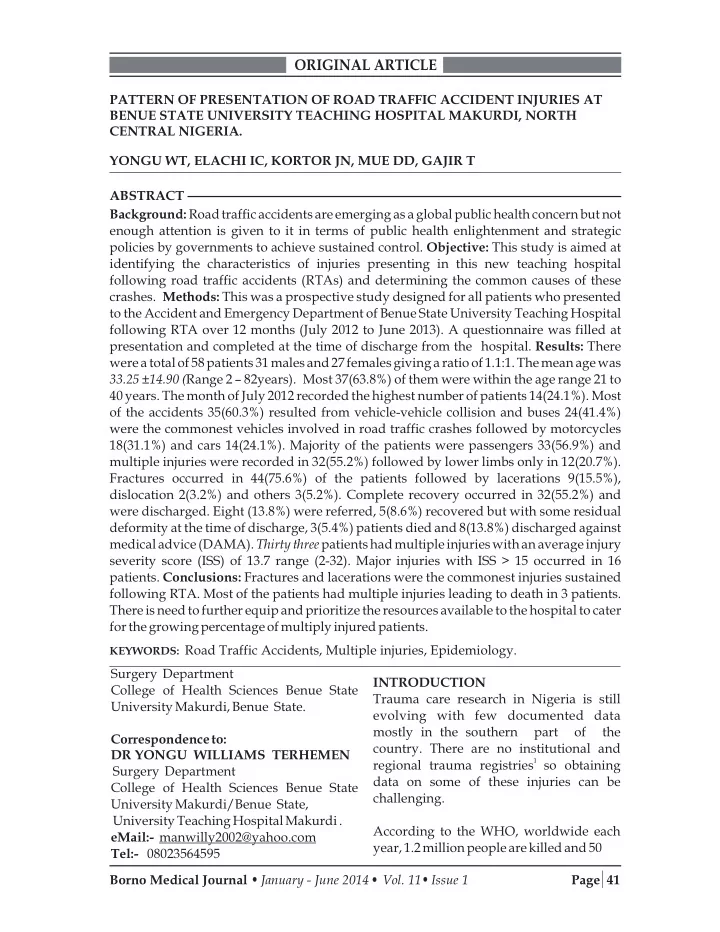
ORIGINAL ARTICLE PATTERN OF PRESENTATION OF ROAD TRAFFIC ACCIDENT INJURIES AT BENUE STATE UNIVERSITY TEACHING HOSPITAL MAKURDI, NORTH CENTRAL NIGERIA. YONGU WT, ELACHI IC, KORTOR JN, MUE DD, GAJIR T ABSTRACT Background: Road traffic accidents


slide-1
SLIDE 1

ABSTRACT PATTERN OF PRESENTATION OF ROAD TRAFFIC ACCIDENT INJURIES AT BENUE STATE UNIVERSITY TEACHING HOSPITAL MAKURDI, NORTH CENTRAL NIGERIA. YONGU WT, ELACHI IC, KORTOR JN, MUE DD, GAJIR T

KEYWORDS: Road Traffic Accidents, Multiple injuries, Epidemiology.

Background: Objective: Methods: Results: Conclusions: Road traffic accidents are emerging as a global public health concern but not enough attention is given to it in terms of public health enlightenment and strategic policies by governments to achieve sustained control. This study is aimed at identifying the characteristics of injuries presenting in this new teaching hospital following road traffic accidents (RTAs) and determining the common causes of these crashes. This was a prospective study designed for all patients who presented to the Accident and Emergency Department of Benue State University Teaching Hospital following RTA over 12 months (July 2012 to June 2013). A questionnaire was filled at presentation and completed at the time of discharge from the hospital. There were a total of58patients 31malesand27femalesgiving a ratioof1.1:1. Themeanage was Range 2 – 82years). Most 37(63.8%) of them were within the age range 21 to 40 years. The month of July 2012 recorded the highest number of patients 14(24.1%). Most

  • f the accidents 35(60.3%) resulted from vehicle-vehicle collision and buses 24(41.4%)

were the commonest vehicles involved in road traffic crashes followed by motorcycles 18(31.1%) and cars 14(24.1%). Majority of the patients were passengers 33(56.9%) and multiple injuries were recorded in 32(55.2%) followed by lower limbs only in 12(20.7%). Fractures occurred in 44(75.6%) of the patients followed by lacerations 9(15.5%), dislocation 2(3.2%) and others 3(5.2%). Complete recovery occurred in 32(55.2%) and were discharged. Eight (13.8%) were referred, 5(8.6%) recovered but with some residual deformity at the time of discharge, 3(5.4%) patients died and 8(13.8%) discharged against medicaladvice (DAMA). patients had multiple injuries with an average injury severity score (ISS) of 13.7 range (2-32). Major injuries with ISS > 15 occurred in 16 patients. Fractures and lacerations were the commonest injuries sustained following RTA. Most of the patients had multiple injuries leading to death in 3 patients. There is need to further equip and prioritize the resources available to the hospital to cater forthe growing percentage ofmultiply injuredpatients. 33.25 ±14.90 ( Thirty three INTRODUCTION Trauma care research in Nigeria is still evolving with few documented data mostly in the southern part

  • f

the

  • country. There are no institutional and

regional trauma registries so obtaining data on some of these injuries can be challenging. According to the WHO, worldwide each year, 1.2 millionpeopleare killedand50

1

Surgery Department College of Health Sciences Benue State University Makurdi,Benue State. Surgery Department College of Health Sciences Benue State University Makurdi/Benue State, UniversityTeachingHospitalMakurdi. 08023564595 Correspondenceto: DR YONGU WILLIAMS TERHEMEN eMail:- Tel:- manwilly2002@yahoo.com

ORIGINAL ARTICLE

Borno Medical Journal Page 41

  • Vol. 11 Issue 1

January - June 2014

slide-2
SLIDE 2

million are injured in road traffic accidents. The cost to low income countries is approximately 1% of their gross national product, more than the total development aid received by these countries . This shows that close attention has to be paid to this epidemic by governments and non governmental agencies especially in the developing world in order to reduce morbidity and mortality from road traffic accidents. Developing countries bear the brunt of the fatalities and disabilities from road traffic crashes accounting for more than 85 per cent of the world's road fatalities and about 90 per cent of the total disability adjusted life years (DALYs) cost due to road injuries . Also in Africa, it has been estimated that 59,000 people lost their lives in road traffic crashes in 1990 and that this figure rose to 144,000 people by 2010, a 144 per cent increase . Statistics has shown that mortality in road traffic accidents is very high among young adults in their prime andwhoalsoconstitutethe workforce. The establishment of law enforcement agencies in some countries has not significantly helped the situation. In Nigeria for example, the mandate of the Federal Road Safety Commission established in 1988 includes ensuring law enforcement, collecting road accident statistics, revising traffic legislation, promotion of road safety education, ensuring adequate provision of medical facilities for traffic injury victims, undertaking research in road safety and coordination of all road safety activities. At the first African Road Safety Congress in Nairobi in 1989, Nigeria was ranked ahead

  • f other African countries in the mortality

2 3 4 5,6

rate on its highways with “the chances of a vehicle killing someone in Nigeria being 47 times higher than in Britain” . It is also evident that Nigeria is worse than most

  • ther countries in terms of traffic accidents,

in spite of her relatively good road

  • network. As at 2004 World Bank report

asserts “from the view – point of road development, Nigeria would no longer be regarded as a developing country”. But unlike in most countries where improved road development and vehicle ownership (as barometers of economic advancement) is accompanied by better traffic management, higher road safety awareness, and a relative decrease in the number of motor accidents, the opposite is true of Nigeria According to the Nigerian Federal Road Safety Corps (2006), between 1970 and 2001, Nigeria recorded a total of 726,383 road traffic accidents resulting in the death

  • f 208,665 persons and 596,425 injuries. In

that period, each succeeding year recorded more accidents, deaths and

  • injuries. Also between 1997 and 2002,

Lagos State alone recorded a total of 39,141 road accidents resulting in the death of 10,132 persons and 18,972 injuries . The Nigerian accident pattern seems to suggest that the better the road, the higher the accident and fatality rate as well as the severity and non-survival indices because

  • f driver noncompliance with speed

limits. . This study was conducted to ascertain the injury pattern following road traffic accidents presenting at the Benue State University Teaching Hospital and to ascertain the com mon causes of these accidents.

7 .8 9 10, 11, 12

Yongu WT et al Borno Medical Journal Page 42

  • Vol. 11 Issue 1

January - June 2014

slide-3
SLIDE 3

MATERIALSANDMETHODS RESULTS This was a prospective study recruiting all patients who presented to the Accident and Emergency Department of Benue State University Teaching Hospital following RTA over a 12 months period(July 2012 to June 2013) with major injuries (requiring admission). A questionnaire was filled at presentation by the attending medical officer after resuscitation and completed at time of discharge or referral from the hospital. The data included age, sex, the status

  • f

victim (driver, passenger or pedestrian), the event that led to the accident(vehicle –vehicle collision, burst tyre, vehicle- pedestrian collision), the vehicles involved, the injuries sustained, the body regions involved and the outcome after

  • treatment. The data was analyzed using

SPSS 16.Ethical clearance for the study was

  • btained.

There were a total of 58 patients 31 males 27 females giving a ratio

  • f

1.1:1. The mean age was (Range 2- 82years). Most 37(63.8%) of them were within the age range of 21 to 40 years (FIGURE1). The month of July 2012 recorded the highest number of patients 14(24.1%) because of a mass casualty situation in that month involving 7 members of National Youth Service Corps (NYSC) after orientation camp in the state . Most of the accidents 35(60.3%) resulted from vehicle-vehicle collision. This was followed by loss of control 20(34.5%) and burst tyre 2(3.4%). Buses 24(41.4%) were the commonest vehicles involved in road traffic crashes followed by motorcycles 33.25±14.90 years 18(31.1%) and cars 14 (24.1%) (FIGURE 2) . Majority of the patients were and multiple injuries were recorded in 32( 55.2%) followed by lower limbs only in 12(20.7%) (FIGURE 3). Fractures occurred in 44(75.6%) of the patients followed by lacerations 9(15.5 % ) dislocation 2(3.2%) and others 3(5.2%) (FIGURE4 recovered completely and were discharged, 8(13.8%) were referred, 5( 8.6%) recovered but with some residual deformity at the time of discharge, 3(5.4%) patients died and 8(13.8%) discharged against medical advice(DAMA). Thirty three patients had multiple injuries with an average injury severity score (ISS)

  • f 13.7 range (2-32). Major injuries with ISS

> 15 occurred in 16 patients. Age Distribution passengers 33 ( 56.9%) ( TABLE 2) ). Thirty two( 55.2%) TABLE1:

Pattern of Presentation of Road Traffic Accident Injuries

Age Frequency Percent 11-20 21-30 31-40 41-50 51-60 61-70 71-80 81-90 Not indicated Total 6 23 14 7 4 1 1 56 2 58 10.3 39.7 24.1 12.1 6.9 1.7 1.7 96.6 3.4 100.0 Borno Medical Journal Page 43

  • Vol. 11 Issue 1

January - June 2014

slide-4
SLIDE 4

TABLE 2: Status of Patients and the Type of Vehicles Involved. FIGURE 1: Vehicles Involved In Road Traffic Accidents by Gender. TYPE OF VEHICLE Car Bus Motorcycle

  • thers

Total Status of Patient Driver 3(5%) 1(1.7%) 15(25.8%) 0(0%) 19(31.9%) Passenger 8(13.8%) 22(38%) 2(3.4%) 1(1.7%) 33(56.9%) Pedestrian 3(5%) 1(1.7%) 1(1.7%) 1(1.7%) 6(11.2%) Total 14(23.9%) 24(41.5%) 18(31%) 2(3.6%) 58(100%) Yongu WT et al Borno Medical Journal Page 44

  • Vol. 11 Issue 1

January - June 2014

slide-5
SLIDE 5

FIGURE 3: Pattern of Injuries FIGURE 2: Anatomical Regions Injured

Pattern of Presentation of Road Traffic Accident Injuries

Borno Medical Journal Page 45

  • Vol. 11 Issue 1

January - June 2014

slide-6
SLIDE 6

DISCUSSION Our result shows that buses 24 (41.3%) were the commonest vehicles involved in accidents in our environment. This may not be unconnected with the fact that they are mostly used for intercity travels and are relatively cheaper than cars in terms of transport fare. Similar findings have been documented in an earlier study by Thanni et al in which mini buses were responsible for 63.9 % of the accidents in their series. The drivers of these vehicles are sometimes not well trained and engage in driving under the influence of alcohol and other stimulants. Our study also found that Vehicle-Vehicle collision was the commonest mechanism

  • f

the accidents. Madubueze et al documented that 38.8% of RTA in their series was due to head–on collisions. They suggested that this may be due to the poor state of our roads causing drivers to swerve to avoid potholes. They also asserted that poor driving techniques coupled with impatience of drivers could be major causativefactors. The male to female ratio was 1.1:1. This does not show the glaring male predominance seen in other studies where 1.5:1, 2.2:1 and 2.5:1 were recorded . This may be due to higher female involvement in both intercity and intra city travels and possibly fending for the family aswellin the study area. The mean age was in the third decade. The age group most involved in RTA as

  • bserved in this study is 21 to 30 years. This

is the vibrant and productive age for the

  • community. Most of them are bread

winners' in their families and sudden incapacitationfromroadtraffic injuries

1,13,14

takes a toll on financial and social well- being of the family. Similar results have alsobeen documentedin earlierstudies. Fractures occurred in 75% of the patients. This is higher than 62.5%, 25.3% and 18.7% recorded by Thanni et al, Solagberu et al and Madubueze et al respectively . This may be due to the fact that the teaching hospital is the main referral hospital within a radius of 70km that has the facilities to routinely treat fractures. Most of the referrals are usually from peripheral hospitals. Some of the patients were discharged against medical advice (DAMA). Most of those that were DAMA had fractures. This is higher than 12.7% documented by Madubueze et al. This shows that there is still patronage of traditional bone setters in

  • ur environment.

Some patients come back for orthodox care after developing complications at the traditional bone setter's place. There is need to continue enlightenment of the populace on dangers

  • f

traditional bone setting in

  • ur

environment. More than half of the patients sustained multiple injuries. This is higher than what was obtained in other similar studies. Buses were mostly involved in the crashes in this study implying higher energy transfer to the patients. Furthermore, the

  • ther tertiary institutions in the state triage

and refer the more severely injured patients to the teaching hospital Mortality rate of 3(5.4%) is within the internationally documentedrate of0.5to 6% . In conclusion vehicle-vehicle collision is the commonest cause of RTA in our

  • environment. Buses have been observed to

be mostly involved in these accidents and

1,13 1,14,15 15 15. 15

Yongu WT et al Borno Medical Journal Page 46

  • Vol. 11 Issue 1

January - June 2014

slide-7
SLIDE 7

multiple injury is the commonest pattern of presentation. There is need for prioritization of resources to cater for the rising number of multiply injured patients Government agencies and non- . governmental organizations who have the responsibility of enlightening the populace should intensify their efforts in order to reduceinjuriessustainedonourroads. REFERENCES 1. Thanni, L.O.A, Kehinde, O.A; Trauma at a Nigerian Teaching H o s p i t a l : P a t t e r n a n d documentation of presentation. Afr Health Sci.2006June;6(2):104–107. 2. Peden M, McGee K, Krug E. Injury: a leading cause of the global burden

  • fdisease.Geneva: WHO; 2002.

3. Aderamo, J.A. Assessing the Trends in Road Traffic Accident Casualties

  • n Nigerian Roads J Soc Sci 2002;

31(3):19-25. 4. Kopits E, Cropper M. Traffic fatalities and economic growth. 37(1):169-178. 5. Balogun JA, Abereoje OK. Pattern of road traffic Accident cases in a Nigerian University teaching Hospital between 1987 and 1990. 1992:95(1): 23– 29 6. Posada J, Ben-Michael E, Herman A, Kahan E, Richter E. Death and injury frommotorvehicle crashes in Colombia. Rev Panam SaludPublica 2000: 7(2):88-91. 7. Onakomaiya, S. O. Trends in Nigeria Road Safety and Accident Situation: A Paper Presented at a Conference on Accident Control and Safety Measures in Mass TransitOperationsInNigeria, Accident Analysis and Prevention 2005: J TropMed Hyg, Nigerian Institute of International Affairs, VictoriaIsland,Lagos.1990 8. Atubi, A.O: Road Traffic Accident Variations in Lagos state, Nigeria LA synopsis of Variance Spectra. African Research Review 2010; 4(2): 197-218 9. Onakomaiya S.O Unsafe at any s p e e d : T o w a r d R o a d Transportation for survival; Inaugural Lecture, University of Ilorin,Ilorin1988. 10. 11. Solagberu BA, Adekanye AO, Ofoegbu CPK et al. Clinical spectrum of trauma at a University hospital in Nigeria. Eur J Trauma. 2002;28:365-369. 12. Solagberu BA, Adekanye AO, Ofoegbu C P, et al. Epidemiology of trauma deaths. West Afr J Med. 2003; 22: 177–181. 13. Madubueze C.C, Onyebuchi Chukwu C.O, Omoke N.I, et al. Road traffic injuries as seen in a Nigerian teaching hospital Int

  • Orthop. 2011May; 35(5):743–746.

Filani, M.O., Gbadamosi, K.T. Spatial and Temporal Pattern of Road Traffic Accident Occurrences in Nigeria: 1970-1995. Nigerian Geographical Journal 2007;5( 1): 55- 70. ACKNOWLEDGEMENTS Our gratitude goes to all the residents in accident and emergency department as well as surgery department who diligently complied with the filling of the questionnaires in spite of their busy schedules.

Pattern of Presentation of Road Traffic Accident Injuries

Borno Medical Journal Page 47

  • Vol. 11 Issue 1

January - June 2014

slide-8
SLIDE 8

Yongu WT etal Cite this article as: Yongu WT, Elachi IC, Kortor JN, Mue DD, Gajir T Pattern of Presentation of Road Traffic Accident Injuries at Benue State University Teaching Hospital Makurdi, North Central Nigeria. Bo Med J 2014; 11(1): 41 - 48. Borno Medical Journal Page 48

  • Vol. 11 Issue 1

January - June 2014