
SLIDE 1
Origin of pulsar orthogonal polarization modes
P.F. WANG, Wei WANG, Jinlin HAN National Astronomical Observatories, CAS
3rd US-Chinese Workshop, GBT, WV
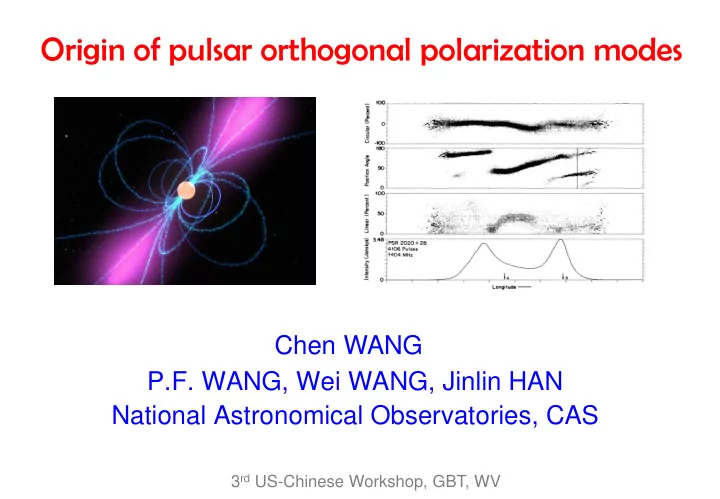
Origin of pulsar orthogonal polarization modes Chen WANG P.F. WANG, - - PowerPoint PPT Presentation
Origin of pulsar orthogonal polarization modes Chen WANG P.F. WANG, Wei WANG, Jinlin HAN National Astronomical Observatories, CAS 3 rd US-Chinese Workshop, GBT, WV Outline Polarized Curvature Radiation in Pulsar Magnetosphere (with both
3rd US-Chinese Workshop, GBT, WV
O-mode X-mode
O O X X
Ordinary mode (O-mode), n < 1 Extraordinary mode (X-mode), n ~ 1
The separation between the emission points of the O/X-mode waves Observed O/X-mode components at given phase are incoherent !
V0 // B B V0
V // B B V V0 1/γcone 1/γcone 1/γ
Classical model considered by Cheng & Ruderman 1979
Profiles with various impact angle Emission beam
Profiles with various impact angle Emission beam
– The observed X-mode and O-mode wave at given phase are emitted from incoherent region; – The orthogonal mode happens naturally due to the change of the dominance of the two modes;
– almost the same magnitude without considering the co-rotation of plasma, which cause strong depolarization; – very different distribution with co-rotation included, high LP can be
PA
Stinebring et al. (1984)
V I L
Mean profile
PA
90o 90o
Which mode is it? O- or X-mode?
Polarization of single pulses
O-mode X-mode
– obtain spin axis of 15 pulsars by Ng & Romani 2004, 2007, 2008. – Not avialable for normal pulsars without PWNe
– Spin-kick alignment proved by Romani, Ng,
Johnston, Wang, Noutsos et al.
– Proper motion measured by pulsar timing and interferometer obs. Brisken et al. 2002, 2003;
Hobbs et al. 2005.
Ng & Romani 2004
PWN of Vela: X-ray obs.
Noutsos et al. 2011
Spin-kick alignment of pulsars
Mode distinguishment for 14 OPM-pulsars (with both believable PM and PA data)
dominate central intensity-peak region. (X O X)
dominate intensity-peak
mode dominates half profiles
Polarization profiles comes from Johnston et al. 2005, 2007; Carr 2007; Han et al. 2009
– O mode refracted towards away from magnetic axis.
– Central O-mode emission from parallel accelaration – X-mode from curvature radiation dominates two wings
X-mode O-mode X-mode
PSR2020+28
– almost the same magnitude without considering the co-rotation of plasma, which cause strong depolarization; – very different distribution with co-rotation included, high LP can be
– 4 of them agree with “O X O” modes sequence – 7 of them are “X O X”, 3 of them are “X O”. – Different OPM-pulsars may have different origin of OPM.
PArot PArot
Kargaltsev & Pavlov 2008
B0531+21 J2229+6114 B0540-69 J1833-1034 J0205+6449 B1509-58 J1124-5916 J1930+1852 B0833-45 J2021+3651 B1706-44 B1800-21
Both spin axis and well-calibrated polarization position angle curve is needed
Wang et al. 2006 Johnston et al. 2005
– Sp Spin-ki kick趋于一致。是否可靠?
– 传播效应对PA PA曲线垂直方向影响不大。基本可靠! – 确定PA PA曲线最陡处的位置。对基本符合RVM描述的S型比较容易。但是 对S曲线不完整的比较勉强!
– 偏振观测与校准 – 多波段偏振观测 – 自行观测数据,长期timi iming或者VL VLBI观测获得。
eading ng side
eading ng side de
Cheng & Ruderman 1979 Bunching dominate curvature dominate
C.-Y. Ng ApJ.601:479 (FITTING PWN TORI)
Chandra ACIS-S3 image of Vela PWN:(1) Vela pulsar, (2) inner arc, (3)
X-mode X-mode X-mode
O-mode X-mode
O-mode X-mode O-mode X-mode B1929+10 B0736-40
O-mode X-mode O-mode X-mode B1237+25 B1857-26
O-mode X-mode O-mode X-mode O-mode X-mode X-mode X-mode X-mode O-mode? B0450-18 B0835-41
O-mode X-mode O-mode X-mode B0355+54 J1735-0724
O-mode X-mode O-mode O-mode
X-mode J0953+0755 J1453-6413
O-mode X-mode O-mode X-mode
J1709-1640 J1645-0317
PA increase V < 0 PA decrease V > 0
波模耦合产生的圆偏振 依赖于PA的变化趋势
PAv
Han et al. 1998, You et al. 2006
PA0v = 16o( 7) PA0v = 1o(10) PA0v = -67o(2) PA0v = 21o ( 15)