
SLIDE 1
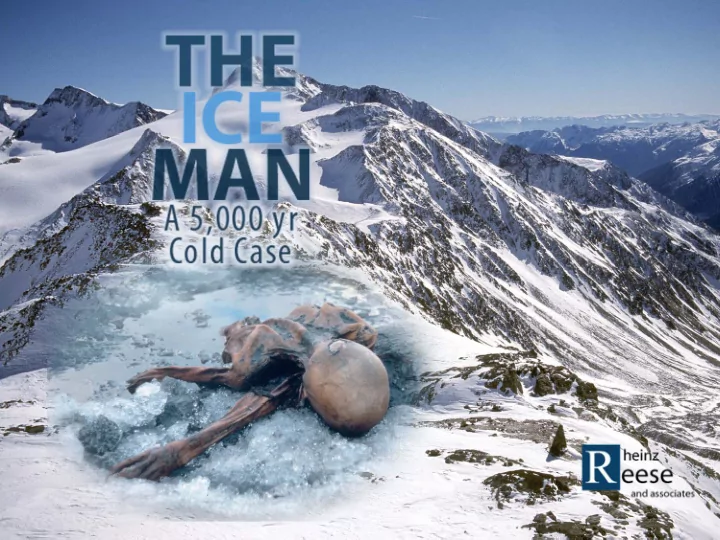
Organization The Ice Man: A 5,000 year old Cold Case is a - - PowerPoint PPT Presentation
Organization The Ice Man: A 5,000 year old Cold Case is a travelling exhibition brought to you by the following partners: Museumspartner, Innsbruck, Austria: produced the original Iceman travelling exhibit seen throughout Europe and
travelling exhibition brought to you by the following partners:
– produced the original Iceman travelling exhibit seen throughout Europe and Australia – content and securing loans – technical and logistics support
Bolzano, Italy:
– permanent home of the Iceman –
– providing the original objects of the Iceman for the North American tour –
Consultant
– redesign of the exhibition for North American markets – new interactives and graphic design
– exclusive representatives for North America
descending from a peak high in the Alps opted to follow a different route
stumbled upon one of the most significant discoveries in the history
ice was the mummified body of a man who had died a violent death 5,000 years ago.
survived at all. He had an arrow in his back, a head wound and a deep cut in his hand. Who murdered the Iceman? Where did he come from?
incomplete murder mysteries ever revealed.
seen:
–
world ‐ over 5,000 years old – a “wet mummy”, i.e. body tissue is elastic and suitable for performing detailed scientific investigations – a natural mummy, unaltered by burial rites or other interventions
Iceman died:
– murder? – sacrifice? – natural?
and equipment provide a unique snapshot of Neolithic life in Europe.
pollen in his digestive tract indicate he must have lived south of the Alps.
during the late Neolithic period.
BC, food was procured mainly from farming and animal rearing.
were also important activities.
mystery.
invited to play the role of detective and forensic scientist. They will:
– find evidence, – look for clues, – compare their conclusions with experts and other visitors, – gain new insights into an unsolved mystery and, – by comparison, find relevance to their own lives and the changing environment.
– Discovery – Forensic Lab – Neolithic Life
– a large, attractive diorama – a full‐size Iceman replica – interactives that engage the visitor in the quest to solve the murder mystery – informative displays – artifacts
– recreation of the scene of the Iceman discovery – half‐body replica of Iceman, face‐down in ice and rock
location of the site on the Italian/Austrian border
– discovery and recovery of the Iceman
– original artifacts found with the Iceman
– recreation of the room where the real mummy is kept at the Iceman Museum in Bolzano, Italy – full‐size replica of Iceman, face‐up on a lab gurney
– visitors review clues, photographs and relevant artifacts to try to solve the mystery of the Iceman’s death. – interactive touch‐table with extremely high resolution photos of all of the body
– discovery of the arrowhead in the Iceman
– bow, arrows, flint knife, copper axe
ICEMAN AUTOPSY
– recreation of a 5,000‐year‐old village in the Alps – full‐sized replica of the Iceman with clothes and his equipment
– how did the Iceman clothes help him cope in his environment? – how did the Neolithic people live off the land? – displays on tool making, copper casting, clothes
– Clips on a typical day in a village
– clothes, tools, copper making, household items
– South Tyrol Museum of Archaeology, Bolzano, Italy – Museo Tridentino Scienze Naturali, Trento, Italy – Castello del Buonconsiglio, Trento, Italy – Ufficio Beni Archeologici, Bolzano, Italy – Musei Civico di Remedello, Remedello, Italy – Museum für Archäologie Thurgau, Thurgau, Switzerland – Naturmuseum Südtirol, Bolzano, Italy
– all insurance, – all shipping, – installation and dismantling crew, – accompanying couriers from lending institutions, – all exhibition décor including the dioramas, walls and reconstructions for the Lab, and Neolithic section, – display cases, – all audio / visual material in two languages – one of which is English, – all graphic panels in two languages ‐ one of which is in English