ORDER ISOMORPHISMS OF OPERATOR INTERVALS Peter Semrl University - - PDF document

order isomorphisms of operator intervals peter semrl
SMART_READER_LITE
LIVE PREVIEW

ORDER ISOMORPHISMS OF OPERATOR INTERVALS Peter Semrl University - - PDF document

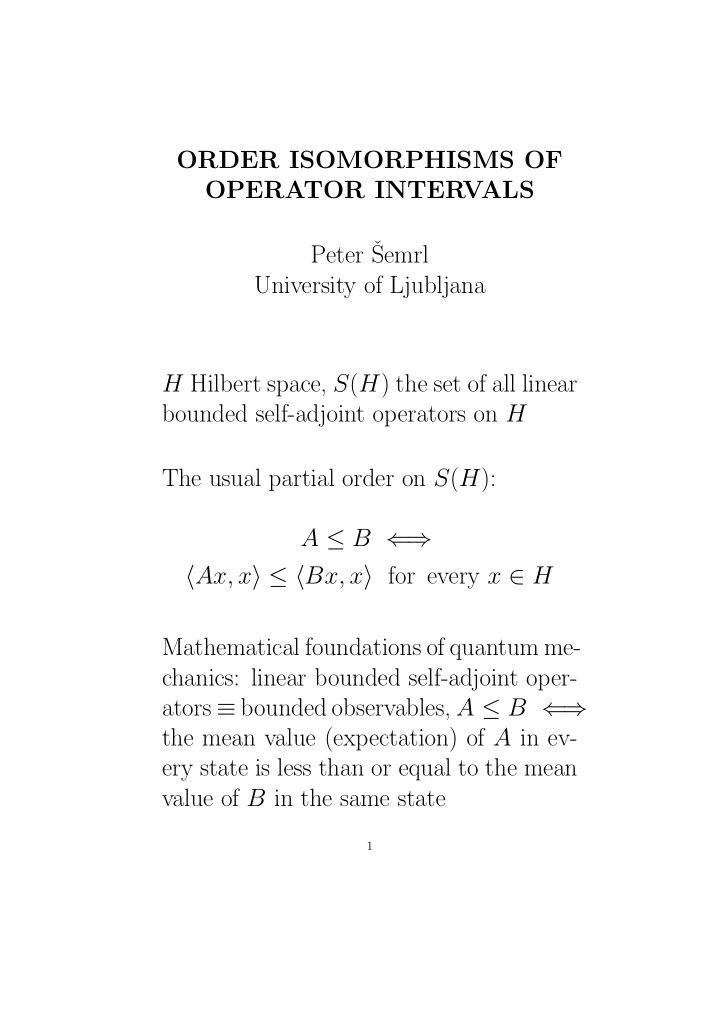
ORDER ISOMORPHISMS OF OPERATOR INTERVALS Peter Semrl University of Ljubljana H Hilbert space, S ( H ) the set of all linear bounded self-adjoint operators on H The usual partial order on S ( H ): A B Ax, x Bx, x


slide-1
SLIDE 1

ORDER ISOMORPHISMS OF OPERATOR INTERVALS Peter ˇ Semrl University of Ljubljana H Hilbert space, S(H) the set of all linear bounded self-adjoint operators on H The usual partial order on S(H): A ≤ B ⇐ ⇒ Ax, x ≤ Bx, x for every x ∈ H Mathematical foundations of quantum me- chanics: linear bounded self-adjoint oper- ators ≡ bounded observables, A ≤ B ⇐ ⇒ the mean value (expectation) of A in ev- ery state is less than or equal to the mean value of B in the same state

1

slide-2
SLIDE 2

THEOREM (Moln´ ar 2001). φ : S(H) → S(H) bijective map such that A ≤ B ⇐ ⇒ φ(A) ≤ φ(B). Then φ is of the form φ(A) = TAT ∗ + B, A ∈ S(H). Here, B ∈ S(H), T : H → H bdd linear

  • r conjugate-linear bijective operator.

We will restrict to the finite-dimensional case.

2

slide-3
SLIDE 3

Hn the set of all n×n hermitian matrices A = A∗ A = UDU∗, D diagonal matrix with real entries on the main diagonal (eigenvalues

  • f A)

A ≥ 0 ⇐ ⇒ all eigenvalues of A are non-negative. A ≤ B ⇐ ⇒ B − A ≥ 0

3

slide-4
SLIDE 4

Moln´ ar’s theorem again, this time just the finite-dimensional case: THEOREM φ : Hn → Hn a bijective map such that A ≤ B ⇐ ⇒ φ(A) ≤ φ(B). Then there exist an invertible matrix T and B ∈ Hn such that either φ(A) = TAT ∗ + B for every A ∈ Hn, or φ(A) = TAtrT ∗ + B for every A ∈ Hn.

4

slide-5
SLIDE 5

Effect algebra En: En = {A ∈ Hn : 0 ≤ A ≤ I} Orthocomplementation on En: A ∈ En : A⊥ = I − A THEOREM (Ludwig, characterization of

  • rtho-order automorphisms of En).

φ : En → En a bijective map such that A ≤ B ⇐ ⇒ φ(A) ≤ φ(B) and φ(A⊥) = φ(A)⊥. Then there exists a unitary matrix U such that either φ(A) = UAU ∗ for every A ∈ En, or φ(A) = UAtrU ∗ for every A ∈ En.

5

slide-6
SLIDE 6

Moln´ ar: bijectivity + order preserving Ludwig: bijectivity + order preserving +

  • rthocomplementation preserving
  • CONJECTURE. φ : En → En a bijective

map such that A ≤ B ⇐ ⇒ φ(A) ≤ φ(B). Then there exists a unitary matrix U such that either φ(A) = UAU ∗ for every A ∈ En, or φ(A) = UAtrU ∗ for every A ∈ En. Wrong!

6

slide-7
SLIDE 7

Example: A → S−1/2 (I − T 2 + T(I + A)−1T)−1 − I

  • S−1/2

S = T 2 2I − T 2 Operator intervals: A, B ∈ Hn, A < B (A < B ⇐ ⇒ A ≤ B and B−A invertible) [A, B] = {C ∈ Hn : A ≤ C ≤ B} En = [0, I]

7

slide-8
SLIDE 8

Bijective maps preserving order in both directions: [A, B] → [A + C, B + C] X → X + C [A, B] → [TAT ∗, TBT ∗] X → TXT ∗ Bijective map satisfying X ≤ Y ⇐ ⇒ φ(Y ) ≤ φ(X): 0 < A < B [A, B] → [B−1, A−1] φ(X) = X−1 [0, I] → [0, I] φ(X) = I − X

8

slide-9
SLIDE 9

A → I + A → (I + A)−1 → T(I +A)−1T → I −T 2+T(I +A)−1T → (I − T 2 + T(I + A)−1T)−1 → (I − T 2 + T(I + A)−1T)−1 − I

9

slide-10
SLIDE 10

p a real number, p < 1. fp : [0, 1] → [0, 1] fp(x) = x px + (1 − p), x ∈ [0, 1].

  • THEOREM. n ≥ 2. φ : En → En bijec-

tive. A ≤ B ⇐ ⇒ φ(A) ≤ φ(B) ⇓ ∃p, q ∈ (−∞, 1), ∃ an invertible matrix T with T ≤ 1 such that either φ(A) = = fq

  • (fp(TT ∗))−1/2 fp(TAT ∗) (fp(TT ∗))−1/2

,

  • r

φ(A) = = fq

  • (fp(TT ∗))−1/2 fp(TAtrT ∗) (fp(TT ∗))−1/2

.

10

slide-11
SLIDE 11

Problem? A, B ∈ Hn, A < B. [A, B] = {C ∈ Hn : A ≤ C ≤ B}, [A, B) = {C ∈ Hn : A ≤ C < B}, (A, B) = {C ∈ Hn : A < C < B}. [A, ∞) = {C ∈ Hn : C ≥ A}, (A, ∞) = {C ∈ Hn : C > A}, (−∞, ∞) = Hn (A, B], (−∞, A], (−∞, A)

11

slide-12
SLIDE 12

Which of the above operator intervals are

  • rder isomorphic?

The general form of all order isomorphisms between operator intervals that are order isomorphic? Simple reduction principle: I ∼ J and I1 ∼ J1 and we know isomor-

  • phisms. Then:

If we know the general form of all order isomorphisms between operator intervals I and I1, then we know the general form of all order isomorphisms between operator intervals J and J1. Similar: ∼ denotes order anti-isomorphic

12

slide-13
SLIDE 13

Each operator interval J is isomorphic to

  • ne of the following operator intervals:

[0, I] [0, ∞) (−∞, 0] (0, ∞) (−∞, ∞) And any two of these operator intervals are order non-isomorphic.

13

slide-14
SLIDE 14

The operator intervals [0, ∞) and (−∞, 0] are obviously order anti-isomorphic. Hence, to understand the structure of all order isomorphisms between any two order iso- morphic operator intervals it is enough to describe the general form of order auto- morphisms of the following four operator intervals: [0, I] [0, ∞) (0, ∞) (−∞, ∞)

14

slide-15
SLIDE 15

The group of order automorphisms of [0, I] and (−∞, ∞): previous slides THEOREM φ : [0, ∞) → [0, ∞) a bijec- tive map such that A ≤ B ⇐ ⇒ φ(A) ≤ φ(B). Then there exists an invertible matrix T such that either φ(A) = TAT ∗ for every A ∈ [0, ∞), or φ(A) = TAtrT ∗ for every A ∈ [0, ∞).

15

slide-16
SLIDE 16

THEOREM φ : (0, ∞) → (0, ∞) a bijec- tive map such that A ≤ B ⇐ ⇒ φ(A) ≤ φ(B). Then there exists an invertible matrix T such that either φ(A) = TAT ∗ for every A ∈ (0, ∞), or φ(A) = TAtrT ∗ for every A ∈ (0, ∞).

16

slide-17
SLIDE 17

Optimality? Can we replace the assumption A ≤ B ⇐ ⇒ φ(A) ≤ φ(B) by the weaker one A ≤ B ⇒ φ(A) ≤ φ(B) and still get the same conclusion? φ : [0, ∞) → [0, ∞) φ(A) = A1/2 bijective map preserving order in one di- rection; operator monotone functions Bijectivity? Essential in the infinite-dimensional case.

17

slide-18
SLIDE 18

A, B ∈ Hn adjacent

  • rank (A − B) = 1

φ : Hn → Hn preserves adjacency in both directions, if A, B adj ⇐ ⇒ φ(A), φ(B) adj

18

slide-19
SLIDE 19

M = {(x, y, z, t) : x, y, z, t ∈ R} (x1, y1, z1, t1), (x2, y2, z2, t2) ∈ M coherent

  • (x1−x2)2+(y1−y2)2+(z1−z2)2 = c2(t1−t2)2

In mathematical foundations of relativity we usually use the harmless normalization c = 1. Two space-time events are coherent (light- like) ⇐ ⇒ a light signal can be sent from

  • ne to the other

Alexandrov: description of bijective maps

  • n M preserving coherency in both direc-

tions r = (x, y, z, t) ↔ t + z x + iy x − iy t − z

  • = A

19

slide-20
SLIDE 20

A ∈ H2 det A = t2 − z2 − x2 − y2 r1, r2 ∈ M, rj ↔ Aj r1, r2 coherent ⇐ ⇒ det(A2 − A1) = 0

  • A2 − A1 singular
  • A1 = A2 or A1 and A2 adjacent

Thus, Alexandrov problem = study of ad- jacency preservers on H2

20

slide-21
SLIDE 21

A, B ∈ Hn, A = B. TFAE:

  • A, B adj.
  • A, B comparable and if C, D belong

to operator interval between A and B, then C and D comparable.

  • Proof. (⇓)

B = A + tP, say t > 0 ⇒ A ≤ B [A, B] = {A + sP : 0 ≤ s ≤ t} C, D ∈ [A, B] ⇒ C = A+s1P, D = A+s2P. (⇑) A, B not adjacent If A, B not comparable, done. If comparable, WLOG A ≤ B. rank (B− A) ≥ 2 ⇒ “enough room” to find two noncomparable in [A, B].

21