OPTIMIZATION OF INDUSTRIAL PARTNERS: GROUND-COUPLED 1. Akademiska - - PowerPoint PPT Presentation

optimization of
SMART_READER_LITE
LIVE PREVIEW

OPTIMIZATION OF INDUSTRIAL PARTNERS: GROUND-COUPLED 1. Akademiska - - PowerPoint PPT Presentation

Building Services Engineering CHALMERS OPTIMIZATION OF INDUSTRIAL PARTNERS: GROUND-COUPLED 1. Akademiska Hus 2. IVT AB HEAT PUMP SYSTEMS 3. Nibe AB 4. Thermia Vrme AB 5. York Refrigeration AB 6. Wilo AB SAQIB JAVED (PhD


slide-1
SLIDE 1

Building Services Engineering CHALMERS

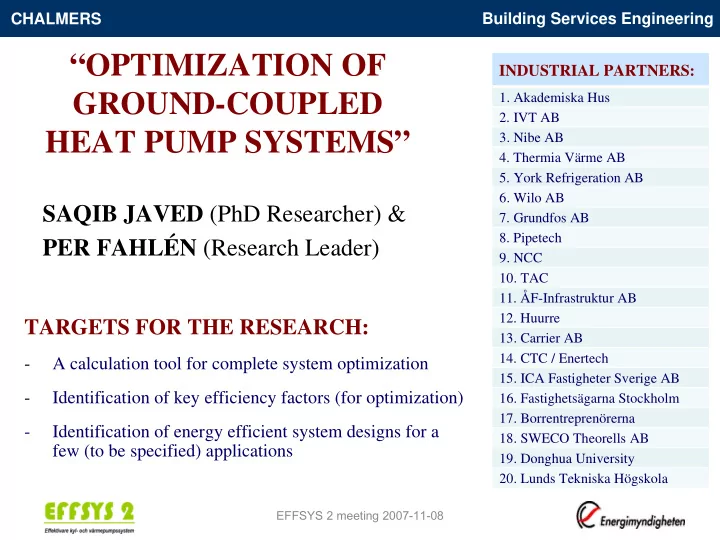
“OPTIMIZATION OF GROUND-COUPLED HEAT PUMP SYSTEMS”

INDUSTRIAL PARTNERS:

  • 1. Akademiska Hus
  • 2. IVT AB
  • 3. Nibe AB
  • 4. Thermia Värme AB
  • 5. York Refrigeration AB
  • 6. Wilo AB
  • 7. Grundfos AB
  • 8. Pipetech
  • 9. NCC
  • 10. TAC
  • 11. ÅF-Infrastruktur AB
  • 12. Huurre
  • 13. Carrier AB
  • 14. CTC / Enertech
  • 15. ICA Fastigheter Sverige AB
  • 16. Fastighetsägarna Stockholm
  • 17. Borrentreprenörerna
  • 18. SWECO Theorells AB
  • 19. Donghua University
  • 20. Lunds Tekniska Högskola

SAQIB JAVED (PhD Researcher) & PER FAHLÉN (Research Leader)

TARGETS FOR THE RESEARCH:

  • A calculation tool for complete system optimization
  • Identification of key efficiency factors (for optimization)
  • Identification of energy efficient system designs for a

few (to be specified) applications

EFFSYS 2 meeting 2007-11-08

slide-2
SLIDE 2

Building Services Engineering CHALMERS

BACKGROUND

Changes in the use of energy in buildings:

  • Decreasing heat demand
  • Increasing cooling demand
  • Increasing electricity demand

180 kWh/m2/år Nya målsättningar

125 kWh/m2/år

Driftel exkl el för värmning Uppvärmning och tappvarmvatten inkl elvärme

100 150 200 250 300 350 50 100 150

kWh/år m² kWh/år m²

1974 1981 1994

Samtliga FLER- Samtliga

1970 1970

LOKALER

1994 50 Kontorshus 80-talet

BOSTADSHUS

EFFSYS 2 meeting 2007-11-08

20 40 60 80

1970 1980 1990 2000 År TWH/år

50 30 10 70 Elenergi för uppvärmning Hushållsel Driftel Direktel

slide-3
SLIDE 3

Building Services Engineering CHALMERS

Heat Radiation Solar Radiation Precipitation Borehole Borehole Borehole Borehole

Heat conduction In rock Groundwater flow Geothermal heat flux

10 - 20 m

I n f l u e n c e d b y s e a s

  • n

a l temperature changes N e u t r a l z

  • n

e T e m p e r a t u r e s t a b l e

  • v

e r t h e y e a r , I n c r e a s i n g w i t h d e p t h

  • Heat source
  • Heat sink
  • Heat Storage

HEAT PUMP, FREE COOLING AND BOREHOLE STORAGE

EFFSYS 2 meeting 2007-11-08

slide-4
SLIDE 4

Building Services Engineering CHALMERS

BOREHOLE SYSTEM

  • Building Load Profile
  • Relation between heating/cooling
  • Borehole Load
  • Specific heat extraction in winter [kWh/m/year]
  • Specific heat injection in summer [kWh/m/year]
  • Borehole system Geometry
  • Depth and number of boreholes
  • Distance between the boreholes
  • Configuration of borehole system (rectangular or line configuration)

p m x p n x p

  • No. Of boreholes, N = m x n

Rectangular Configuration

Linear Cofiguration

Dimensioning Factors

EFFSYS 2 meeting 2007-11-08

slide-5
SLIDE 5

Building Services Engineering CHALMERS

DIMENSIONING FACTORS

  • Geometry factor: Volume of borehole system / heat exchange area
  • Load factor: Relation between heating and cooling demands
  • Specific borehole load: Relation between building demand and borehole

length

] [m A V G = ] [− + + =

cooling heating cooling heating

Q Q Q Q ε ] / / [ m year kWh L Q q

tot heating h =

] / / [ m year kWh L Q q

tot cooling c =

] / / [ m year kWh q q q

h c tot

+ =

EFFSYS 2 meeting 2007-11-08

slide-6
SLIDE 6

Building Services Engineering CHALMERS

DIMENSIONING EXAMPLE

10th Year Temperature [°C] qh/qc ; ε

150 / 50; 0,5 50 / 150; -0,5 100 / 100; 0

Design Conditions Min Max Min Max Min Max Line configuration: 1·20 = 20 borehole

  • 2,7

13,8 11,0 31,6 4,3 22,7 U configuration: 6·8 ↔ 20

  • 2,9

13,5 11,7 32,3 4,5 22,8 Open rectangle configuration: 5·7 ↔ 20

  • 3,2

13,2 12,4 32,9 4,7 23,0 Rectangular: 4·5 = 20 borehole

  • 4,2

11,9 15,2 35,4 5,6 23,7

EFFSYS 2 meeting 2007-11-08

slide-7
SLIDE 7

Building Services Engineering CHALMERS

5 10 15 20 20 40 60 80 100 120 Number of boreholes [-] G e o m e try fa c to r, G [m ] RECTANGLE LINE

BOREHOLE SYSTEM Relation between load profile and geometry

  • Dominated heating demand
  • Direct heat exchange
  • Linear configuration
  • Dominated cooling demand
  • Direct heat exchange
  • Linear configuration
  • Balanced heating & cooling demand
  • Heat storage
  • Rectangular configuration

EFFSYS 2 meeting 2007-11-08

slide-8
SLIDE 8

Building Services Engineering CHALMERS

FREE COOLING APPLICATION Astronomy house - Lund

  • Geometry:
  • Load Factor:
  • Specific Borehole Load:

] [ 7 , 6 m G = ] [ 5 . 155 515 155 515 − ≈ − + − = ε 130 4000 475000 ≈ =

h

q 39 4000 155000 ≈ − =

c

q ] / / [ m year kWh

Measured Quantity MWh/year kWh/m2/year

Heating demand 515 97 Cooling demand 155 29 Heat from the heat pump 475 89 Auxiliary heat 40 8 Free cooling 130 25 Cooling and heating at same time from the heat pump 15 3 Cooling without heating from the heat pump 10 2 Electricity for the heat pump 104 20 Electricity for the pumps 7 1

EFFSYS 2 meeting 2007-11-08

slide-9
SLIDE 9

Building Services Engineering CHALMERS

FREE COOLING APPLICATION Astronomy house - Lund

EFFSYS 2 meeting 2007-11-08

slide-10
SLIDE 10

Building Services Engineering CHALMERS

WORK PLAN

  • Previous work *

– Data bases (Fridoc, compendex …) – personal contacts (project group)

  • State-of-the-art review (analysis & synthesis) * ¤

– Practical experience, measured results, estimate of future potential – Modeling tools, identification of the need for development and measurements for validation; suitable ways to proceed

  • Overview & classification of current system designs *

– Inventory of review, classification and selection of systems for further investigations (modeling and measurement)

EFFSYS 2 meeting 2007-11-08

slide-11
SLIDE 11

Building Services Engineering CHALMERS

  • Field tests *

– Inventory of existing and need for new tests, planning and start of measuring program, analysis & synthesis

  • Theoretical analysis *

– Development of component models (e.g. collector, heat pump, heat exchangers, pumps, fans etc.) – Comparison of calculations and measurements – Simulation of selected system solutions with variation of design values (sensitivity analysis: how critical is the system design for the technical & economic result?) – Identification of strengths and weaknesses of different designs

WORK PLAN

EFFSYS 2 meeting 2007-11-08

slide-12
SLIDE 12

Building Services Engineering CHALMERS

  • Reporting, presentation & dissemination of results *

– Intermediate work reports for each sub-task – International conferences: IEA, IIR, ASHRAE – National conferences: Effsys Annual Meeting, Energitinget – Scientific articles: Journal of the IIR, Energy and buildings, ASHRAE – Popular articles: ScanRef, Energi och Miljö, VVS-Forum – Licentiate Thesis

WORK PLAN

EFFSYS 2 meeting 2007-11-08

slide-13
SLIDE 13

Building Services Engineering CHALMERS

OTHER IMMEDIATE WORK PLANS

  • Involve partner companies

– To find expectations and work inputs

  • Test facility at Chalmers

– To develop a test facility with a borehole system, heat pumps and three storage tanks – To perform some test simulations and plan actual lab tests and inputs to the simulation methodology based on results

  • f the simulations

EFFSYS 2 meeting 2007-11-08

slide-14
SLIDE 14

Building Services Engineering CHALMERS

THANK YOU!

EFFSYS 2 meeting 2007-11-08

slide-15
SLIDE 15

Building Services Engineering CHALMERS

TIME PLAN

Period: YEAR 2007 2008 2009 Activity / quarter 1 2 3 4 1 2 3 4 1 2 3 4

Project planning 1 Literature survey 2 State-of-the-art report 3 Current systems: inventory 4 Field tests 5.1 Theory: Modeling 5.2 Theory: Simulation 5.3 Theory: Analysis and synthesis 6 Presentation of results (lic., conferences, articles)

* Back* EFFSYS 2 meeting 2007-11-08

slide-16
SLIDE 16

Building Services Engineering CHALMERS

  • System Modeling

– Ground loop modeling (Nov – Dec)

  • Existing analytical & numerical design and simulation tools for ground loop
  • Methods for determining thermal conductivity & other ground formation properties
  • 3

– Heat pump and other equipment modeling (Aug – Oct)

  • Heat pump models, circulation pump models, heat exchanger models, pipe & fittings pressure

drop models and other equipment models

– Building modeling

  • System Simulation

– Software used – Simulation methodology – Simulation results

  • System Optimization

– Optimization problem statement – Methodology – Results

STATE-OF-THE-ART REPORT

Back EFFSYS 2 meeting 2007-11-08