
SLIDE 1
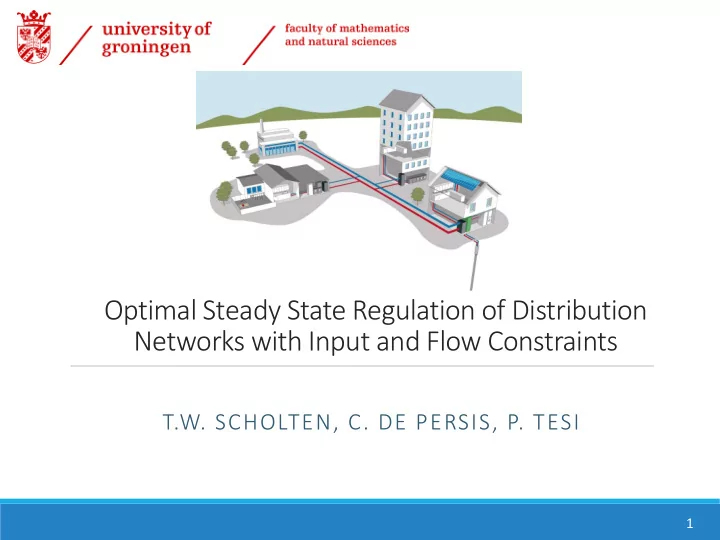
Optimal Steady State Regulation of Distribution Networks with Input and Flow Constraints
T.W. SCHOLTEN, C. DE PERSIS, P. TESI
1
Optimal Steady State Regulation of Distribution Networks with Input - - PowerPoint PPT Presentation
Optimal Steady State Regulation of Distribution Networks with Input and Flow Constraints T.W. SCHOLTEN, C. DE PERSIS, P. TESI 1 Outline Introduction Unsaturated Saturated Conclusion Control goal 2 Motivation Control goal 1 Conclusions
1
Introduction
Motivation Problem description Model
Unsaturated
Control goal 1 Controller design 1 Stability result
Saturated
Control goal 2 Controller design 2 Main result Case study
Conclusion
Conclusions Future work
2
3 INTRODUCTION UNSATURATED SATURATED CONCLUSION
4 INTRODUCTION UNSATURATED SATURATED CONCLUSION
5 INTRODUCTION UNSATURATED SATURATED CONCLUSION
6 INTRODUCTION UNSATURATED SATURATED CONCLUSION
7
Design distributed controllers and such that (flow on the edges) (input at the nodes) where
INTRODUCTION UNSATURATED SATURATED CONCLUSION
8
suitable gains. suitable gains. Flow on the edges Input on the nodes
INTRODUCTION UNSATURATED SATURATED CONCLUSION
Recall:
9 INTRODUCTION UNSATURATED SATURATED CONCLUSION
10
1. undirected graph G is connected 2. there exists a of s.t. If: then Problem 1 Solved
INTRODUCTION UNSATURATED SATURATED CONCLUSION
11
Motivation:
INTRODUCTION UNSATURATED SATURATED CONCLUSION
12
and (flow on the edges) (input at the nodes) Design distributed controllers such that given positive real (arbitrarily small) numbers with for all
INTRODUCTION UNSATURATED SATURATED CONCLUSION
13
suitable gains. suitable gains. Flow on the edges Input on the nodes
INTRODUCTION UNSATURATED SATURATED CONCLUSION
14
Steady state deviation from optimum
INTRODUCTION UNSATURATED SATURATED CONCLUSION
15
Then, the matching condition is satisfied if Let be the optimal steady state input and a
INTRODUCTION UNSATURATED SATURATED CONCLUSION
corresponding flowrate.
16
and
INTRODUCTION UNSATURATED SATURATED CONCLUSION
1. Matching condition is satisfied 2. There exists at least one pair
3. The directed graph G is strongly connected 4. The directed graph G is balanced If Then Problem 2 is solved Details skipped
17 INTRODUCTION UNSATURATED SATURATED CONCLUSION
Store (volume) Discharge (volume) Unsaturated flows Saturated flow Optimal input Transient behavior
18 INTRODUCTION UNSATURATED SATURATED CONCLUSION
19 INTRODUCTION UNSATURATED SATURATED CONCLUSION
INTRODUCTION MODEL CONTROL CONCLUSION 20