Optimal Learning Rate What is the optimal value opt of the learning - - PowerPoint PPT Presentation

optimal learning rate
SMART_READER_LITE
LIVE PREVIEW

Optimal Learning Rate What is the optimal value opt of the learning - - PowerPoint PPT Presentation

Optimal Learning Rate What is the optimal value opt of the learning rate? Consider 1 -dim. case. Use first-order Taylor expansion around current weight w c E ( w ) = E ( w c ) + ( w w c ) E ( w c ) . w Differentiating both sides


slide-1
SLIDE 1

Optimal Learning Rate

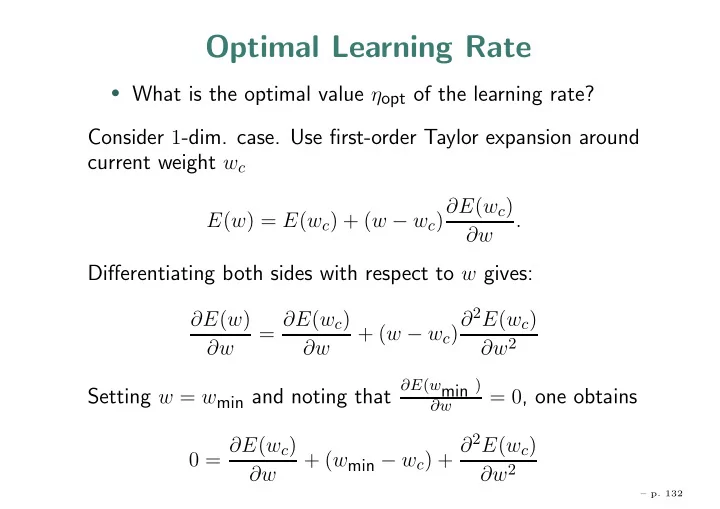
  • What is the optimal value ηopt of the learning rate?

Consider 1-dim. case. Use first-order Taylor expansion around current weight wc

E(w) = E(wc) + (w − wc)∂E(wc) ∂w .

Differentiating both sides with respect to w gives:

∂E(w) ∂w = ∂E(wc) ∂w + (w − wc)∂2E(wc) ∂w2

Setting w = wmin and noting that

∂E(wmin ) ∂w

= 0, one obtains 0 = ∂E(wc) ∂w + (wmin − wc) + ∂2E(wc) ∂w2

– p. 132

slide-2
SLIDE 2

Optimal Learning Rate (cont.)

wmin = wc − ∂2E(wc) ∂w2 −1

  • ηopt

∂E(wc) ∂w

w η < ηopt E(w) wmin w η = ηopt E(w) wmin

– p. 133

slide-3
SLIDE 3

Hopfield Network Introductory Example

  • Suppose we want to

store N binary images in some memory.

  • The memory should

be content-addressable and insensitive to small errors.

  • We present corrupted

images to the memory (e.g. our brain) and re- call the corresponding images.

presentation of corrupted images recalled by the memory

– p. 134

slide-4
SLIDE 4

Hopfield Network

S1 S2 S3 S4 S5 w51 = w15

  • wij denotes weight

connection from unit j to unit i

  • no unit has connection

with itself wii = 0, ∀i

  • connections are sym-

metric wij = wji, ∀i, j State of unit i can take values ±1 and is denoted as Si. State dynamics are governed by activity rule:

Si = sgn  

j

wijSj   , where sgn(a) =

  • +1

if a ≥ 0,

−1

if a < 0

– p. 135

slide-5
SLIDE 5

Learning Rule in a Hopfield Network

Learning in Hopfield networks:

  • Store a set of desired memories {x(n)} in the network,

where each memory is a binary pattern with

xi ∈ {−1, +1}.

  • The weights are set using the sum of outer products

wij = 1 N

  • n

x(n)

i

x(n)

j ,

where N denotes the number of units (N can also be some positive constant, e.g. number of patterns). Given a m × 1 column vector a and 1 × n row vector b. The outer product

a ⊗ b (short a b) is defined as the m × n matrix    a1 a2 a3    ⊗ [b1 b2 b3] =    a1b1 a1b2 a1b3 a2b1 a2b2 a2b3 a3b1 a3b2 a3b3    , m = n = 3

– p. 136

slide-6
SLIDE 6

Learning in Hopfield Network (Example)

Suppose we want to store patterns x(1) = [−1, +1, −1] and

x(2) = [+1, −1, +1].  

−1 +1 −1

  ⊗ [−1, +1, −1] =    +1 −1 +1 −1 +1 −1 +1 −1 +1   

+

 

+1 −1 +1

  ⊗ [+1, −1, +1] =    +1 −1 +1 −1 +1 −1 +1 −1 +1   

– p. 137

slide-7
SLIDE 7

Learning in Hopfield Network (Example) (cont.)

W = 1 3    −2 +2 −2 −2 +2 −2   

Recall: no unit has connection with itself. The storage of patterns in the network can also be interpreted as constructing stable states. The condition for patterns to be stable is: sgn

 

j

wijxi   = xi , ∀i.

Suppose we present pattern x(1) to the network and want to restore the corresponding pattern.

– p. 138

slide-8
SLIDE 8

Learning in Hopfield Network (Example) (cont.)

Let us assume that the network states are set as follows:

Si = xi, ∀i. We can restore pattern x(1) = [−1, +1, −1] as

follows:

S1 = sgn  

3

  • j=1

w1jSj   = −1 S2 = sgn  

3

  • j=1

w2jSj   = +1 S3 = sgn  

3

  • j=1

w3jSj   = −1

Can we also restore the original patterns by presenting “similar”patterns which are corrupted by noise?

– p. 139

slide-9
SLIDE 9

Updating States in a Hopfield Network

Synchronous updates:

  • all units update their states Si = sgn
  • j wijSj
  • simultaneously.

Asynchronous updates:

  • one unit at a time updates its state. The sequence of

selected units may be a fixed sequence or a random sequence. Synchronously updating states can lead to oscillation (no convergence to a stable state).

S1 = +1 S2 = −1

1 1

– p. 140

slide-10
SLIDE 10

Aim of a Hopfield Network

Our aim is that by presenting a corrupted pattern, and by ap- plying iteratively the state update rule the Hopfield network will settle down in a stable state which corresponds to the desired pattern. Hopfield network is a method for

  • pattern completion
  • error correction.

The state of a Hopfield network can be expressed in terms of the energy function

E = −1 2

  • i,j

wijSiSj

Hopfield observed that if a state is a local minimum in the energy function, it is also a stable state for the network.

– p. 141

slide-11
SLIDE 11

Basin of Attraction and Stable States

basin of attraction

  • stable states

Within the space the stored patterns x(n) are acting like attractors.

– p. 142

slide-12
SLIDE 12

Haykin’s Digit Example

Suppose we stored the following digits in the Hopfield network:

Energy = −67.73 Pattern 0 Energy = −67.87 Pattern 1 Energy = −82.33 Pattern 2 Energy = −86.6 Pattern 3 Energy = −77.73 Pattern 4 Energy = −90.47 Pattern 6 Energy = −83.13 Pattern 9 Energy = −66.93 Pattern box

– p. 143

slide-13
SLIDE 13

Updated States of Corrupted Digit 6

Energy = −10.27 Start Pattern Energy = −12.2 updated unit 40 Energy = −13.6 updated unit 39 Energy = −14.87 updated unit 81 Energy = −15.87 updated unit 98 Energy = −18.07 updated unit 80 Energy = −20.4 updated unit 12 Energy = −22.2 updated unit 114 Energy = −23.33 updated unit 115 Energy = −25.73 updated unit 49 Energy = −26.8 updated unit 117 Energy = −29.67 updated unit 3 Energy = −30.13 updated unit 48 Energy = −31.47 updated unit 6 Energy = −34.4 updated unit 79

– p. 144

slide-14
SLIDE 14

Updated States of Corrupted Digit 6 (cont.)

Energy = −36.73 updated unit 113 Energy = −38.4 updated unit 57 Energy = −41.07 updated unit 103 Energy = −42.4 updated unit 18 Energy = −45.27 updated unit 109 Energy = −47.6 updated unit 83 Energy = −50.4 updated unit 71 Energy = −52.67 updated unit 77 Energy = −56.47 updated unit 26 Energy = −58.4 updated unit 15 Energy = −60.67 updated unit 31 Energy = −63.33 updated unit 58 Energy = −64.47 updated unit 16 Energy = −68 updated unit 29 Energy = −71.27 updated unit 88

– p. 145

slide-15
SLIDE 15

Updated States of Corrupted Digit 6 (cont.)

The resulting pattern (stable state with energy −90.47) matches the desired pattern.

Energy = −73.73 updated unit 72 Energy = −77.27 updated unit 90 Energy = −81.47 updated unit 19 Energy = −84.27 updated unit 21 Energy = −87.33 updated unit 25 Energy = −90.47 updated unit 73 Energy = −90.47 Original Pattern 6

– p. 146

slide-16
SLIDE 16

Recall a Spurious Pattern

Energy = −28.27 Start Pattern Energy = −28.27 updated unit 44 Energy = −30.27 updated unit 12 Energy = −31.93 updated unit 64 Energy = −32.8 updated unit 45 Energy = −33.4 updated unit 98 Energy = −35.6 updated unit 111 Energy = −37.6 updated unit 50 Energy = −40 updated unit 81 Energy = −42.6 updated unit 95 Energy = −44.53 updated unit 65 Energy = −44.8 updated unit 15 Energy = −48.13 updated unit 54 Energy = −50.53 updated unit 62 Energy = −51.87 updated unit 33

– p. 147

slide-17
SLIDE 17

Recall a Spurious Pattern (cont.)

Energy = −53.73 updated unit 37 Energy = −56.53 updated unit 91 Energy = −59.93 updated unit 58 Energy = −61.6 updated unit 84 Energy = −63.2 updated unit 43 Energy = −63.73 updated unit 28 Energy = −66.8 updated unit 112 Energy = −67.6 updated unit 48 Energy = −69 updated unit 88 Energy = −70.4 updated unit 26 Energy = −71.93 updated unit 73 Energy = −74.13 updated unit 70 Energy = −76.6 updated unit 40 Energy = −80.27 updated unit 117 Energy = −81.4 updated unit 106

– p. 148

slide-18
SLIDE 18

Recall a Spurious Pattern (cont.)

The Hopfield network settled down in local minima with energy −84.93. This pattern however is not the desired

  • pattern. It is a pattern which was not stored in the network.

Energy = −84.8 updated unit 61 Energy = −84.93 updated unit 15 Energy = −83.13 Original Pattern 9

– p. 149

slide-19
SLIDE 19

Incorrect Recall of Corrupted Pattern 2

Energy = −22.07 Start Pattern Energy = −22.07 updated unit 97 Energy = −22.13 updated unit 17 Energy = −22.33 updated unit 58 Energy = −24.13 updated unit 45 Energy = −24.53 updated unit 18 Energy = −27.6 updated unit 100 Energy = −28.33 updated unit 7 Energy = −29.87 updated unit 103 Energy = −31.47 updated unit 81 Energy = −32.13 updated unit 68 Energy = −32.33 updated unit 86 Energy = −35.47 updated unit 119 Energy = −36.53 updated unit 33 Energy = −38.67 updated unit 87

– p. 150

slide-20
SLIDE 20

Incorrect Recall of Corrupted Pattern 2 (cont.)

Energy = −39.2 updated unit 57 Energy = −41.73 updated unit 73 Energy = −45.47 updated unit 120 Energy = −48 updated unit 104 Energy = −49.6 updated unit 43 Energy = −51.6 updated unit 91 Energy = −51.67 updated unit 37 Energy = −55.6 updated unit 3 Energy = −56.4 updated unit 31 Energy = −58.27 updated unit 24 Energy = −60.73 updated unit 101 Energy = −61.87 updated unit 41 Energy = −62.87 updated unit 117 Energy = −64.8 updated unit 65 Energy = −68.93 updated unit 10

– p. 151

slide-21
SLIDE 21

Incorrect Recall of Corrupted Pattern 2 (cont.)

Energy = −69.87 updated unit 8 Energy = −70.13 updated unit 76 Energy = −71.47 updated unit 32 Energy = −72.93 updated unit 106 Energy = −73.47 updated unit 75 Energy = −77.07 updated unit 114 Energy = −78.8 updated unit 67 Energy = −82.13 updated unit 112 Energy = −82.67 updated unit 47 Energy = −83.8 updated unit 85 Energy = −84.53 updated unit 96 Energy = −85.33 updated unit 48 Energy = −86.4 updated unit 28 Energy = −87.73 updated unit 38 Energy = −88.53 updated unit 27

– p. 152

slide-22
SLIDE 22

Incorrect Recall of Corrupted Pattern 2 (cont.)

Although we presented the corrupted pattern 2, the Hopfield network settled down in the stable state that corresponds to pattern 6.

Energy = −90.47 updated unit 86 Energy = −82.33 Original Pattern 2

– p. 153

slide-23
SLIDE 23

MacKay’s Example of an Overloaded Network

Six patterns are stored in the Hopfield network, however most

  • f them are not stable states.
Desired memories: ! ! ! ! ! ! ! ! ! !

Spurious states represent stable states that are different from the stored desired patterns.

– p. 154

slide-24
SLIDE 24

Spurious States and Capacity

  • Reversed states ((−1) · x(n)) have same energy as the
  • riginal patterns x(n).
  • Stable mixture states are not equal to any single pattern.

They corresponds to a linear combination of an odd number of patterns.

  • Spin glass states are local minima that are not correlated

with any finite number of the original patterns. Capacity: What is the relation between the number d of units and the maximum number Nmax of patterns one can store by allowing some small error. If Nmax =

d 4 log d then most of stored

patterns can be recalled perfectly.

– p. 155