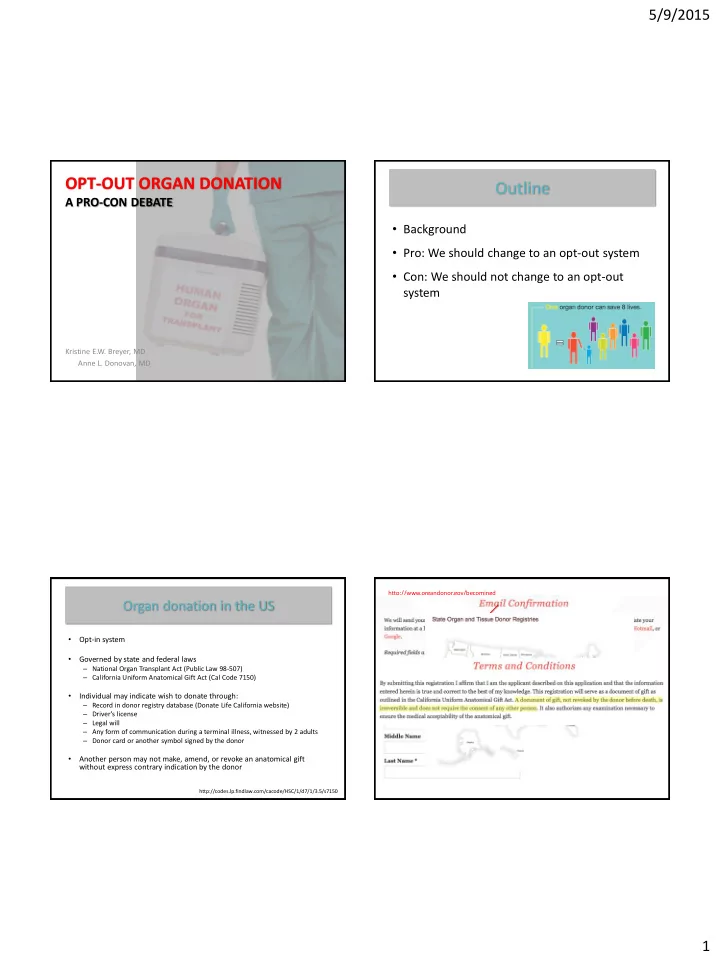
OPT-OUT ORGAN DONATION Outline A PRO-CON DEBATE Background Pro: - - PDF document

opt out organ donation outline
SMART_READER_LITE
LIVE PREVIEW

OPT-OUT ORGAN DONATION Outline A PRO-CON DEBATE Background Pro: - - PDF document

5/9/2015 OPT-OUT ORGAN DONATION Outline A PRO-CON DEBATE Background Pro: We should change to an opt-out system Con: We should not change to an opt-out system Kristine E.W. Breyer, MD Anne L. Donovan, MD


slide-1
SLIDE 1

5/9/2015 1

OPT-OUT ORGAN DONATION

A PRO-CON DEBATE

Kristine E.W. Breyer, MD Anne L. Donovan, MD

Outline

  • Background
  • Pro: We should change to an opt-out system
  • Con: We should not change to an opt-out

system

Organ donation in the US

  • Opt-in system
  • Governed by state and federal laws

– National Organ Transplant Act (Public Law 98-507) – California Uniform Anatomical Gift Act (Cal Code 7150)

  • Individual may indicate wish to donate through:

– Record in donor registry database (Donate Life California website) – Driver’s license – Legal will – Any form of communication during a terminal illness, witnessed by 2 adults – Donor card or another symbol signed by the donor

  • Another person may not make, amend, or revoke an anatomical gift

without express contrary indication by the donor

http://codes.lp.findlaw.com/cacode/HSC/1/d7/1/3.5/s7150

http://www.organdonor.gov/becomingd

  • nor/index.html
slide-2
SLIDE 2

5/9/2015 2

What is opt-out organ donation?

  • Consent for donation is assumed unless a person

explicitly opts out

  • Also called “presumed consent” or “deemed

consent”

  • Used in multiple countries in Europe and worldwide

PRO-CON DEBATE

OPT-OUT ORGAN DONATION:

PRO: WE SHOULD CHANGE TO AN OPT-OUT SYSTEM

Anne L. Donovan, MD Assistant Clinical Professor Department of Anesthesia and Critical Care Medicine University of California, San Francisco No Disclosures

slide-3
SLIDE 3

5/9/2015 3 United States transplant statistics

Organ Number on Wait List Median Waiting Time (days)* All 135,691 63 – 2030 Kidney 109,613 597 – 2030 Liver 15,829 76 – 1314 Pancreas 1,092 229 – 707 Kidney/Pancreas 2,080 263 – 758 Heart 4,138 63 – 423 Lung 1,648 429 – 966 Heart/Lung 38 386 – 2457 Intestine 253 149 – 286

*Wait time varies by blood type **As of 4/11/15 www.optn.transplant.hrsa.gov

Only 40% of eligible donors in the US donate

(Family refusal rate: 50%)

1 organ donor can save up to 8 lives

www.organdonor.gov Mossialos BMC Health Serv 2008

How to enlarge donor pool?

  • Living donors
  • Mandatory choice
  • Donation after cardiac death
  • Change the definition of death

– i.e. persistent vegetative state

  • Accept higher risk donors
  • Increase public awareness of “opting in”
  • Change to an opt-out system

www.organdonationrates.org

slide-4
SLIDE 4

5/9/2015 4

www.organdonationrates.org

Why change to opt-out?

  • Increases number of donors
  • Increases public willingness

to donate

slide-5
SLIDE 5

5/9/2015 5

Opt-In Consent (per M) Opt-Out Consent (per M) Deceased Donors 9.98 14.24 Living Donors 9.36 5.49 Total Kidneys transplanted 22.43 28.32 Total livers transplanted 7.53 11.60

www.organdonationrates.org

Opt-out Opt-in

2012 Donation After Brain Death Rankings

Opt-out systems increase willingness to donate

Willing to Donate Own Organs (%) Willing to Donate Family Member’s Organs (%) Informed Consent (Opt-in) 57% 44% Presumed Consent (Soft opt-out) 64% 51% Enforced Presumed Consent (Hard opt-out) 60% 51%

Mossialos BMC Health Serv 2008

Why might opt-out increase numbers?

  • Change in societal expectations and norms
  • NOT donating in an opt-out system may be looked

down upon

  • Taking decision-making away from grieving family

members

  • Changes to the system
  • Overcoming inertia of “opting in”
slide-6
SLIDE 6

5/9/2015 6

BMJ 2007

http://bma.org.uk/organdonation

BMA calls for opt-out system Types of opt-out systems

  • Enforced presumed consent (“hard opt-out”)

– Organ donation is automatic for those who have not

  • pted out if organs are in good condition
  • Unenforced presumed consent (“soft opt-out”)

– Input from families is allowed

  • In practice, most families are approached in opt-
  • ut systems

Mossialos BMC Health Serv Res 2008 http://bma.org.uk/organdonation

slide-7
SLIDE 7

5/9/2015 7

  • rgandonationwales.org

Wales implements opt-out system Is opt-out organ donation ethical?

  • Consent can be explicit or implicit
  • Patient and family retain rights
  • Continue to respect patient autonomy
  • Benefit of many over benefit of one

Saunders B J Med Ethics 2011

Summary

  • Organ shortage is a major public health

problem

  • Other methods to increase donor pool limited
  • Opt-out systems have higher donors per

capita

  • Implicit (presumed) consent is ethical
  • Opt-out organ transplant system may be a

good option for increasing organ availability

slide-8
SLIDE 8

5/9/2015 8

References

1. Beloucif S. Curr Op Anes. 2012. 25(2):198-202. 2. Coad L, et al. Transpl Res. 2013. 2:9. 3. Day M. BMJ. 2007. 335:114. 4. Matesanz R. Nefrologia. 2001. 21:S5. 5. Michielsen, P. J R Soc Med. 1996. 89:663. 6. Mossialos E, et al. BMC Health Serv Res. 2008. 8(48). 7. Nathan HM, et al. Am J Transpl. 2003. 3:29-40. 8. Rithalia A, et al. BMJ. 2009. 9. Rodriguez-Arias D, et al. The Lancet. 2010. 376:1109-12. 338:a3162.

  • 10. Saunders B. J Med Ethics. 2011. 37(6):362.
  • 11. Shepherd L, et al. BMC Medicine. 2014. 12:131.
  • 12. Smith R, et al. BMJ. 1999. 318:248.

CON: WE SHOULD NOT CHANGE TO AN OPT-OUT SYSTEM

Kristine E.W. Breyer, MD Assistant Clinical Professor Department of Anesthesia and Critical Care Medicine University of California, San Francisco No Disclosures

Outline: Keep ‘Opt-In’

  • Ethical and Legal Principles

– Precedents – Disparities

  • Data on Opt-out outcomes

Opt-out Violates Autonomy

  • Presumed Consent violates the ethical

principle of patient Autonomy

  • Operating under Presumption
slide-9
SLIDE 9

5/9/2015 9

Autonomy

  • “Personal rule of the self that is free from both

controlling interferences by others and from personal limitations that prevent meaningful choice”

  • Cornerstone of modern era medical ethics
  • Informed Consent
  • Patient-centered healthcare

http://missinglink.ucsf.edu/lm/ethics/Content%20Pages/fast_fact_auton_bene.htm/

Autonomy Precedent

Jehovah’s Witness:

  • Legal right to refuse life saving therapy based

upon religious or personal values

  • Requires informed consent
  • Precedent set in 1914 Schloendorff v. New

York Hospital

Autonomy Precedent

  • Human Research

– Nuremberg Code of Ethics – Department of Health & Human Services – Food and Drug Administration – Institutional review boards

Autonomy Precedent

  • Fetal Stem Cells

– Informed consent is required

  • Umbilical Cord Blood

– Informed consent is required

slide-10
SLIDE 10

5/9/2015 10

Disparities

  • Where are our current gaps?

Goldberg, Critical Care Med 2013

CONSENT RATES BY ETHNICITY

Disparities

  • Lack of universal access to healthcare
  • Organs procured from general population may

not benefit the general population

Disparities

COUNTY POVERTY LEVEL & RATE OF TRANSPLANTATION ANNUAL TRANSPLANTATION RATE

Mohan, Transplantation 2014

slide-11
SLIDE 11

5/9/2015 11

Disparities

Higgins, Am J Trans 2006

PREVALENCE OF ESRD BY ETHNICITY WAITLIST FOR TRANSPLANTATION BY ETHNICITY

Is Presumed Consent Worth it?

  • Organ shortage
  • Does presumed consent help to fulfill this

gap?

Chile

Family Refusal Rate Donation Rates

Dominguez, J. Transp Proceed 2013

Spain

1979: Legislation for Presumed Consent

– Donor rate ~ 14 per million population

slide-12
SLIDE 12

5/9/2015 12

1979: Legislation for Presumed Consent

– Donor rate ~ 14 per million population

1989:

– Donor rate ~ 14 per million population

  • RATE DONATION WAS UNCHANGED

Spain

Matesanz Transplantation 1996 http://donatelifecalifornia.org/education/faqs/presumed-consent//

Is the United States Ready for Presumed Consent?

Failed Legislation:

  • Pennsylvania
  • Maryland
  • Delaware
  • Texas
  • New York

California Donor Network

  • Official Position: against

http://voicesinbioethics.org/2014/09/09/should-the-united-states-sign-off-on-presumed-consent/

slide-13
SLIDE 13

5/9/2015 13

Opt-in!

  • Presumed consent violates Autonomy
  • Does not address disparities
  • Has not been supported in the United States
  • Does not work

THANK YOU