
SLIDE 1
8
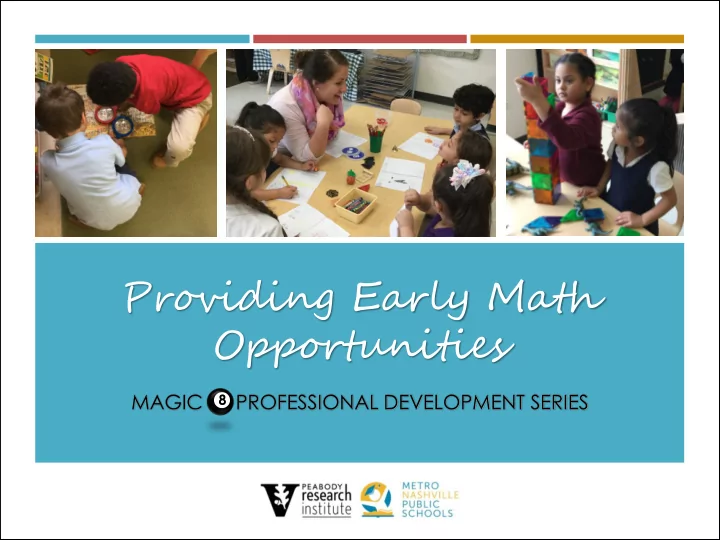
Opportunities MAGIC PROFESSIONAL DEVELOPMENT SERIES 8 THE - - PowerPoint PPT Presentation
Providing Early Math Opportunities MAGIC PROFESSIONAL DEVELOPMENT SERIES 8 THE MAGIC 8 CLASSROOM PRACTICES Reduce time spent in transition 1. Improving level of instruction 2. Creating a positive climate 3. Increasing teacher
8
Magic 8 Professional Development Series |
PROVIDING EARLY MATH OPPORTUNITIES
8 2
1.
Reduce time spent in transition
2.
Improving level of instruction
3.
Creating a positive climate
4.
Increasing teacher listening to children
5.
Planning sequential activities
6.
Promoting associative and cooperative interactions
7.
Fostering high levels of involvement
8.
Providing math opportunities 2017-18 MNPS Initiative: Focus on Literacy
3
Magic 8 Professional Development Series |
PROVIDING EARLY MATH OPPORTUNITES
8
In a landmark 2007 study, Duncan and colleagues found that early childhood math knowledge and skills predict BOTH later math and reading achievement, while literacy skills only predicted reading. Math skills are also related to children’s Executive Functioning skills (attention, working memory, inhibitory control) Children who participate in more math activities have stronger math gains.
This difference was even more pronounced for children who started pre-k with weaker math skills.
Math activities are “sequential” in nature – a series of steps; require children to plan
Math activities can also encourage associative and cooperative learning among children by requiring them to work together to accomplish a task BUT WAIT, THERE’S MORE!
Magic 8 Professional Development Series |
PROVIDING EARLY MATH OPPORTUNITIES
8 4
* Encourage children to work together:
Associative/Cooperative Interactions
32% 15%
When compared with other content areas, Math activities…
3.55 2.72 Involvement in Learning (1-5 scale)
* Are more engaging for children:
Sequential Learning Activities
* Promote more sequential thinking:
75% 23%
Why do we see so little math in Pre- K classrooms? DISCUSSION POINT: Yet, children were
Math activities an average of 7 minutes a day!
Math Activity Non-Math Activity
Magic 8 Professional Development Series |
PROVIDING EARLY MATH OPPORTUNITIES
8 5
The Pre-K classroom offers opportunities to take advantage of children’s natural curiosity to develop mathematical concepts and understanding. This involves…
children’s math thinking
Are there some math skills that you are more comfortable teaching than others? DISCUSSION POINT:
Magic 8 Professional Development Series |
PROVIDING EARLY MATH OPPORTUNITIES
8 6
Patterns & Algebraic Thinking Geometry & Spatial Sense
Shape & Space Transformations Visualization Sorting/Classifying Representing Data Describing Data
Data Analysis
Counting Quantity Comparison Order Numerals Operations
Number & Operations
What number is two numbers AFTER 3? What number comes right BEFORE 10?
Measurement Attributes Comparing & Ordering Behaviors & Processes
Measurement
7
Magic 8 Professional Development Series |
PROVIDING EARLY MATH OPPORTUNITES
8
Are there some materials that seem more engaging than others?
Divide into teams of 2-3 people each Visit a classroom
(not one of those represented on your team)
Gather 5 different math materials in 6 minutes
Calculate scores:
1 point for each math component area represented (number, geometry, measurement, etc.)
1 bonus point for each math material gathered from outside “toys and games” or “math” center
1 bonus point for unconventional math materials (e.g., art materials, books, dramatic)
Team with the highest total score wins!
Review the materials each team has gathered, and consider the following questions:
DIRECTIONS & SCORING:
How children typically use these materials in your classroom? Which math skills/components are promoted by these materials? How do you introduce/set up these materials in centers?
your own classroom
people each & visit a classroom
Magic 8 Professional Development Series |
PROVIDING EARLY MATH OPPORTUNITIES
8 8
Daily routines (calendar, lining up, tallying votes or attendance)
Spontaneous comments and conversations during center time
Meal-time conversations
Whole group lessons to model skills or introduce materials; asking children to share their work or strategies
Small group lessons to teach specific concepts
How do you currently incorporate math content throughout the day?
DISCUSSION POINT:
Let’s vote on what we should study
make a graph to see which topic wins… What kind of pattern can we make today when we line up? How many more forks do we need for the blue table?
Magic 8 Professional Development Series |
PROVIDING EARLY MATH OPPORTUNITIES
8 9
Playing with manipulatives and talking about math provide experiences and insights for both the teacher and the child.
For children, math manipulatives are objects that provide concrete opportunities for thinking
For teachers, math manipulatives are tools to help foster and clarify a children’s math understanding.
Magic 8 Professional Development Series |
PROVIDING EARLY MATH OPPORTUNITIES
8 10
Keep your eyes open and your ears on!
Provide math materials and encourage play in a “math-y” way
Call attention to quantity in everyday interactions
Talk with a child one-on-one to probe his/her thinking
Discover what the child doesn’t know
How do you know the quarters are heavier than the pennies? Do you have the same number of blocks as me?
11
Magic 8 Professional Development Series |
PROVIDING EARLY MATH OPPORTUNITES
8
How do the materials support this interaction?
How does the teacher build on the child’s math exploration?
How does the teacher support the child’s understanding?
What skills are being targeted here?
Are there aspects of this interaction that could be helpful for you to try? As you watch, consider…
MNPS pre-k teacher Jessica Farmer supports a child’s math exploration during free choice centers
Used with permission
12
Magic 8 Professional Development Series |
PROVIDING EARLY MATH OPPORTUNITES
8
What kinds of questions does she ask?
How does she respond to children’s contributions/attempts?
How does the teacher support the child’s understanding?
How can you incorporate math into literacy or other activities in your classroom?
Pre-k teacher Cathy Foote uses a story book (Goldilocks and the Three Bears) to introduce a lesson on measurement
Let’s Measure: In the Classroom | PBS KIDS Lab
As you watch, consider…
13
Magic 8 Professional Development Series |
PROVIDING EARLY MATH OPPORTUNITES
8
We are grateful to the following MNPS Pre-K Instructional Coaches and Multi-Classroom Leaders for their invaluable feedback in developing these materials:
SeTara DeThrow Carrie Head Susan McClain Stephanie Mullins Holly Stone Ashley Aldridge Wilson Rhiannon Wilson
https://my.vanderbilt.edu/mnpspartnership/