Boolean Functions and their Applications Loen, Norway, June 1722, - - PowerPoint PPT Presentation

boolean functions and their applications loen norway june
SMART_READER_LITE
LIVE PREVIEW

Boolean Functions and their Applications Loen, Norway, June 1722, - - PowerPoint PPT Presentation

Boolean Functions and their Applications Loen, Norway, June 1722, 2018 Journey into differential and graph theoretical properties of (generalized) Boolean function Pante St anic a ( includes joint work with T. Martinsen, W. Meidl, A.


slide-1
SLIDE 1

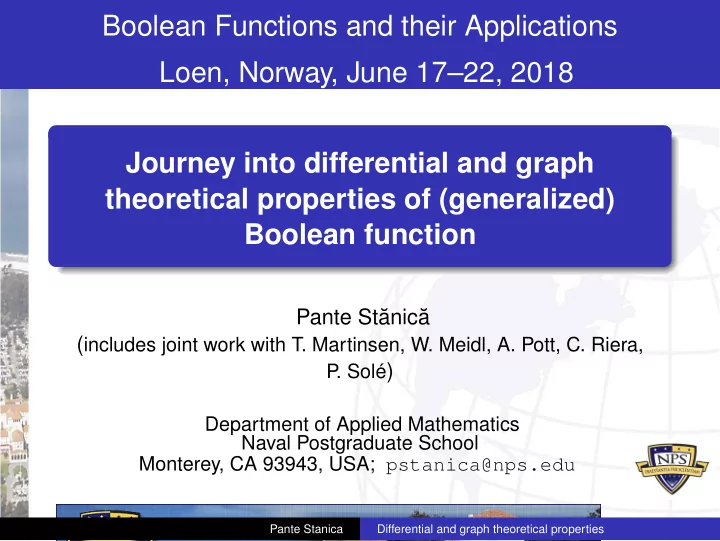
Boolean Functions and their Applications Loen, Norway, June 17–22, 2018 Journey into differential and graph theoretical properties of (generalized) Boolean function

Pante St˘ anic˘ a (includes joint work with T. Martinsen, W. Meidl, A. Pott, C. Riera,

P . Solé) Department of Applied Mathematics Naval Postgraduate School Monterey, CA 93943, USA; pstanica@nps.edu

Pante Stanica Differential and graph theoretical properties

slide-2
SLIDE 2

The objects of the investigation: (Generalized) Boolean functions I

Boolean function f : Fn

2 → F2

Generalized Boolean function f : Fn

2 → Zq (q ≥ 2);

its set GBq

n; when q = 2, Bn;

(Generalized) Walsh-Hadamard transform: H(q)

f

(u) =

  • x∈Fn

2

ζf(x)

q

(−1)u·x, ζq = e

2πi q ; (use Wf, if q = 2)

Fourier transform: Ff(u) =

  • x∈Fn

2

f(x)(−1)u·x Let 2k−1 < q ≤ 2k. Then GBq

n ∋ f ←

→ {ai}0≤i≤k−1 ⊂ Bn: f(x) = a0(x) + 2a1(x) + · · · + 2k−1ak−1(x), ∀x ∈ Fn

2.

Pante Stanica Differential and graph theoretical properties

slide-3
SLIDE 3

Characterizing generalized bent f : Fn

2 → Z2k

f : GBq

n is generalized bent (gbent) if |Hf(u)| = 2n/2, ∀u.

Theorem (Various Authors 2015–’17) Let f(x) = a0(x) + 2a1(x) + · · · + 2k−2ak−2(x) + 2k−1ak−1(x) be a function in GB2k

n , k > 1, ai ∈ Bn, 0 ≤ i ≤ k − 1, and

˜ f ∈ ak−1 ⊕ a0, a1, . . . ak−2. Then f is gbent iff ˜ f is bent (n even), respectively, semibent (n odd), with an (explicit) extra condition on the Walsh-Hadamard coeff.

Pante Stanica Differential and graph theoretical properties

slide-4
SLIDE 4

Differential properties of generalized Boolean functions I

u ∈ Fn

2 is a linear structure of f ∈ GBq n if the derivative

Duf(x) := f(x ⊕ u) − f(x) = c ∈ Zq constant, for all x ∈ Fn

2.

Let Sf = {x ∈ Fn

2 | Hf(x) = 0} = ∅ (gen.WH support)

Theorem (Martinsen–Meidl–Pott–S., 2018) Let f ∈ GB2k

n , with f(x) = k−1 i=0 2iai(x), ai ∈ Bn. The following

are equivalent:

(i) a is a linear structure for f. (ii) a is a linear structure for ai, s.t. ai(a) = ai(0), 0 ≤ i < k − 1. (iii) a satisfies ζf(a)−f(0) = (−1)a·w, for all w ∈ Sf.

Pante Stanica Differential and graph theoretical properties

slide-5
SLIDE 5

Differential properties of generalized Boolean functions II

We say that f ∈ GB2k

n satisfies the (generalized)

propagation criterion of order ℓ (1 ≤ ℓ ≤ n), gPC(ℓ), iff the autocorrelation Cf(v) =

x∈Vn ζf(x)−f(x⊕v) = 0, for all

vectors v ∈ Fn

2 of weight 0 < wt(v) ≤ ℓ.

f is gbent ⇐ ⇒ gPC(n). Theorem (Martinsen–Meidl–Pott–S., 2018) Let f ∈ GB2k

n , and A(w) j

= (Dwf)−1(j) = {x|f(x ⊕ w) − f(x) = j}. Then f is gPC(ℓ) if and only if, for 1 ≤ wt(w) ≤ ℓ, |A(0)

0 | = 2n, |A(0) j

| = 0, |A(w)

j

| = |A(w)

j+2k−1|, ∀ 0 ≤ j ≤ 2k−1 − 1.

Pante Stanica Differential and graph theoretical properties

slide-6
SLIDE 6

Can one "visualize” some cryptographic properties of a Boolean function?

Cayley graph of f : Fn

2 → F2, Gf = (Fn 2, Ef),

Ef = {(w, u) ∈ Fn

2 × Fn 2 : f(w ⊕ u) = 1}.

Adjacency matrix Af = {ai,j}, ai,j := f(i ⊕ j) (where i is the binary representation as an n-bit vector of the index i); Spectrum of Gf is the set of eigenvalues of Af (Gf). Cayley graph Gf has eigenvalues λi = Wf(i), ∀i.

Pante Stanica Differential and graph theoretical properties

slide-7
SLIDE 7

Cayley graph example: f(x1, x2, x3) = x1x2 ⊕ x1x3 ⊕ x3

Pante Stanica Differential and graph theoretical properties

slide-8
SLIDE 8

Strongly regular graphs

A graph is regular of degree r (or r-regular) if every vertex has degree r; The Cayley graph of a Boolean function is always a regular graph of degree wt(f). We say that an r-regular graph G with v vertices is a strongly regular graph (SRG) with parameters (v, r, e, d) if ∃ integers e, d ≥ 0 s.t. for all vertices u, v:

the number of vertices adjacent to both u, v is e if u, v are adjacent, the number of vertices adjacent to both u, v is d if u, v are nonadjacent.

We assume throughout that Gf is connected (in fact, one can show that all connected components of Gf are isomorphic).

Pante Stanica Differential and graph theoretical properties

slide-9
SLIDE 9

Bernasconi-Codenotti correspondence

Shrikhande & Bhagwandas ’65: A connected r-regular graph is strongly regular iff ∃ exactly three distinct eigenvalues λ0 = r, λ1, λ2 (also, e = r + λ1λ2 + λ1 + λ2, d = r + λ1λ2). The parameters satisfy r(r − e − 1) = d(v − r − 1). The adjacency matrix A satisfies (J is the all 1 matrix) A2 = (d − e)A + (r − e)I + eJ. Bernasconi-Codenotti correspondence: Bent functions exactly correspond to strongly regular graphs with e = d.

Pante Stanica Differential and graph theoretical properties

slide-10
SLIDE 10

P .J. Cameron: “Strongly regular graphs lie on the cusp between highly structured and unstructured. For example, there is a unique srg with parameters (36, 10, 4, 2), but there are 32548 non-isomorphic srg with parameters (36, 15, 6, 6). In light of this, it will be difficult to develop a theory of random strongly regular graphs!”

Pante Stanica Differential and graph theoretical properties

slide-11
SLIDE 11

Plateaued functions and their Cayley graphs

f ∈ GB2k

n is called s-plateaued if |Hf(u)| ∈ {0, 2(n+s)/2} for

all u ∈ Fn

2.

For k = 1: s = 0 (n even), f is bent; if s = 1 (n odd), or s = 2 (n even), we call f semibent. Advantages: they can be balanced and highly nonlinear with no linear structures. In general, the spectrum of the Cayley graph of an s-plateaued f : Fn

2 → F2 will be 4-valued (so, not srg!): if

the WH transform of f takes values in {0, ±2

n+s 2 }, then the

Fourier transform of f takes values in {wt(f), 0, ±2

n+s 2 −1}; Pante Stanica Differential and graph theoretical properties

slide-12
SLIDE 12

Cayley graphs of plateaued Boolean functions: example

Cayley graph of the semibent f(x) = x1x2⊕x3x4⊕x1x4x5⊕x2x3x5⊕x3x4x5

1 2 3 4 5 6 7 8 9 10 11 12 13 14 15 16 17 18 19 20 21 22 23 24 25 26 27 28 29 30 31 32

Pante Stanica Differential and graph theoretical properties

slide-13
SLIDE 13

Cayley graphs of plateaued Boolean functions with wt(f) = 2(n+s−2)/2

There is one case when we do obtain an srg: Theorem (Riera–Solé–S. 2018) If f : Fn

2 → F2 is s-plateaued and wt(f) = 2(n+s−2)/2, then Gf (if

connected) is the complete bipartite graph between supp(f) and supp(f) (if disconnected, it is a union of complete bipartite graphs). Moreover, Gf is strongly regular with (e, d) =

  • 0, 2(n+s−2)/2

.

Pante Stanica Differential and graph theoretical properties

slide-14
SLIDE 14

Strongly walk-regular graphs

van Dam and Omidi: G is strongly ℓ-walk-regular of parameters (σℓ, µℓ, νℓ) if there are σℓ, µℓ, νℓ walks of length ℓ between every two adjacent, every two non-adjacent, and every two identical vertices, respectively. Every strongly regular graph of parameters (v, r, e, d) is a strongly 2-walk-regular graph with parameters (e, d, r).

Pante Stanica Differential and graph theoretical properties

slide-15
SLIDE 15

Cayley graphs of plateaued Boolean functions with wt(f) = 2(n+s−2)/2

Theorem (Riera–Solé–S. 2018) Let f : Fn

2 → F2 be a Boolean function, and assume that Gf is

connected and r := wt(f) = 2(n+s−2)/2. Then, f is s-plateaued (with 4-valued spectra) if and only if Gf is strongly 3-walk-regular of parameters (σ, µ = ν) = (2−nr 3 + 2n+s−2 − 2s−2r, 2−nr 3 − 2s−2r).

1 In fact, we showed that it is ℓ-walk regular for all odd ℓ, and

found the parameters explicitly.

Go2OpenQues Pante Stanica Differential and graph theoretical properties

slide-16
SLIDE 16

Generalized Boolean and their Cayley graphs I

For f ∈ GBq

n, (gen.) Cayley graph Gf: Vn vertices; (u, v)

edge of (multiplicative) weight ζf(u⊕v) (additively f(u ⊕ v)).

1 1 1

  • 1

1 1 1

  • 1

ⅈ ⅈ ⅈ

ⅈ 1

  • 1

1 1 1

  • 1

1 ⅈ ⅈ

1 1 1

  • 1

1 1 ⅈ

ⅈ ⅈ

1

  • 1

1 1 1

ⅈ ⅈ ⅈ ⅈ

1 1 1

  • 1

ⅈ ⅈ ⅈ ⅈ

1

  • 1

1

ⅈ ⅈ

ⅈ 1 1

ⅈ ⅈ 1 ⅈ

ⅈ ⅈ ⅈ 1 1 1

  • 1

1 1 1

  • 1

1

  • 1

1 1 1

  • 1

1 1 1 1

  • 1

1 1 1

  • 1

1 1 1 1 1 1

  • 1

1

  • 1

1 1 1 1 1 2 3 4 5 6 7 8 9 10 11 12 13 14 15 16

Pante Stanica Differential and graph theoretical properties

slide-17
SLIDE 17

Strong regularity for weighted graphs

Let X, Y ⊆ Z2k. A weighted regular G = (V, E, w), V ⊆ Vn, w : E → Z2k is a (gen.) (X; Y)-strongly regular of parameters (eX,Y, dX,Y) iff # vertices c adjacent to both a, b, with w(a, c), w(b, c) ∈ Y, is exactly eX,Y, if w(a, b) ∈ X, resp., dX,Y, if w(a, b) ∈ ¯ X. One can weaken the condition and define a (X1, X2; Y)-srg notion, where X1 ∩ X2 = ∅, not necessarily a bisection; or even allowing a multi-section, and all of these variations can be fresh areas of research for graph theory experts. Note that this is a natural extension of the classical definition: for q = 2, and X = {1}, the classical strongly regular graph is then equivalent to an (X; X)-strongly regular graph.

Pante Stanica Differential and graph theoretical properties

slide-18
SLIDE 18

Bernasconi-Codenotti strong regularity for gbents

Theorem (Riera–S.–Gangopadhyay 2018) Let f ∈ GB4

n, n even. Then f is gbent iff Gf is (X; ¯

X)-strongly regular with eX = dX, for both X = {0, 1}, and X = {0, 3}. Theorem (Riera–S.–Gangopadhyay 2018) If f = a0 + 2a1 + · · · + 2k−1ak−1, k ≥ 2, ai ∈ Bn, is gbent (n even) then the associated weighted Cayley graph is (X 0

c ; X 1 c )-strongly regular with explicit X 0 c , X 1 c .

Pante Stanica Differential and graph theoretical properties

slide-19
SLIDE 19

Food for thought

How do the Cayley graphs for generalized semibent/plateaued look like? Can one investigate other cryptographic properties of Boolean functions in terms of their Cayley graphs? Investigate the “APN property” for functions : Fn

2 → Z2n;

Construct functions with small differential spectra; Look at other functions, like rotation symmetric in the generalized context and their differential properties; Define the nonlinearity in that environment; Define some of these properties (depending upon the Walsh-Hadamard transform with respect to other characters, and/or combine multiple characters.

Pante Stanica Differential and graph theoretical properties

slide-20
SLIDE 20

Theorem (Pante Stanica: http://faculty/nps.edu/pstanica)

Thank you for your attention!

Proof. None required, but questions are welcome!

Pante Stanica Differential and graph theoretical properties