Opportunities for participation in balancing Share thoughts with/ - - PDF document

opportunities for participation in balancing
SMART_READER_LITE
LIVE PREVIEW

Opportunities for participation in balancing Share thoughts with/ - - PDF document

Opportunities for participation in balancing Share thoughts with/ seek feedback from MAC members on possible opportunities for greater participation in balancing Consider options around decommitment of Verve coal units and alternatives


slide-1
SLIDE 1

Opportunities for participation in balancing

  • Share thoughts with/ seek feedback from MAC members on

possible opportunities for greater participation in balancing

  • Consider options around decommitment of Verve coal units and

alternatives to OCGT (oil or gas) – Higher value opportunities or exposures – More generic approach is problematic under current market design

  • Assumption that pricing and cost allocation distortions are

addressed to the extent practical under current design (i.e. cost reflectivity principle)

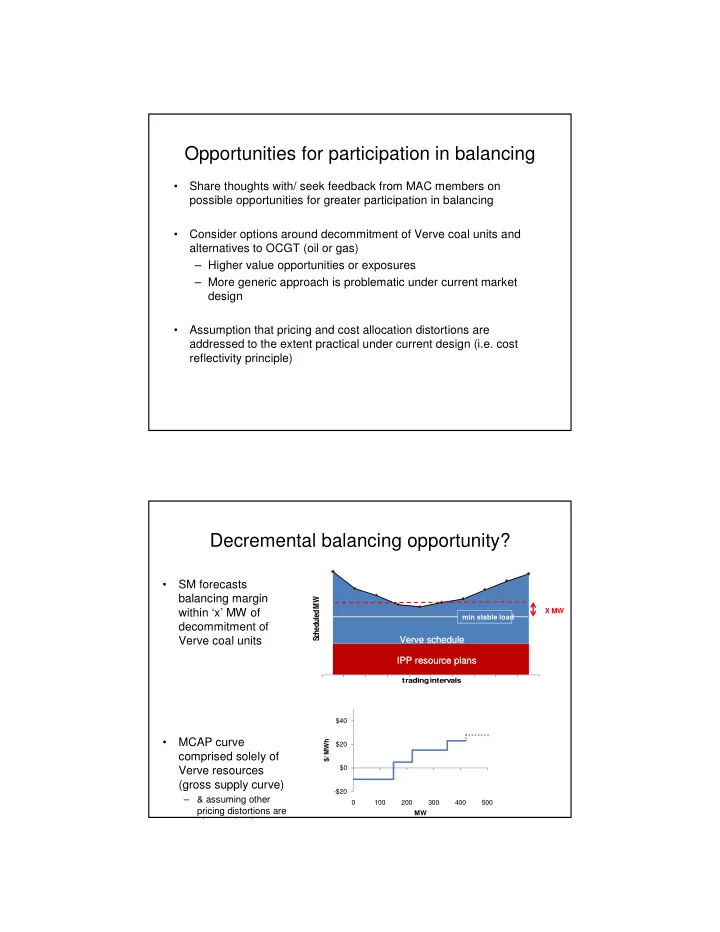
Decremental balancing opportunity?

  • SM forecasts

balancing margin within ‘x’ MW of decommitment of Verve coal units

  • MCAP curve

comprised solely of Verve resources (gross supply curve)

– & assuming other pricing distortions are also resolved to extent

‘x’ MW Scheduled MW trading intervals

Verve schedule Verve schedule IPP resource plans IPP resource plans

min stable load X MW

  • $20

$0 $20 $40 100 200 300 400 500 $/ MWh MW

slide-2
SLIDE 2

Decremental balancing opportunity?

  • SM advises market of decremental balancing opportunity/ calls for

DecBSC offers from participants

  • Indicates total quantity, timing and expected MCAP if decommitment
  • ccurs
  • Participants submit DecBSC offers

1. Turn Down Tranche (TDT):

  • Single P-Q tranche per facility (simplifies assessments/ dispatch)
  • ‘Option’ which SM can request at short notice

2. Decommitment tranche DT:

  • P-Q, min/max times, lead time etc
  • Assessment more complex (need to determine how to evaluate)
  • If submitting DT, must submit TDT (even if zero if already at

minimum)

Decremental balancing opportunity?

  • SM notifies participants their DecBSC options(s) have been

accepted

  • SM maintains operational communication with participants about

prospects for their option(s) to be called

  • SM advises market it has accepted options
  • If required, SM would dispatch TDs first (i.e. before TDTs)
  • If SM calls (dispatches) DecBSCs:

1. TDT:

  • Eligible to set balancing price: MCAP = min(dispatched incBSC
  • ptions, Verve dispatched balancing quantity)

2. DT:

  • Establishing MCAP tricky given lead times, multi period decisions
  • Will require careful analysis of approach
slide-3
SLIDE 3

Incremental balancing opportunity?

  • SM forecasts balancing margin

within ‘x’ MW of dispatching Verve OCGTs (gas or liquid) for energy

– Does not require that all slow start units be committed (e.g. because

  • f min run times)
  • SM announces incremental balancing support opportunity

– Forecast times/ MCAP if OCGTs called – Call for IPPs to provide incremental BSC (IncBSC) offers

S cheduled MW trading intervals

Verve schedule Verve schedule IPP resource plans IPP resource plans OCGTs OCGTs

Incremental balancing opportunity?

  • IPPs make IncBSC offers
  • 1 P-Q tranche per facility (simple assessment of offers)
  • Dispatchable on SM request (no lead time if called)
  • If SM calls (dispatches) IncBSCs:
  • Eligible to set balancing price (balancing price will be no less

than highest price incBSC option dispatched

  • Insert called IncBSCs into MCAP curve, adjust relevant

quantity

slide-4
SLIDE 4

Why not a more generic approach?

  • Generic participation (under current balancing arrangement) will

threaten market efficiency:

– e.g. IPP renominations (of resource plans ) potentially invalidates gross commitment and dispatch of Verve as balancer