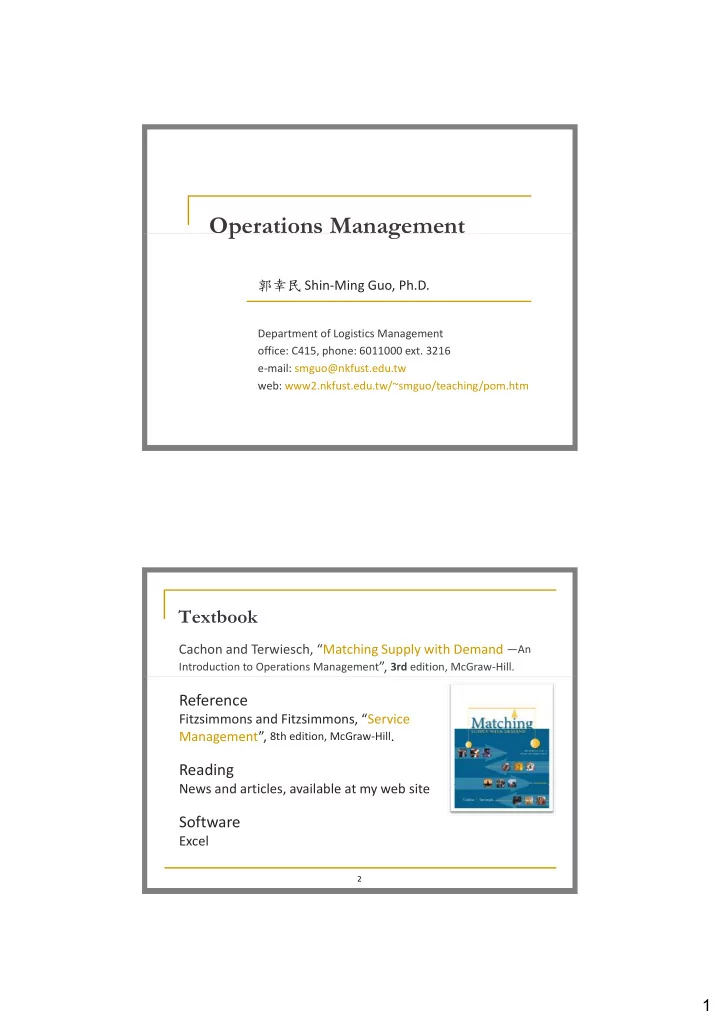
Operations Management p g Shin Ming Guo, Ph.D. Department of - - PDF document

operations management p g
SMART_READER_LITE
LIVE PREVIEW

Operations Management p g Shin Ming Guo, Ph.D. Department of - - PDF document

Operations Management p g Shin Ming Guo, Ph.D. Department of Logistics Management office: C415, phone: 6011000 ext. 3216 e mail: smguo@nkfust.edu.tw web: www2.nkfust.edu.tw/~smguo/teaching/pom.htm Textbook Cachon and Terwiesch,


slide-1
SLIDE 1

1

Operations Management p g

Department of Logistics Management

郭幸民 Shin‐Ming Guo, Ph.D.

  • ffice: C415, phone: 6011000 ext. 3216

e‐mail: smguo@nkfust.edu.tw web: www2.nkfust.edu.tw/~smguo/teaching/pom.htm

Textbook

Cachon and Terwiesch, “Matching Supply with Demand —An

Introduction to Operations Management”, 3rd edition, McGraw‐Hill.

Reference

Fitzsimmons and Fitzsimmons, “Service Management”, 8th edition, McGraw‐Hill.

Reading

N d ti l il bl t b it News and articles, available at my web site

Software

Excel

2

slide-2
SLIDE 2

2

Course Outline I

1 Introduction 2 The Process View of the Organization 3 Evaluating Process Capacity Service Blueprinting and Service Encounter 4 Estimating and Reducing Labor Costs g g 5 The Link between Operations and Finance

3

Course Outline II

7 Variability and Waiting Times 8 The Impact of Variability on Throughput Losses Waiting Line Management 12 Forecasting and Betting on Uncertain Demand 14 Inventory Management: Service Levels y g 16 Revenue Management

4

slide-3
SLIDE 3

3

Grading

Homework 40% Report 20% Final Exam 30% Participation 10%

No Plagiarism, No Cheating

5

Sample Topics for Team Report

Loan Processing at Capital One — Wharton School g p Great Italian Cuisine without the Wait — HBS Taco Bell Corp. — HBR British Columbia NICU Bed Allocation — University of Western

Ontario

Which Products Should You Stock?

HBR

Which Products Should You Stock? — HBR The Morrison Company: redesigning the manufacturing process — HBR

6

slide-4
SLIDE 4

4

Chapter 1 Introduction p

 What is Operations Management?  Matching Supply with Demand  Matching Supply with Demand  What Can Operations Management Do?

What is an Operation System?

Transformation = Production = Service

Physical: manufacturing Location: transportation Exchange: retailing Storage: warehousing Physiological: health care Informational: telecommunications

8

slide-5
SLIDE 5

5

What is Service?

Tangible or intangible? Tangible or intangible? Customer involvement? Standardization or customization? Human or machine processing? Inventory and leftover?

9

Differences between Manufacturing & Service

Characteristic Manufacturing Service

Product Tangible Tangible & Intangible Product Tangible Tangible & Intangible Customer involvement Low High Uniformity of input High Low Labor content Low High Uniformity of output High Low Performance Measurement Easy Difficult Performance Measurement Easy Difficult Quality Control High Low Inventory Much Little or Perishable

10

slide-6
SLIDE 6

6

Focus: Matching Supply with Demand

 Demand can vary and is unpredictable.  Supply is inflexible and maybe costly.  Demand < Supply  Impossible to stock

service

 Demand > Supply  Customers may not want

11

 Demand > Supply  Customers may not want

to wait

What About a Shortage of Vaccine?

Nintendo於2006年推出大受歡迎的Wii遊戲機,民 眾排隊搶購後立刻轉售以賺取數百美元差價

12

slide-7
SLIDE 7

7

Who Cares About Inventory?

Acer在2011年出現有史以來第一次虧損,出清 過剩PC庫存導致一億五千萬美元的虧損。

13

Economic Consequences of Mismatch

Air travel Emergency Room Retailing Supply

Seats on specific fli h Medical service Consumer l i flight electronics

Demand

Travel for specific time & destination Urgent need for medical service Kids buying video games

Supply Exceeds Demand

Empty seat Doctors, nurses, and infrastructure are under‐utilized High inventory costs

Demand Exceeds Supply

Overbooking; Profit loss Crowding and delays in the ER, Deaths Foregone profit; Consumer dissatisfaction

14

slide-8
SLIDE 8

8

How to Run a Successful Business?

 Low Cost?  Low Cost?  Fast Delivery?  Quality Service?  Better Selection?

15

Four Dimensions of Performance Tradeoffs

Cost

▪ Efficiency

Quality

▪ Product quality

(h d?)

▪ Measured by:

‐ cost per unit ‐ utilization

Time

(how good?)

▪ Process quality

(as good as promised?)

Variety Time

▪ Responsiveness to demand ▪ Measured by:

‐ customer lead time ‐ flow time

Variety

▪ Customer heterogeneity ▪ Measured by:

‐ number of options ‐ flexibility / set‐ups

16

slide-9
SLIDE 9

9

1st Use: Overcome Inefficiencies

Responsiveness High Eliminate inefficiencies Current frontier In the industry

Competitor A Competitor C

Low Labor Productivity Low High

Competitor B

17

旅客登機時間會影響旅客

It’s Details that Count

對服務品質的認知、航空 公司準點表現與營運成本 Speed and Convenience for Passengers!

18

slide-10
SLIDE 10

10

2nd Use: Help Making Trade-Offs

Responsiveness High Trade‐off Very short waiting times Frequent operator idle time Long waiting times, yet operators are Labor Productivity Low Low High almost fully utilized

19

Call center of Deutsche Bundesbahn

Goal: 80% of incoming calls wait less than 20 seconds Starting point: 30% of incoming calls wait less than 20 secs Starting point: 30% of incoming calls wait less than 20 secs. Problem: Must decide staffing levels of call centers and understand impact on efficiency Solution: Provides tools to support strategic trade‐offs

20

slide-11
SLIDE 11

11

3rd Use: Evaluate Proposed Redesigns/New Technologies

Responsiveness High Redesign process Current frontier h d New frontier Low In the industry Labor Productivity Low High

21 22

slide-12
SLIDE 12

12

Operation is the Heart of the Business

 Operations account for 60 to 80% of the

direct expenses that burden a firm’s profit. p p

 Operations directly affect customers and

are essential to the competitiveness

  • f the firm.

 Managers need to perform and

make decisions in all functions.

23