Oocyte Cryopreservation Center for Reproductive Health Evelyn - - PowerPoint PPT Presentation

oocyte cryopreservation
SMART_READER_LITE
LIVE PREVIEW

Oocyte Cryopreservation Center for Reproductive Health Evelyn - - PowerPoint PPT Presentation

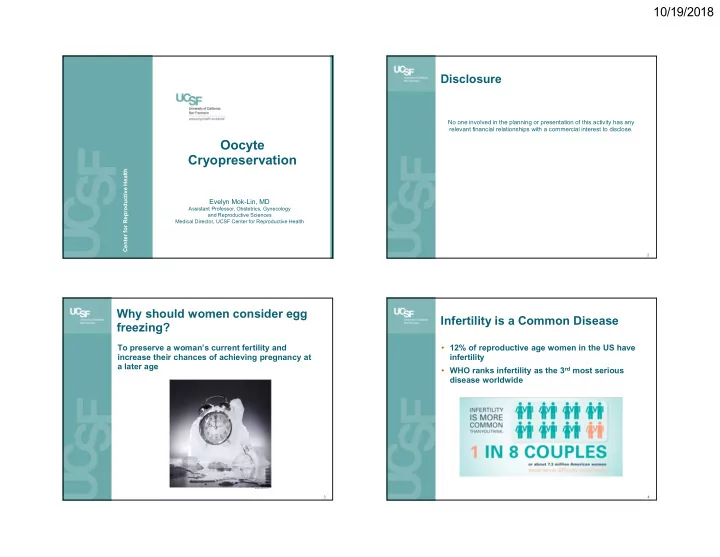
10/19/2018 Disclosure No one involved in the planning or presentation of this activity has any relevant financial relationships with a commercial interest to disclose. Oocyte Cryopreservation Center for Reproductive Health Evelyn Mok-Lin, MD


slide-1
SLIDE 1

10/19/2018 1

Oocyte Cryopreservation

Center for Reproductive Health

Evelyn Mok-Lin, MD

Assistant Professor, Obstetrics, Gynecology and Reproductive Sciences Medical Director, UCSF Center for Reproductive Health

2

Disclosure

No one involved in the planning or presentation of this activity has any relevant financial relationships with a commercial interest to disclose.

3

Why should women consider egg freezing?

To preserve a woman’s current fertility and increase their chances of achieving pregnancy at a later age

www.elle.com

Infertility is a Common Disease

  • 12% of reproductive age women in the US have

infertility

  • WHO ranks infertility as the 3rd most serious

disease worldwide

4

slide-2
SLIDE 2

10/19/2018 2

5

Age is the #1 Predictor of Fertility

  • Women are less likely to conceive and more

likely to miscarry as they get older

Heffner, NEJM 2004 6

Decreasing Egg Quantity with Age

Wallace and Kelsey, PLoS 2010

  • Finite number of follicles at birth
  • 12% remaining at age 30
  • 3% remaining at age 40

Abnormal Spindles in Older Eggs

20-25 year old eggs

– 17% of eggs with abnormal spindle assembly

40-45 year old eggs

– 83% of eggs with abnormal spindle assembly

7 Battaglia et al, Human Reproduction 1996

Increasing Rates of Chromosomal Abnormalities with Age

8

slide-3
SLIDE 3

10/19/2018 3

Medical indications for egg freezing

1. Need for medical or surgical treatments that reduce ovarian reserve and/or affect egg quality

  • Chemotherapy
  • Pelvic radiation
  • USO/BSO
  • *Testosterone for gender dysphoria

2. Risk for early menopause

  • Family history of POI and/or personal history of

diminished ovarian reserve (DOR)

– If not otherwise ready to conceive – DOR does not equal poor egg quality or future infertility

3. Genetic mutation carrier

  • BRCA, FMR

9

Elective indications for egg freezing

20,000 women in the U.S. underwent elective egg cryo by 2018 1. Women who wish to delay childbearing due to personal or professional circumstances

10

Elective indications for egg freezing

2. Women/couples who want to have more than 1 child

11

Optimal timing for elective egg freezing

  • What is the ideal age?
  • Is there a minimum or maximum age?

Franasiak et al. Fertility and Sterility 2014

slide-4
SLIDE 4

10/19/2018 4

Optimal timing for elective egg freezing

  • Decision-tree model for egg freezing vs no action

– ages 25-40 yrs – attempt at procreation 3, 5 or 7 years after – unassisted attempts for 6 months and then IVF

13

Mesen et al. Fertility and Sterility 2015

Mesen et al. 2015

  • Live birth rate (LBR) highest when egg freezing performed

at <34 yrs (>70%)

– Steadily declines with increasing age to 26.2% at age 40 yrs

  • Greatest improvement in LBR at age 37 yrs

– 30% difference in chance of live birth with egg freezing compared to no action (51.6% vs 21.9%) – Little benefit at ages 25-30 yrs (2.6-7.1% increase)

  • Egg freezing was most cost-effective at age 37 yrs

https://uncfertility.com/treatment-options/egg-calculator/

14 15

Embryo versus Egg Freezing

  • Embryo cryopreservation

– Well-established

  • Most data
  • Highest success rates
  • Allows for assessment of embryo quality and

preimplantation genetic testing (PGT)

– Limitations:

  • More expensive
  • Requires male partner or donor sperm
  • Potential legal and ethical issues re: use / disposition

16

Embryo versus Egg Freezing

  • Oocyte cryopreservation

– More practical

  • Offers flexibility for use with sperm of choice
  • Lower cost and logistically easier

– Limitations:

  • Less long-term data

– Short-term data with no increased risk of chromosomal

  • r congenital anomalies
  • Lower success rates

– Lab-dependent cryopreservation skills/techniques – No data on egg quality so difficult to estimate subsequent success rates

slide-5
SLIDE 5

10/19/2018 5

17

Egg freezing process and timeline

Fertility Preservation Program

1 3 5 7 9

FSH+LH

hCG trigger Egg Retrieval

11 13 Days

  • The procedure is typically completed within 2

weeks

18

Fertility Preservation Program

Frequent monitoring visits

19

Fertility Preservation Program

Egg retrieval with US guidance

20

Fertility Preservation: Risks

  • No association with subsequent ovarian or breast

malignancies

  • Stimulation and procedure-related risks include:

– Ovarian hyperstimulation syndrome (OHSS) – Ovarian torsion – Bleeding – Infection – Injury to adjacent organs

  • Symptoms

– Most common: bloating, cramping, headaches – Less common: nausea, mood swings, breast tenderness

Fertility Preservation Program

slide-6
SLIDE 6

10/19/2018 6

21

Success rates

What are the expected chances of live birth from frozen eggs? How many eggs should I freeze?

22

Predicting likelihood of live birth

  • Goldman et al., Human Reproduction 2017:

23

Goldman et al., 2017

24

Decision regret and satisfaction after elective egg freezing

Surveyed 201 women after elective egg cryo

  • 167 (83%)

reported increased control over reproductive planning

  • 33 (16%)

experienced mod-severe regret

slide-7
SLIDE 7

10/19/2018 7

25

Greenwood et al. 2018

Increased regret associated with:

  • Lower number
  • f eggs

cryopreserved

  • Perceived

lower adequacy of information and emotional support

Greenwood et al., ASRM 2018

“It felt like a huge cloud that had been hanging over my head had been lifted.” “The process helped me evaluate what I really want in life.” “Just before egg freezing, I was considering marrying a man I knew I did not love because he wanted to have children soon and I knew he would be a sufficient father” “The process of freezing my eggs made me realize that I wanted a baby more than I wanted a partner, and I decided to have a baby on my own.” “I feel more worried now about my fertility than before. The process gives you a lot of information about your fertility- sometimes that information will be great, sometimes not great.” “It was extremely emotionally draining and I felt very lonely with a lack of support.”

26 27

Summary

  • A woman’s egg quantity and quality decline with

increasing age

  • Egg freezing offers women the opportunity to

preserve fertility for medical or elective reasons

  • Egg freezing is a safe, non-experimental

procedure that is typically completed within 2 weeks

  • There may be emotional hazards and “false

hope” associated with elective egg cryo

  • The decision to freeze or not freeze should be

tailored to the patient’s individual clinical and personal situation

Thank you