Oocyte Cryopreservation Fertility Preservation Program (aka Egg - - PowerPoint PPT Presentation

oocyte cryopreservation
SMART_READER_LITE
LIVE PREVIEW

Oocyte Cryopreservation Fertility Preservation Program (aka Egg - - PowerPoint PPT Presentation

10/16/2015 Disclosure No one involved in the planning or presentation of this activity has any relevant financial relationships with a commercial interest to disclose. Oocyte Cryopreservation Fertility Preservation Program (aka Egg Freezing)


slide-1
SLIDE 1

10/16/2015 1

Oocyte Cryopreservation (aka Egg Freezing)

Fertility Preservation Program

Evelyn Mok-Lin, MD

Assistant Professor Department of Obstetrics, Gynecology and Reproductive Sciences Division of Reproductive Endocrinology and Infertility

2

Disclosure

No one involved in the planning or presentation of this activity has any relevant financial relationships with a commercial interest to disclose.

Fertility Preservation Program

3

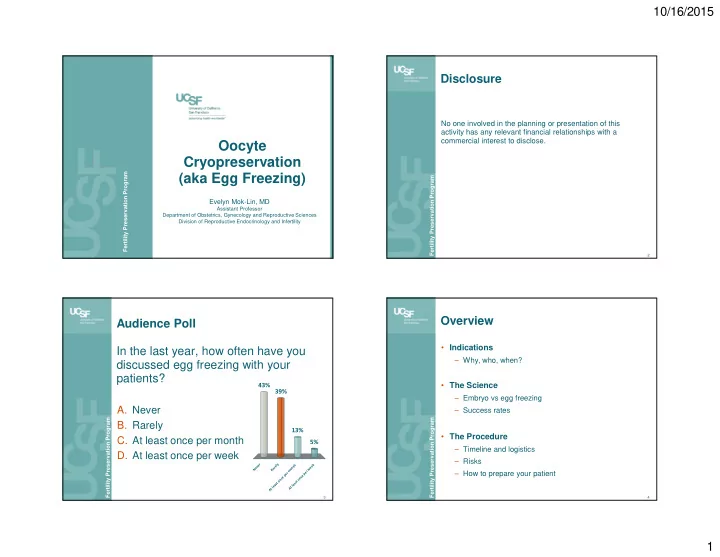
Audience Poll In the last year, how often have you discussed egg freezing with your patients?

  • A. Never
  • B. Rarely
  • C. At least once per month
  • D. At least once per week

Fertility Preservation Program

N e v e r R a r e l y A t l e a s t

  • n

c e p e r m

  • n

t h A t l e a s t

  • n

c e p e r w e e k

43% 5% 13% 39%

4

Overview

  • Indications

– Why, who, when?

  • The Science

– Embryo vs egg freezing – Success rates

  • The Procedure

– Timeline and logistics – Risks – How to prepare your patient

Fertility Preservation Program

slide-2
SLIDE 2

10/16/2015 2

5

Indications: Why?

  • Why consider egg freezing?

– To preserve a woman’s current fertility and increase their chances of achieving pregnancy at a later age

Fertility Preservation Program

www.elle.com

6

Fertility Preservation Program

Wallace and Kelsey, PLoS 2010

7

Fertility Preservation Program

Heffner, NEJM 2004

Indications: Who?

  • Who should consider egg freezing?

– Women who require medical or surgical treatments that reduce ovarian reserve

  • Cancer
  • Other conditions requiring chemotherapy (SLE,

thalassemia)

  • Complex and/or recurrent ovarian cysts
  • BRCA mutation carriers

– Women at risk for early menopause

  • Family history of primary ovarian insufficiency (POI)
  • Personal history of diminished ovarian reserve (DOR)

8

slide-3
SLIDE 3

10/16/2015 3 Indications: Who?

  • Elective (“Social”) Egg Freezing

– Women who wish to delay childbearing due to personal or professional circumstances

9

Indications: Who?

  • Elective (“Social”) Egg Freezing

– Women/couples who want to have more than 1 child

10

Indications: When?

  • What is the optimal age?

11

Franasiak et al. Fertility and Sterility 2014

Optimal timing for elective egg freezing

  • Decision-tree model for egg freezing vs no action

– ages 25-40 yrs, attempting procreation 3, 5 or 7 years after – unassisted attempts for 6 months and then IVF – conception rates and cost estimates for fresh IVF cycles vs egg freezing, storage and subsequent usage

12

Mesen et al. Fertility and Sterility 2015

slide-4
SLIDE 4

10/16/2015 4

  • Live birth rate (LBR) highest when egg freezing performed

at <34 yrs (>70%)

– Steadily declines with increasing age to 26.2% at age 40 yrs

  • Greatest improvement in LBR at age 37 yrs

– 30% difference in chance of live birth with egg freezing compared to no action (51.6% vs 21.9%)

  • Little benefit at ages 25-30 yrs (2.6-7.1% increase)
  • Egg freezing was most cost-effective at age 37 yrs

13

Mesen et al. Fertility and Sterility 2015

Indications: When?

  • When should a woman undergo egg freezing?

– Early to mid-30s is ideal – Take personal timeline into consideration – No absolute age cut-off

14 15

Embryo versus Egg Freezing

  • Embryo cryopreservation

– Well-established

  • Most data
  • Highest success rates

– Higher survival – Pre-implantation genetic screening (PGS)

– Limitations:

  • Requires male partner or donor sperm
  • Legal and ethical issues

Fertility Preservation Program

16

Embryo versus Egg Freezing

  • Oocyte cryopreservation

– More practical

  • Future sperm of choice
  • Lower initial cost
  • Logistically more simple

– No longer “experimental” (ASRM 2012) – Limitations:

  • Less long-term data

– Short-term data with no increased risk of chromosomal

  • r congenital anomalies
  • Lower success rates

– Unknown fertilization rates and embryo quality Fertility Preservation Program

slide-5
SLIDE 5

10/16/2015 5

17

Success Rates

18

Success Rates

19

Egg Freezing Procedure

Fertility Preservation Program

1 3 5 7 9

FSH+LH

hCG trigger Egg Retrieval

11 13 Days

  • The procedure is typically completed within 2

weeks

20

Egg Freezing Procedure

  • Each visit during ovarian stimulation involves

monitoring of estradiol levels and follicle sizes

Fertility Preservation Program

slide-6
SLIDE 6

10/16/2015 6

21

Egg Freezing Procedure

  • Egg retrieval is performed under MAC

anesthesia

  • Mature eggs are cryopreserved (unless cancer)
  • Once frozen, quality of eggs does not change

Fertility Preservation Program

22

Risks of Egg Freezing

  • Ovarian hyperstimulation syndrome (OHSS)
  • Ovarian torsion
  • Bleeding
  • Infection
  • Damage to adjacent organs
  • No association with long-term risks to the

patient:

– Breast cancer – Ovarian cancer – Premature menopause

Fertility Preservation Program

23

Preparing your patient for egg freezing

  • Initial work up

– Ovarian reserve testing (AMH, day 3 FSH/E2) – *Additional labs: T+S, CBC, ID panel – Formal pelvic ultrasound not necessary – Updated healthcare maintenance: pap smear, mammogram

  • Hormonal contraceptives

– Stop long-term OCPs temporarily – Hold on replacing LARCs (except Paragard)

Fertility Preservation Program

24

Summary

  • A woman’s egg quantity and quality decline with

increasing age, particularly after her mid-30s

  • Egg freezing offers women the opportunity to delay

childbearing for medical or elective reasons

  • Egg freezing is a safe, non-experimental procedure

that is typically completed within 2 weeks

  • The ideal candidate is a healthy woman in her early

to mid-30s with high ovarian reserve who is able to freeze 20 mature eggs

Fertility Preservation Program

slide-7
SLIDE 7

10/16/2015 7

Thank you