
SLIDE 1
Ontario Archaeology 101
- r
12,000 Years in 60 Minutes.
Paul Racher, MA, CAHP, RPA June 23, 2016 president@ontarioarchaeology.org
Ontario Archaeology 101 or 12,000 Years in 60 Minutes. Paul - - PowerPoint PPT Presentation
Ontario Archaeology 101 or 12,000 Years in 60 Minutes. Paul Racher, MA, CAHP, RPA June 23, 2016 president@ontarioarchaeology.org First off, I want to say what a shame it is that you cant see me right now. I sat for this photograph just
Paul Racher, MA, CAHP, RPA June 23, 2016 president@ontarioarchaeology.org
First off, I want to say what a shame it is that you can’t see me right now. I sat for this photograph just yesterday and it doesn’t begin to do me justice.
Ok, that’s not true, I actually look more like this most of the time:
(me)
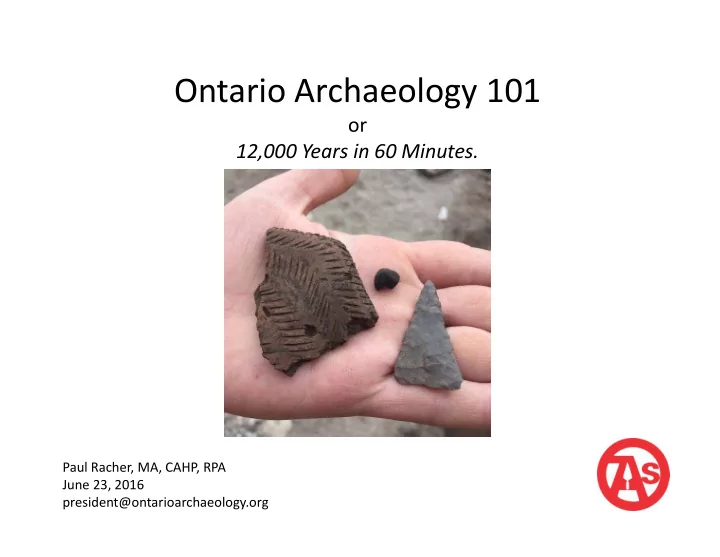
But the archaeology I am here to talk about is far more photo-worthy and wonderful. And that is what matters. There is a rich, 12,000 year-long archaeological record in Ontario; a record that is represented by puzzling and fascinating and mysterious and beautiful artifacts…
Broadly‐speaking, we divide the archaeological history of the province into 2 categories: Pre‐ Contact and Post Contact (sometimes called Historic) – where contact coincides with the arrival of Europeans around AD 1600 or so. With all due apologies to you history buffs, the term historic is a problem to many First Peoples, since they feel it suggests that there was no “history” before the arrival of Europeans – and I am more than inclined to agree with them.
Samuel De Champlain arrived in Ontario in 1615.
1) Palaeo-Indian (11,500 – 9,500 years ago) 2) Archaic (9,500 to 3,000 years ago) 3) Woodland (3,000 years ago to roughly AD 1650)
Palaeo‐Indians: The First People
So mysterious…. The story of the First Peoples (the so‐called Palaeo‐Indians) is not clear. We don’t know much about how these early people lived, what language they spoke, and what was important to them. Their sites are VERY
12,000 years ago, there may have been less than 200 people living in the ENTIRE province. All we really know about them is that:
Ontario from the west
environment that was at first sub‐arctic and later boreal in nature
the hunting of big game animals
points and a few other interesting and unique tool forms
Palaeo‐Indians: The First People
Our lack of understanding of this period means that, when we talk about these first people, we have to fill in a lot of the “gaps” in our information with imagination. If you have seen the Pre‐Contact exhibits at most museums, it’s clear that we aren’t very good at this – the displays are almost always terrible. At this point, it is worth making a short tangential journey to examine why.
The First Problem: Preservation
Preservation is a fundamental problem in archaeology. Organic materials such as wood, bone, cloth, antler and leather simply don’t preserve well in the ground – yet these were the most available, sustainable, and useful raw materials people had at their disposal for making the items they needed to survive. Take a look at this 1845 (ish) painting by Paul Kane of an Ojibway camp on the shores of Lake Huron and try to imagine how much of what you see would be left if they walked away from it and left it for a hundred years. How about 500 years? Or 11,500 years? Would any of those things that endured over that time be important? Would they have anything to say about what mattered to the people in the picture?
The second problem is us. When we imagine the past, we are often hampered by traditional stereotypes of what the past ought to be like. These were most famously articulated by the English philosopher Thomas Hobbes (1588‐1679) who suggested that the lives of people in traditional societies were “solitary, poor, nasty, brutish and short.” It wasn’t until anthropologists started studying hunter gatherers in the mid 20th Century that it was discovered that most of them lived quite comfortably, while working fewer hours per day than ourselves.
The third problem with the way we interpret the past comes from who we are and where we stand in history – and it only tends to come into play when we are discussing the archaeology of First Peoples. Specifically, we (Euro‐Canadians) are the Settler Society. We are the newcomers and it’s abundantly clear that, as a society, we haven’t exactly been kind in the way we have dealt with the Indigenous population. Historically, that means that we have tended to cling to stereotypes that denigrate, mock, and downplay the cultures and lifestyles of those
societies were (and are) wonderful, then we would have to acknowledge the stain on ourselves for having treated them so poorly. This is the essence of Colonialism and why it’s been so hard to eradicate. It doesn’t require old‐style racism to work – it just needs us to make assumptions (often handed down to us as ‘true’) – and then not challenge them. I’m going to be coming back to this later.
What all of this means is that we have to be very careful in how we imagine the past. We have to proceed from the facts we have at hand of course, but we also need to question
What makes archaeology both ‘beautiful’ and ‘terrible’ is that the object of our study is hidden, incomplete, and mysterious. It is an adventure to be able to explore the past and it is extremely gratifying when we make a
easy to be wrong and embarrass yourself. Hubris, that excess of pride which was so quickly and horribly punished in Classical myth (as in the case of poor Prometheus here), has no place in the heart of an archaeologist. When you do archaeology you need to be comfortable with doubt and unknowing. A good archaeologist is one who understands this part of its nature and is humble before it.
If you want to imagine what it looks like to question our stereotypes and biases, while acknowledging some universalities in the human experience, I’d like to introduce you to the work of my friend, Emily
research – but is presented in the context of even more important things that we know to be true:
where children played, parents loved them, and grandparents taught them.
Consider this exhibit from the American Museum of Natural History:
Now compare and contrast it with this illustration by Emily. There is as much difference between them as you’d find between the words on the label of a pill bottle and those from a poem by T.S. Eliot. It’s evocative, it’s alive, and it’s beautiful.
Beginning around 10,000 years ago, the climate warmed and the environment started to become more like it is today. As the deciduous forest spread into Ontario, more plant and animal food sources became
cultures we call “Archaic” emerged. It’s probably safe to say that the most common types of sites we encounter during archaeological assessments are Archaic sites. There are so many different artifact types associated with the period that your eyes would glaze over if I tried to take you through them.
So I am going to stick to the “big picture” and let you know a few general items about the Archaic that are worth noting:
1) There is every indication that Archaic peoples had an encyclopedic knowledge of their environment and how to extract what they needed from it with minimal effort. 2) It’s the first time we encounter structures like houses in the archaeological record – thanks to better preservation than we see on earlier sites. 3) It’s the first time we see clear evidence of ceremonialism and ritual behavior in the archaeological record. 4) There is plenty of evidence for huge trade networks that spanned the continent – from the Gulf of Mexico to the far north. 5) The lifestyles we see represented on Archaic sites were so sustainable and so successful that many
hundreds or even thousands of years.
The Archaic Period was followed by what archaeologists call the Woodland Period, around 2800 years ago. It starts with the appearance of pottery and for the first 1200 years or so, that pottery is almost the only thing that distinguishes it from the Archaic way of life. Hunting and gathering appears to have remained the primary mode of subsistence until around AD 400.
Starting around A.D. 400, we find the first rudimentary evidence of maize (corn) horticulture on sites belonging to what archaeologists call the Princess Point culture. Many of these are located along the Grand River. Here is another one of my friend Emily’s illustrations of what life might have looked at then. We know that most of the communities were usually on flood plains, that people hunted, fished, and grew corn, and that the rivers served as their highways for travel.
The Late Woodland Period
Between A.D. 1000 and 1650, during what we call the Late Woodland period, maize horticulture allowed for population increases which in turn lead to larger settlement sizes, higher population density, and increased social complexity among the peoples involved. It’s during this time that we encounter the longhouse peoples who were the ancestors of the Wendat (Huron), Neutral and Petun Nations that the French met when they arrived in the early 1600s. During this period, villages covered as much as 5 hectares, with longhouses sometimes reaching over 100 metres in length. It is believed that some of these settlements may have held as many as 2500 (or more) inhabitants.
Why Woodland Archaeology Matters Late Woodland sites are wonderful for several reasons. 1) Preservation from Woodland sites, particularly the later ones, is
pottery, but bone, shell, wood, botanicals (seeds and wood), and even the outlines of their houses. 2) There is demonstrable cultural continuity between the Late Woodland peoples of Ontario and the First Nations who live here now. That means we can access more information about the stories of these peoples, and learn more about the things we find on their archaeological sites, through oral history and traditional knowledge.
3) The contribution of Late Woodland Archaeology to our understanding of the Cultural Heritage Landscape Another stereotype that we routinely bump against is the notion that the First Nations didn’t really make productive use of the land (which was one of the justifications that the Settler Society used to explain away land seizures). One of my favorite quotes on this subject comes from one of my favorite (really!) actors, the great John Wayne, who said: This may be an early example of what could now alternately be called Gwyneth Paltrow, Sean Penn, or Jenny McCarthy Syndrome – an illness that reminds us that the skills sets needed to pretend to be someone else for a living don’t make you an expert in health care, politics or social policy.
A few years back in Kitchener, we found a Late Woodland Village that we estimated was once home to around 600 people. Assuming their diet was about 50% maize (and this seems to be in the neighbourhood of correct, though perhaps a bit low, based on studies of bone isotopes and such), that would mean that the village needed about 219,000 lbs of maize per year just to survive (or something between 51 and 270 acres of fields, depending on local soil fertility). BUT, we know from accounts of the early French explorers that the longhouse peoples they met liked to grow as much as 3 or 4 times what they needed to provide a buffer against crop losses and to give some surpluses for trading with their neighbours (especially the Anishinaabeg). If this is the case, that meant that the fields around our little village may have needed to produce as much as 876,000 lbs of maize per year on somewhere between 200 and 1080 acres of land – all of which would have been cleared by fire and stone axes and worked with nothing more complicated than digging sticks.
It’s been estimated that the Neutral and Wendat peoples of southern Ontario had a population of around 70,000 people. Had they tried to grow enough maize for 4 years, that would have meant they were aiming for an annual harvest of 102,200,000 lbs of
But this: And this: Which is to say: prior to contact, it seems clear that much of southern Ontario was a managed landscape – with well marked trails, a good deal of land under cultivation, and almost “park like” quality to it. Our image of dark, foreboding woods with dark faces peeking out from the trees is almost certainly totally false. So why does it still exist? (more on this later)
Contact! All of this changed after contact, but it’s worth mentioning at this point that European contact took many forms and proceeded at differing paces in each. There was: 1) A Disease Frontier that spread rapidly as soon as Europeans arrived and travelled across traditional trade routes between First Nations 2) A Trade Frontier in which European goods started appearing and impacting traditional value systems – even of peoples who had not yet met a European 3) A Contact Frontier as European traders and explorers pushed further and further inland and 4) A Settlement Frontier in which European settlers looked for land to make their home – at the expense of Indigenous land rights.
Champlain arrived in what would become Ontario in 1615. At roughly the same time, Europe developed a taste for beaver hats as a status symbol. Soon after, the whole of eastern North America was engulfed in what we now call the Beaver Wars (roughly 1628‐1701). As many of you probably know, this was a war over access to the hunting grounds and trade routes needed by fur traders to ensure a steady flow of beaver pelts into Europe. It was a terrible time in which thousands
The story isn’t entirely one about suffering and disaster and collapse. There are also narratives of strength, resistance, and endurance in the face of overwhelming
evidence of cultural continuity, the survival of traditions, and a thoughtful and selective engagement with the Settler Society. This illustration (also by Emily Damstra) shows the Mohawk and Mississauga settlement at Davisville (near Brantford) in 1810. In it you can see that, while European trade goods were in use, the lifestyle was still clearly a traditional one. You still see such traditions carrying
materialism, continued hunting, fishing and gathering, traditional family structures, and the continued existence of clans. You can substitute longhouses for ranch houses, and canoes for cars, but the underlying values endure.
Why Historic Archaeology Matters Once we get into the historic/documented era, some people say, “why do we need to do archaeology when we have written history?” and the answer I give is always the same: History books rely on the written record for their facts – and sometimes that record just plain wrong – willfully so even. In such cases, archaeologists are rather like forensic scientists, looking past what people said about themselves for facts about how they actually were (people may stretch the truth but their garbage speaks for itself). In a more unintentional sense, the historical record is often simply incomplete when it comes to the mundane details
about people with undocumented lives who might
to be seen again. Often we find evidence of everyday activities and objects that were considered so simple, so basic, that nobody ever though to take note of them – so without archaeology they too would be lost. Too often, we also have ignored important communities on the margins of the Settler Society – not just the First Nations but Black people, Irish Catholics, and others. In many cases, archaeology is the only way to contribute elements to the “story” of the past where history falls short – and it does so by providing tangible cultural materials like artifacts that people can see and handle for themselves.
So let’s skip ahead to modern times. Not this one:
But this one. Specifically, where we are right now in the relationship between Canada’s First Peoples and the Settler Society….
For centuries, and right to this day, we have operated within a Colonialist framework – one in which the very institutions of our society seemed
their persons, and erasing their languages, cultures, and histories. We’ve mocked it. We’ve made it ugly. And what we couldn’t distort – we have taken. When the system has been threatened, we have turned to violence.
As we have treated the people, so we have treated their history. My friend Ron Williamson from ASI has suggested that, in Halton, Peel, York and Durham Regions alone, 8000 archaeological sites were destroyed between 1951 and 1991. Imagine how many were lost in the rest of Ontario? Here’s an analogy that I like to use to explain to kids just how precious an archaeological site is. I tell them that I like to think of the archaeological record as being like a zoo – with thousands of rare and unique animals in it – but all of them female. When one dies, it is never going to be replaced. Ever. So why do we tolerate it?
Alas poor Brick! I knew him, Horatio.
The insidious thing about Colonialism is that it really doesn’t need “old school” racism to survive. It doesn’t need personalized forms of hostility, or the ugly and overt state‐sponsored racism of Nazi Germany or South Africa. It just needs a Settler Society to make some assumptions that go unquestioned, and a relentless bureaucracy supported by the educational system, churches, and other institutions. If you accept theses premises, the system has a terrible logic to it.
If you accept that the First Peoples of Canada never made “productive” use of their land, then what is wrong with the fact that it was taken away from them?
If you accept that the First Peoples of the Americas never made any significant sort of contribution to world history, art or culture, then why bother celebrating it?
If you accept that the cultures of First Peoples were defined by violence and endemic warfare, what would be wrong with working to destroy those cultures and assimilate those peoples?
If you put all of these stereotypes together, the image that emerges is of a people who can’t be trusted to take care
their lands, and are of a temperament that puts them on the wrong end of the moral spectrum.
It’s an interesting irony that we get upset about the Taliban destroying monuments in Afghanistan, but we are okay with hundreds of archaeological sites being destroyed every year here in Ontario. Or that we are horrified by images of African hunger and poverty but we are comfortable with it on reserves here. Or that we complain about the environmental records of countries like China, but ignore the fact that we have polluted First Nations Lands with mine tailings and mercury and waste products of tar sands extraction.
Things ARE starting to change – though in some ways we have been dragged kicking and screaming in the new relationship. Specifically, since the 2000’s, the Supreme Court has ruled repeatedly that developers, proponents, and the Crown have a “Duty to Consult and Accommodate” with First Nations whose treaty rights may be impacted by projects. With each new decision, these rights have been refined and expanded. We’re on the verge of a sea change in the relationship between Canada and its First Peoples. As Martin Luther King said, the arc of history is long, but it bends towards justice. We seem to be on the verge of recognizing the First Nations as one of the founding pillars of Canadian society. Not just the two solitudes of French and English, but three.
Historically, we archaeologists have been a pretty quiet bunch. We work out of dusty offices in basements and
personalities that make us more fit for dealing with the dead than the living. A lot of us feel like we weren’t born in the right time. All told, there is a certain sort of person who becomes an archaeologist and that person is not socially well‐adjusted. For years too, I think we suffered from the sort of spiritual malaise you get when you feel like no one is interested in your
nothing we did matters.
But there’s something we know – and indeed, its something that we have always known, that suddenly matters. We archaeologists know how AMAZING the Indigenous peoples of this place
faced, the beauty and sustainability of their lifestyles, and the many fruits of their genius that we still benefit from to this day. Suddenly, we are finding ourselves at the centre of OMB hearings and land claims and high profile projects and on government agendas in ways that would have been considered unthinkable just a few years ago. If being a part of this is something that interests you, I invite you to consider joining us: http://www.ontarioarchaeology.on.ca/ Thank you.