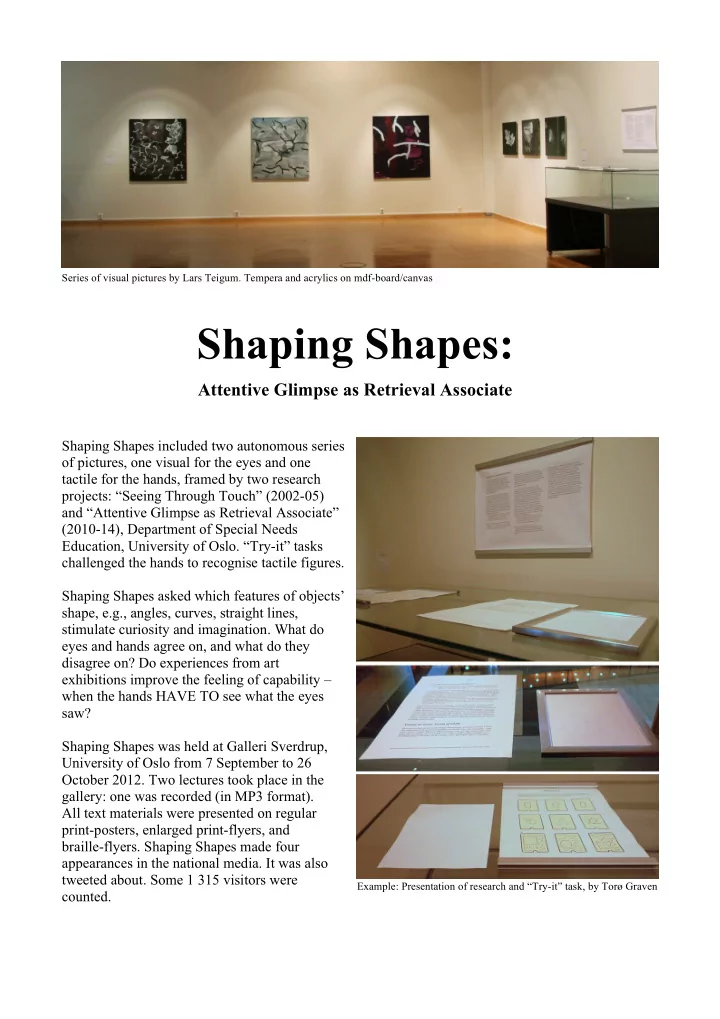
SLIDE 2 Series of tactile pictures, including two books, by Randi Annie Strand. Different embossing techniques
“One of my newly blinded pupils claimed that she had no idea what to direct her attention towards when she was tactually exploring objects. Tactile information was overwhelming to her, thus she had, gradually, become tactually
- inactive. Other newly blinded pupils claimed to, visually, imagine their tactually explored objects: sometimes
succeeding and sometimes not. (...) Indeed, also some of my adventitiously blinded pupils claimed to, visually, imagine their tactually explored objects, but only when these were tactually unfamiliar to them. In particular, one of my adventitiously blinded pupils claimed that his ability to, visually, imagine his tactually explored objects decreased as the objects became tactually more familiar to him. For instance, he could perfectly well, visually, imagine a painting hanging over his living-room sofa, but could no longer, visually, imagine his wife’s, his daughter’s, or even his own face: these had now become tactually familiar.” Graven, T. (2009). Seeing Through Touch: When Touch Replaces Vision as the Dominant Sense Modality [p. 1]. Saarbrücken: VDM Verlag Dr. Müller AG & Co.
Some 37 million people worldwide experience blindness, the majority loosing their sight during adulthood (http://www.blindeforbundet.no), touch joining, even replacing, vision in seeing what the eyes saw. A possible link between vision and touch has been of great interest in the fields of philosophy, neurology, and psychology. To cut a long story short, empiricists such as Berkley and Locke, as well as neuropsychologist Luria, advocated that the world is perceived according to prior experience, e.g., visually. In contrast, gestalt psychologists and phenomenologists, e.g., Merleau-Ponty, advocated that there is no visual and no tactile experience but rather a total experience from which it is impossible to single out visual and/or tactile contributions. Indeed, two
- pposite positions have been advocated: vision and touch are (1) totally separate or (2) joined
- together. More recent research (e.g., Cornoldi & Vecchi; Graven; Klatzky & Lederman; Kosslyn;
Millar) does, however, tie the two together by advocating a third position, i.e., that vision and touch are totally separate in some areas (e.g., vision processing colour and touch temperature) but totally joined together in others (e.g., in processing shape). A cognitive vision-touch link which processes
- verlapping – visual and tactile – information about objects' shape and thus improves recognition
proficiency, has been suggested (e.g., Easton, Srinivas & Greene; Graven; Millar).
Tactile picture, by Randi Annie Strand