Outline of Presentation MARS: Applying Multiplicative Introduction - - PDF document

outline of presentation mars applying multiplicative
SMART_READER_LITE
LIVE PREVIEW

Outline of Presentation MARS: Applying Multiplicative Introduction - - PDF document

Outline of Presentation MARS: Applying Multiplicative Introduction -- the vector model over R+ Adaptive User Preference Multiplicative adaptive query expansion algorithm Retrieval to Web Search MARS -- meta-search engine Zhixiang


slide-1
SLIDE 1

1

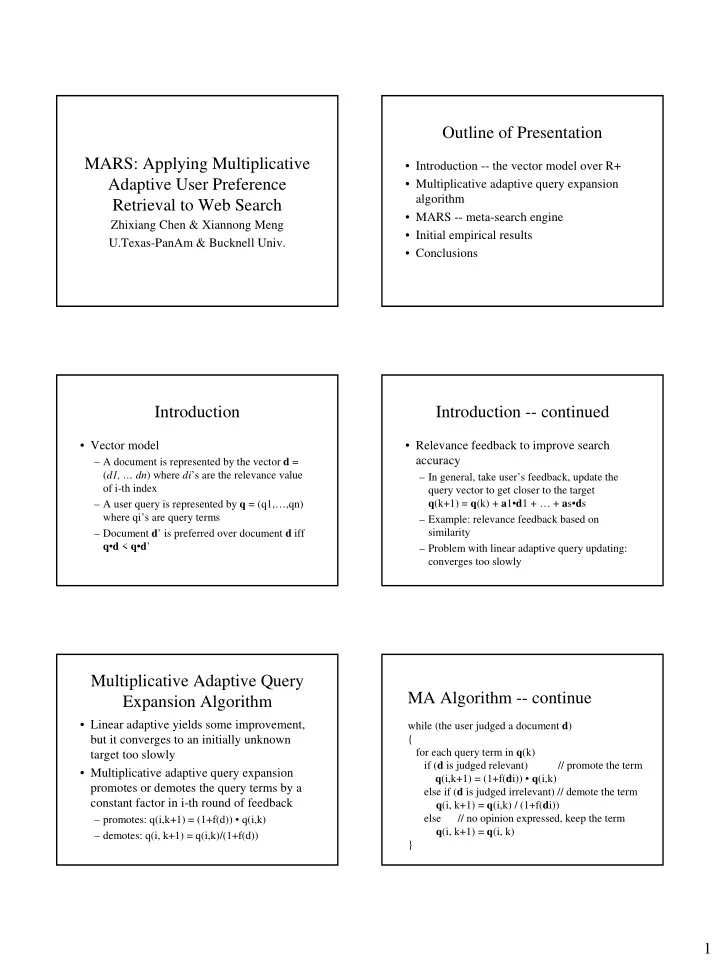
MARS: Applying Multiplicative Adaptive User Preference Retrieval to Web Search

Zhixiang Chen & Xiannong Meng U.Texas-PanAm & Bucknell Univ.

Outline of Presentation

  • Introduction -- the vector model over R+
  • Multiplicative adaptive query expansion

algorithm

  • MARS -- meta-search engine
  • Initial empirical results
  • Conclusions

Introduction

  • Vector model

– A document is represented by the vector d = (d1, … dn) where di’s are the relevance value

  • f i-th index

– A user query is represented by q = (q1,…,qn) where qi’s are query terms – Document d’ is preferred over document d iff q•d < q•d’

Introduction -- continued

  • Relevance feedback to improve search

accuracy

– In general, take user’s feedback, update the query vector to get closer to the target q(k+1) = q(k) + a1•d1 + … + as•ds – Example: relevance feedback based on similarity – Problem with linear adaptive query updating: converges too slowly

Multiplicative Adaptive Query Expansion Algorithm

  • Linear adaptive yields some improvement,

but it converges to an initially unknown target too slowly

  • Multiplicative adaptive query expansion

promotes or demotes the query terms by a constant factor in i-th round of feedback

– promotes: q(i,k+1) = (1+f(d)) • q(i,k) – demotes: q(i, k+1) = q(i,k)/(1+f(d))

MA Algorithm -- continue

while (the user judged a document d) { for each query term in q(k) if (d is judged relevant) // promote the term q(i,k+1) = (1+f(di)) • q(i,k) else if (d is judged irrelevant) // demote the term q(i, k+1) = q(i,k) / (1+f(di)) else // no opinion expressed, keep the term q(i, k+1) = q(i, k) }

slide-2
SLIDE 2

2

MA Algorithm -- continue

  • The f(di) can be any positive function
  • In our experiments we used

f(x) = 2.71828 • weight(x)

  • where x is a term appeared in di
  • We have detailed analysis of the performance of the MA

algorithm in detail in another paper

  • Overall, MA performed better than linear additive query

updating such as Rocchio’s similarity based relevance feedback in terms of time complexity and search accuracy

  • In this paper we present some experiment results

The Meta-search Engine MARS

  • We implemented the algorithm MARS in
  • ur experimental search engine
  • The meta-search engine has a number of

components, each of which is implemented as a module

  • It is very flexible to add or remove a

component

The Meta-search Engine MARS

  • - continue

The Meta-search Engine MARS

  • - continue
  • User types a query into the browser
  • The QueryParser sends the query to the

Dispatcher

  • The Dispatcher determines whether this is

an original query, or a refined one

  • If it is the original, send the query to one of

the search engines according to user choice

  • If it is a refined one, apply the MA

algorithm

The Meta-search Engine MARS

  • - continue
  • The results either from MA or directly from
  • ther search engines are ranked according

to the scores based on similarity

  • The user can mark a document relevant or

irrelevant by clicking the corresponding radio button at the MARS interface

  • The algorithm MA refines document

ranking by either promoting or demoting the query term

slide-3
SLIDE 3

3

Initial Empirical Results

  • We conducted two types of experiments to

examine the performance of MARS

  • The first is the response time of MARS

– The initial time retrieving results from external search engines – The refine time needed for MARS to produce results – Tested on a SPARC Ultra-10 with 128 M memory

Initial Empirical Results --continue

  • Initial retrieval time:

– mean: 3.86 seconds – standard deviation: 1.15 seconds – 95% confidence interval 0.635 – maximum: 5.29 seconds

  • Refine time:

– mean: 0.986 seconds – standard deviation: 0.427 seconds – 95% confidence interval: 0.236 – maximum: 1.44 seconds

Initial Empirical Results --continue

  • The second is the search accuracy

improvement

– define

  • A: total set of documents returned
  • R: the set of relevant documents returned
  • Rm: set of relevant documents among top-m-ranked
  • m: an integer between 1 and |A|
  • recall rate = |Rm| / |R|
  • precision = |Rm| / m

Initial Empirical Results --continue

– randomly selected 70+ words or phrases – send each one to AltaVista, retrieving the first 200 results of each query – manually examine results to mark documents as relevant or irrelevant – compute the precision and recall – use the same set of documents for MARS

slide-4
SLIDE 4

4

Initial Empirical Results --continue

Recall

(200, 10) (200, 20) Precision (200,10) (200,20)

AltaVista

0.11 0.19 0.43 0.42

MARS

0.20 0.25 0.65 0.47

Initial Empirical Results --continue

  • Results show that the extra processing time
  • f MARS is not significant, relative to the

whole search response time

  • Results show that the search accuracy is

improved by in both recall and precision

  • General search terms improve more,

specific terms improve less

Conclusions

  • Linear adaptive query update is too slow to

converge

  • Multiplicative adaptive is faster to converge
  • User inputs are limited to a few iterations of

feedback

  • The extra processing time required is not

too significant

  • Search accuracy in terms of precision and

recall is improved