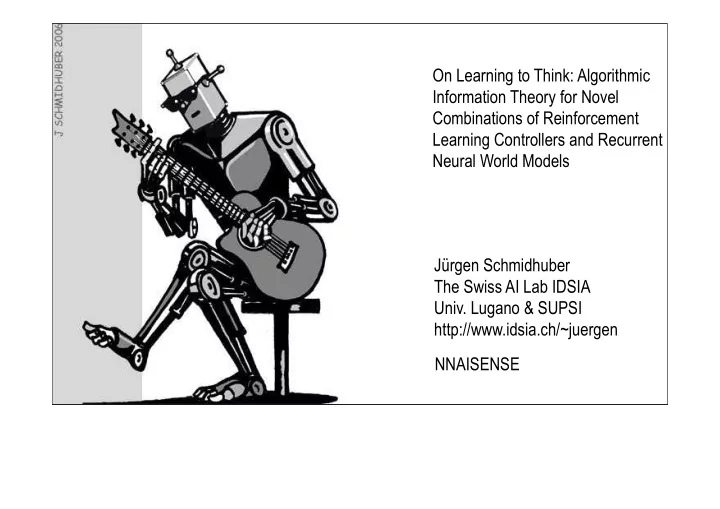
SLIDE 1 Jürgen Schmidhuber The Swiss AI Lab IDSIA
http://www.idsia.ch/~juergen On Learning to Think: Algorithmic Information Theory for Novel Combinations of Reinforcement Learning Controllers and Recurrent Neural World Models NNAISENSE
SLIDE 2
Jürgen Schmidhuber You_again Shmidhoobuh
SLIDE 3 With Hochreiter (1997), Gers (2000), Graves, Fernandez, Gomez, Bayer…
1997-2009. Since 2015 on your phone! Google, Microsoft, IBM, Apple, all use LSTM now
http://www.idsia.ch/~juergen/rnn.html
SLIDE 4
LSTM learns knot-tying tasklets: Mayr Gomez Wierstra Nagy Knoll Schmidhuber, IROS’06
SLIDE 5
2005: Reinforcement- Learning or Evolving RNNs with Fast Weights
Robot learns to balance 1 or 2 poles through 3D joint
http://www.idsia.ch/~juergen/evolution.html
Gomez & Schmidhuber: Co-evolving recurrent neurons learn deep memory POMDPs. GECCO 2005
SLIDE 6
Finds Complex Neural Controllers with a Million Weights – RAW VIDEO INPUT! Faustino Gomez, Jan Koutnik, Giuseppe Cuccu, J. Schmidhuber, GECCO, July 2013 Reinforcement Learning in Partially Observable Worlds
SLIDE 7
J.S.: IJCNN 1990, NIPS 1991: Reinforcement Learning with Recurrent Controller & Recurrent World Model
Learning and planning with recurrent networks
SLIDE 8 IJNS 1991: R-Learning of Visual Attention
- n 100,000 times slower computers
http://people.idsia.ch/~juergen/attentive.html
SLIDE 9
1991: current goal=extra fixed input 2015: all of this is coming back!
SLIDE 10
RoboCup World Champion 2004, Fastest League, 5m/s Alex @ IDSIA, led FU Berlin’s RoboCup World Champion Team 2004 Lookahead expectation & planning with neural networks (Schmidhuber, IEEE INNS 1990): successfully used for RoboCup by Alexander Gloye-Förster (went to IDSIA) http://www.idsia.ch/~juergen/learningrobots.html
SLIDE 11 RNNAIssance 2014-2015 On Learning to Think: Algorithmic Information Theory for Novel Combinations of Reinforcement Learning RNN- based Controllers (RNNAIs) and Recurrent Neural World Models
http://arxiv.org/abs/1511.09249
SLIDE 12
Formal theory of fun & novelty & surprise & attention & creativity & curiosity & art & science & humor Maximize Future Fun(Data X,O(t))~ ∂CompResources(X,O(t))/∂t
E.g., Connection Science 18(2):173-187, 2006 IEEE Transactions AMD 2(3):230-247, 2010 http://www.idsia.ch/~juergen/creativity.html
SLIDE 13 https://www.youtube.com/watch?v=OTqdXbTEZpE Continual curiosity-driven skill acquisition from high-dimensional video inputs for humanoid robots. Kompella, Stollenga, Luciw,
- Schmidhuber. Artificial Intelligence,
2015
SLIDE 14
now talking to investors
neural networks-based artificial intelligence
SLIDE 15
NIPS 2016 demo: Reinforcement learning to park Cooperation NNAISENSE - AUDI
SLIDE 16