
SLIDE 1
Mariia Golovianko, Svitlana Gryshko & Vagan Terziyan
Check updates here: http://www.mit.jyu.fi/ai/IKC-2017.pptx IKC-2017, Gdańsk, Poland, 11-12 September 2017
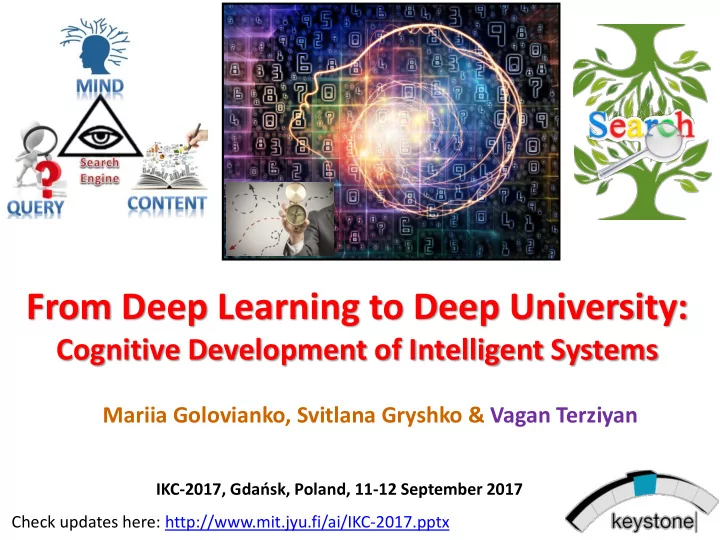
From Deep Learning to Deep University: Cognitive Development of - - PowerPoint PPT Presentation
From Deep Learning to Deep University: Cognitive Development of Intelligent Systems Mariia Golovianko, Svitlana Gryshko & Vagan Terziyan IKC-2017, Gda sk, Poland, 11-12 September 2017 Check updates here:
Check updates here: http://www.mit.jyu.fi/ai/IKC-2017.pptx IKC-2017, Gdańsk, Poland, 11-12 September 2017
Mariia Golovianko, PhD, Department of Artificial Intelligence, Kharkiv National University of Radioelectronics (UKRAINE), e-mail: mariia.golovianko@nure.ua ; golovianko@gmail.com . Vagan Terziyan, Professor (Distributed Systems), Faculty of Information Technology, University of Jyväskylä (FINLAND), e-mail: vagan.terziyan@jyu.fi .
Svitlana Gryshko, PhD, Associate Professor of Department of Economic Cybernetics and Management of Economic Security, Kharkiv National University of Radioelectronics (UKRAINE), e-mail: svitlala.gryshko@nure.ua ; hryshko.sv@gmail.com .
whose photos and pictures (or their fragments) posted on the Internet, we used in the presentation.
“The paper is well-written and its presentation in IKC may initiate some interesting discussion ... The main problem is that …
since keyword-based search is not discussed at all …”
One can still make just a cosmetic improvement of available search engines, but the search process and the search skills, needed for human or artificial and autonomous users of the search engines, require a radical change due to the big data challenge …
https://link.springer.com/chapter /10.1007/978-81-322-1050-4_38
Terziyan V., Golovianko M., & Cochez M., TB-Structure: Collective Intelligence for Exploratory Keyword Search. In: A. Calì, D. Gorgan, & M. Ugarte (Eds.), Semantic Keyword-Based Search on Structured Data Sources. KEYSTONE 2016, LNCS 10151, 2017, Springer, pp. 171-178. (presentation slides are here).
31
Do not even try to hardcode a fully skilled AI. It is known to be impossible. The only way is to program a “child” (basic intelligent instincts and capabilities to learn own skills) and then train it to the level it will be capable for further self- development. But it is very important to teach your “child” smartly and carefully…
In the “deep” University, an artificial system will consciously develop its cognitive skills to explore (search, sense and understand what to search, why and how) the external physical and abstract world together with itself smartly and creatively.
starts September 2018
New International Master Program: COIN: Cognitive Computing and Collective Intelligence
On completion of the programme, the graduates will be able to use, design and train complex self-managed and continuously evolving public and private industrial systems, digital ecosystems, cyber-physical systems, systems-of-systems, platforms, services and applications; will be able to connect their designs with publicly available Deep Learning and Big Data analytics and Web-based Cognitive Computing capabilities as services; will be able to figure-out and approach various challenging aspects of wicked problems world-wide, which require collective intelligence and self-managing service- based architectures for their solutions; understand and professionally utilize for that purpose knowledge on enabling technologies and tools; … Students, who will graduate from the programme with a Master of Science in Natural Sciences from the Faculty of Information Technology, will think beyond the routine and will be able not just to adapt to a change but to help to create and control it. This means that our graduates will not be able only to “solve smart problems”, but in addition to it they will be able to “invent new and smart problems” and drive them by “designing artificial smart problem solvers”.