Olfaction (Chap 14) Lecture 21 Jonathan Pillow Sensation & - - PowerPoint PPT Presentation

olfaction chap 14
SMART_READER_LITE
LIVE PREVIEW

Olfaction (Chap 14) Lecture 21 Jonathan Pillow Sensation & - - PowerPoint PPT Presentation

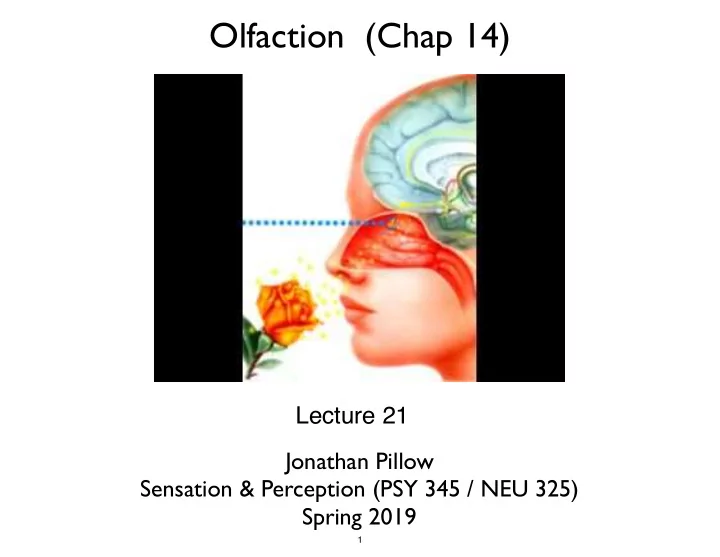
Olfaction (Chap 14) Lecture 21 Jonathan Pillow Sensation & Perception (PSY 345 / NEU 325) Spring 2019 1 The Chemical Senses Olfaction : The sense of smell (today) Gustation : The sense of taste 2 Odor: A general smell sensation of a


slide-1
SLIDE 1

Jonathan Pillow Sensation & Perception (PSY 345 / NEU 325) 
 Spring 2019 Lecture 21

Olfaction (Chap 14)

1
slide-2
SLIDE 2

The Chemical Senses

Olfaction: The sense of smell (today) Gustation: The sense of taste

2

slide-3
SLIDE 3

Odorants:

  • Chemical compounds
  • But not every chemical is

an odorant

  • Most are small, volatile,

and hydrophobic (don’t diffuse in water)

Odor:

A general smell sensation

  • f a particular quality

3

slide-4
SLIDE 4
  • ur “machinery” is less sensitive than
  • ther animals (dogs, etc.)
  • dogs can detect odorant concentrations 100x lower than humans


(dogs: can detect 1 part-per-million, humans: 100 parts-per-million)

  • but, experiments show that human receptors respond to single
  • dorant molecules
  • the difference? Dogs have ~ 1 billion receptors, humans have ~ 10

million

Is smell even relevant to humans?

4

slide-5
SLIDE 5

Conventional wisdom: humans not very good at olfaction

Bloodhound tracking a pheasant through a field

Gibbons, B. Nat. Geogr. Mag. 170, 324–361 (1986).

5

slide-6
SLIDE 6

Conventional wisdom is wrong!

Human tracking a scent trail through a field

Porter et al 2007

6

slide-7
SLIDE 7

Human scent-tracking

Porter et al 2007

7

slide-8
SLIDE 8

Two nostrils sample different regions of space

8

slide-9
SLIDE 9

single- vs. dual-nostril sniffing

  • humans use info from both nostrils for scent tracking

(24% slower w/ 1 nostril) “nasal prism”

9

slide-10
SLIDE 10

Click to edit Master title style

How good is our sense of smell?

  • Latest findings suggest we can detect
  • ver one trillion smells!
  • We can only detect about 7.5 million

colors. From the book: (Oh really!)

10

slide-11
SLIDE 11

Physiology of the Olfactory System

11

slide-12
SLIDE 12

The nose

  • Olfactory cleft: space at the back of the nose into which air

flows, where the main olfactory epithelium is located

  • Olfactory epithelium: secretory mucosa whose primary function

is to detect odorants

12

slide-13
SLIDE 13

Olfactory epithelium: the “retina of the nose”

Three cell types

Supporting cells: Provides metabolic and physical support for the olfactory sensory neurons Basal cells: Precursor cells to olfactory sensory neurons

Olfactory sensory neurons (OSNs): The main cell type in the olfactory epithelium

  • OSNs make direct contact with

physical stimulus (i.e., unlike in retina, cochlea, or skin)

13

slide-14
SLIDE 14

Olfactory sensory neuron

  • Responses are slow!
  • OSN axons among

the thinnest and slowest in the body

14

slide-15
SLIDE 15

Olfactory epithelium: the “retina of the nose”

Cilia: Hairlike protrusions on OSN dendrites 


  • Have receptor sites for odorant
  • molecules. 

  • structures for olfactory signal

transduction Olfactory receptor (OR): The region

  • n the cilia of OSNs where odorant

molecules bind

  • Takes seven or eight odor

molecules binding to a receptor to initiate an action potential

15

slide-16
SLIDE 16

Olfactory epithelium: the “retina of the nose”

Cribriform plate: bony structure with tiny holes (even with the eyebrows), separating the nose from the brain

  • Axons from OSNs pass

through the tiny holes to enter the brain

16

slide-17
SLIDE 17

Olfactory epithelium: the “retina of the nose”

Mitral cells: The main projective

  • utput neurons in the olfactory bulb

Glomeruli: Spherical conglomerates containing the incoming axons of the OSNs

  • Each OSN converges on two

glomeruli

17

slide-18
SLIDE 18

Sensory pathway for

  • lfactory system

18

slide-19
SLIDE 19

Olfactory bulb: The blueberry-sized extension of the brain just above the nose, where olfactory information is first processed

  • There are two olfactory bulbs, one in each brain

hemisphere, corresponding to the left and right nostrils.

19

slide-20
SLIDE 20

Primary olfactory cortex: cortical area where olfactory information is first processed. Limbic system:

  • Involved in many aspects of emotion and memory
  • Olfaction is unique for its direct connection to limbic system

20

slide-21
SLIDE 21

Why Olfaction is Weird

  • direct connection to cortex
  • many subsequent cortical

connections to midbrain

Learning & Memory Emotion, Aggression, Fear Homeostasis, Aggression, Growth, ANS

  • also, no “smell-o-topic” maps: no topography

21

slide-22
SLIDE 22

Olfactory Physiology

Anosmia: The total inability to smell, most often resulting from sinus illness or head trauma

  • A hard blow to the front of the

head can cause the cribriform plate to be jarred back or fractured, slicing off the fragile

  • lfactory neurons
  • Anosmia causes a profound

loss of taste as well as smell

Essay: “The Miseries of losing one’s sense of smell” http://www.slate.com/id/2195018/

22

slide-23
SLIDE 23

Genetic basis of olfactory receptors:

  • Buck and Axel (1991) showed that genome contains about

1000 different olfactory receptor genes; each codes for a single type of OR

  • All mammals have pretty much the same 1000 genes.
  • However, some genes are non-functional “pseudogenes”

Dogs and mice: About 20% are pseudogenes Humans: Between 60% and 70% are pseudogenes Each person has a different number of pseudogenes, resulting in individual differences in sensitivity to smells

23

slide-24
SLIDE 24

Evolutionary trade-off between vision and olfaction

% pseudogenes species (color-coded by family)

Gilad et al, PLoS 2004

Old World Primates New World Primates

24

slide-25
SLIDE 25

Evolutionary trade-off between vision and olfaction

% pseudogenes species (color-coded by family)

Gilad et al 2004

tri-chromats di-chromats

howler monkey Old World Primates New World Primates

25

slide-26
SLIDE 26

Gilad et al 2004

Black arrows indicate on which lineages the acquisition

  • f full trichromatic color vision
  • ccurred.

Red lines show lineages with a high proportion of OR pseudogenes

26

slide-27
SLIDE 27

shape-pattern theory of olfactory perception

  • scent percept depends on fit between

OR shape and odorant shape

27

slide-28
SLIDE 28

Theories of olfactory perception:

  • Shape-pattern theory: The current dominant theory. 


  • The binding pattern of odorants in the olfactory epithelium

produces specific firing patterns of neurons in the olfactory bulb, which then determine the particular scent we perceive


  • Vibration theory: now defunct.


  • Proposes that every perceived smell has a different

vibrational frequency, and that molecules that produce the same vibrational frequencies will smell the same

(or is it? See this bizarre TED talk: https://www.ted.com/talks/luca_turin_on_the_science_of_scent)

28

slide-29
SLIDE 29

Study of stereoisomers

  • Molecules that are mirror-image rotations of one another;

although they contain the same atoms, they can smell completely different

  • Vibration theory cannot explain this phenomenon

smells of caraway smells of spearmint Theory that molecules with similar vibration frequencies should smell similarly

29

slide-30
SLIDE 30

The importance of patterns

  • How can we detect so many different scents if our genes
  • nly code for about 1000 olfactory receptors?

  • We can detect pattern of activity across many receptor types
  • Intensity of odorant changes which receptors are activated


(Weak concentrations of an odorant may not smell the same as strong concentrations of it!)

  • Specific time-order of activation of OR receptors is important

30

slide-31
SLIDE 31

Bi-nostral smelling: why have two nostrils? “The world smells different to each nostril”

Sobel et al, Nature 2000 Background

  • 1. Airflow is greater into one nostril than the other,

due to slight swelling that obstructs airflow.

  • 2. Switches nostrils several times per hour.

Q: What are the consequences for olfaction?

31

slide-32
SLIDE 32

Bi-nostral smelling: why have two nostrils?

Background

  • 1. Airflow is greater into one nostril

than the other, due to slight swelling that obstructs airflow.

  • 2. Switches nostrils several times

per hour. Obstructed nostril (swollen turbinates) un-obstructed nostril (relaxed turbinates)

32

slide-33
SLIDE 33
  • Odorants sorb across nasal mucosa at different rates
  • “high-sorption” odorant – induces small response when

airflow is low, and large one when airflow is high

  • “low-sorption” odorant – large response when airflow is

low; small Finding: odorants do indeed smell different in nostrils, depending on the air flow and sorption

  • f the odorant!

33

slide-34
SLIDE 34

Olfactory Psychophysics

  • How much stimulation is required before we perceive

something to be there?


  • Olfactory detection thresholds: Depend on several factors

Women: Generally lower thresholds than men, especially during ovulatory period of menstrual cycles, 
 (but sensitivity is not heightened during pregnancy) Professional perfumers and wine tasters can distinguish up to 100,000 odors (or is it 1 trillion???)

34

slide-35
SLIDE 35

Age: By 85, 50% of population is effectively anosmic And also: (like those high- pitched noises, enjoy smelling while you still can!)

35

slide-36
SLIDE 36

Olfactory Hedonics

Odor hedonics: the “liking” dimension of odor perception

  • measured with scales of pleasantness, familiarity, and intensity

Familiarity and intensity:

  • Pleasantness: obvious
  • Familiarity: tend to like odors we’ve smelled before
  • Intensity: more complicated relationship with odor liking

36

slide-37
SLIDE 37

Odorants: Pleasantness vs. intensity

inverted U-shaped function Linearly decreasing function

37

slide-38
SLIDE 38

Nature or nurture?

  • Long-standing debate: innate vs. learned
  • verdict: almost completely “nurture”
  • infants: not put off by sweat or feces; don’t discriminate

banana from smell of rancid food

  • Cross-cultural data support associative learning

Olfactory Hedonics

  • Wintergreen study (Moncrief, 1966)

  • Americans like it. 

  • English rated it the most unpleasant of many odors

(used in medicine)


  • US Army: tried to develop stink bomb for crowd dispersal:

couldn’t find a smell that was universally disgusting (including “US Army Issue Latrine Scent”)

38

slide-39
SLIDE 39

Japanese and American people have very different tastes in food

Natto

  • fermented

soybeans; Japanese breakfast food

Cheese

  • disgusting

to most Japanese

39

slide-40
SLIDE 40
  • learned taste aversion: Avoidance of a flavor after it

has been paired with gastric illness.


  • finding: from the smell, not the taste (Bartoshuk 1990)

Olfactory Hedonics

  • Evolutionary argument: generalists (like us, and roaches)

don’t need innate smell aversions to predators

40

slide-41
SLIDE 41

The smell, sight, sound, feel, and verbal label of popcorn elicit memories equivalent in terms of accuracy but not emotion

Olfaction and memory

Q: are odors really the best cues to memories?

  • Memories triggered by odor cues are distinctive in their emotionality
  • But not (it turns out) more accurate

41

slide-42
SLIDE 42

Olfaction summary

  • odors, odorants
  • scent tracking, binostril smelling (2 reasons)
  • olfactory cleft, olfactory epithelium
  • Olfactory Receptors (ORs), located on cilia
  • Olfactory Sensory Neurons (ORNs)
  • cribiform plate, glomeruli, mitral cells, olfactory bulb, primary
  • lfactory cortex, limbic system
  • anosmia
  • pseudogenes and trichromatic color vision
  • shape-pattern theory
  • olfactory hedonics, learned taste aversion
  • olfaction and memory
  • pheromones / chemosignals &

VNO (in book)

42