Olfaction (Chap 14) Lecture 20 Jonathan Pillow Sensation & - - PowerPoint PPT Presentation

olfaction chap 14
SMART_READER_LITE
LIVE PREVIEW

Olfaction (Chap 14) Lecture 20 Jonathan Pillow Sensation & - - PowerPoint PPT Presentation

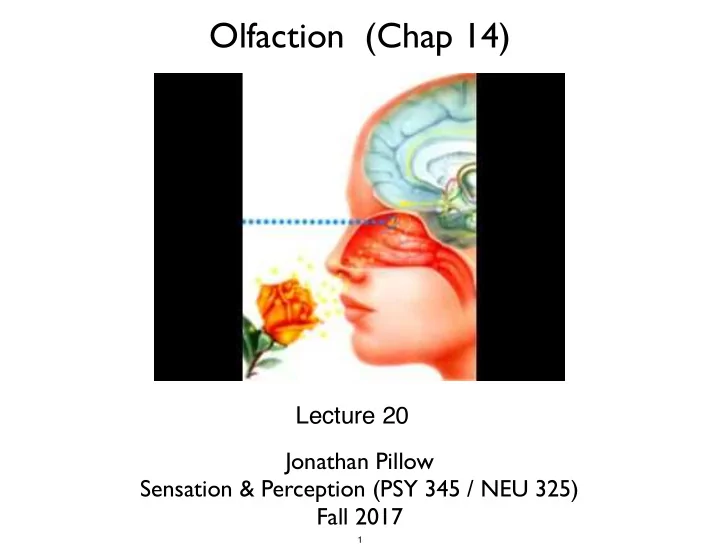
Olfaction (Chap 14) Lecture 20 Jonathan Pillow Sensation & Perception (PSY 345 / NEU 325) Fall 2017 1 The Chemical Senses Olfaction : The sense of smell (today) Gustation : The sense of taste 2 Odor: A general smell sensation of a


slide-1
SLIDE 1

Jonathan Pillow Sensation & Perception (PSY 345 / NEU 325) 
 Fall 2017 Lecture 20

Olfaction (Chap 14)

1
slide-2
SLIDE 2

The Chemical Senses

Olfaction: The sense of smell (today) Gustation: The sense of taste

2

slide-3
SLIDE 3

Odorants:

  • Chemical compounds
  • But not every chemical is

an odorant

  • Most are small, volatile,

and hydrophobic (don’t diffuse in water)

Odor:

A general smell sensation

  • f a particular quality

3

slide-4
SLIDE 4
  • ur “machinery” is less sensitive than
  • ther animals (dogs, etc.)
  • dogs can detect odorant concentrations 100x lower than humans


(dogs: can detect 1 part-per-million, humans: 100 parts-per-million)

  • but, experiments show that human receptors respond to single
  • dorant molecules
  • the difference? Dogs have ~ 1 billion receptors, humans have ~ 10

million

Is smell even relevant to humans?

4

slide-5
SLIDE 5

Conventional wisdom: humans not very good at olfaction

Bloodhound tracking a pheasant through a field

Gibbons, B. Nat. Geogr. Mag. 170, 324–361 (1986).

5

slide-6
SLIDE 6

Conventional wisdom is wrong!

Human tracking a scent trail through a field

Porter et al 2007

6

slide-7
SLIDE 7

Human scent-tracking

Porter et al 2007

7

slide-8
SLIDE 8

Two nostrils sample different regions of space

8

slide-9
SLIDE 9

single- vs. dual-nostril sniffing

  • humans use info from both nostrils for scent tracking

(24% slower w/ 1 nostril) “nasal prism”

9

slide-10
SLIDE 10

Physiology of the Olfactory System

10

slide-11
SLIDE 11

The nose

  • Olfactory cleft: space at the back of the nose into which air

flows, where the main olfactory epithelium is located

  • Olfactory epithelium: secretory mucosa whose primary function

is to detect odorants

11

slide-12
SLIDE 12

Olfactory epithelium: the “retina of the nose”

Three cell types

Supporting cells: Provides metabolic and physical support for the olfactory sensory neurons Basal cells: Precursor cells to olfactory sensory neurons

Olfactory sensory neurons (OSNs): The main cell type in the olfactory epithelium

  • OSNs are only kind of sensory

receptors that make direct contact with physical stimulus (i.e., unlike in retina, cochlea, skin, or tongue)

12

slide-13
SLIDE 13

Olfactory sensory neuron

  • Responses are slow!
  • OSN axons are

among the thinnest and slowest in the body

13

slide-14
SLIDE 14

Olfactory epithelium: the “retina of the nose”

Cilia: Hairlike protrusions on OSN dendrites 


  • Have receptor sites for odorant molecules. 

  • structures for olfactory signal transduction

Olfactory receptor (OR): The region on the cilia of OSNs where odorant molecules bind

  • Takes seven or eight odor molecules

binding to a receptor to initiate an action potential

14

slide-15
SLIDE 15

Olfactory epithelium: the “retina of the nose”

Cribriform plate: bony structure with tiny holes (even with the eyebrows), separating the nose from the brain

  • Axons from OSNs pass through

the tiny holes to enter the brain

15

slide-16
SLIDE 16

Olfactory epithelium: the “retina of the nose”

Mitral cells: The main projective output neurons in the olfactory bulb Glomeruli: Spherical conglomerates containing the incoming axons of the OSNs

  • Each OSN converges on two glomeruli

16

slide-17
SLIDE 17

Sensory pathway for

  • lfactory system

17

slide-18
SLIDE 18

Olfactory bulb: The blueberry-sized extension of the brain just above the nose, where olfactory information is first processed

  • There are two olfactory bulbs, one in each brain

hemisphere, corresponding to the left and right nostrils.

18

slide-19
SLIDE 19

Primary olfactory cortex: cortical area where olfactory information is first processed. Limbic system:

  • Involved in many aspects of emotion and memory
  • Olfaction is unique for its direct connection to limbic system

19

slide-20
SLIDE 20

Why Olfaction is Weird

  • direct connection to cortex
  • many subsequent cortical

connections to midbrain

Learning & Memory Emotion, Aggression, Fear Homeostasis, Aggression, Growth, ANS

  • also, no “smell-o-topic” maps: no topography

20

slide-21
SLIDE 21

Olfactory Physiology

Anosmia: The total inability to smell, most often resulting from sinus illness or head trauma

  • A hard blow to the front of the

head can cause the cribriform plate to be jarred back or fractured, slicing off the fragile

  • lfactory neurons
  • Anosmia causes a profound

loss of taste as well as smell

Essay: “The Miseries of losing one’s sense of smell” http://www.slate.com/id/2195018/

21

slide-22
SLIDE 22

Genetic basis of olfactory receptors:

  • Buck and Axel (1991) showed that genome contains about

1000 different olfactory receptor genes; each codes for a single type of OR

  • All mammals have pretty much the same 1000 genes.
  • However, some genes are non-functional “pseudogenes”

Dogs and mice: About 20% are pseudogenes Humans: Between 60% and 70% are pseudogenes Each person has a different number of pseudogenes, resulting in individual differences in sensitivity to smells

22

slide-23
SLIDE 23

Evolutionary trade-off between vision and olfaction

% pseudogenes species (color-coded by family)

Gilad et al, PLoS 2004

Old World Primates New World Primates

23

slide-24
SLIDE 24

Evolutionary trade-off between vision and olfaction

% pseudogenes species (color-coded by family)

Gilad et al 2004

tri-chromats di-chromats

howler monkey Old World Primates New World Primates

24

slide-25
SLIDE 25

Gilad et al 2004

Black arrows indicate on which lineages the acquisition

  • f full trichromatic color vision
  • ccurred.

Red lines show lineages with a high proportion of OR pseudogenes

25

slide-26
SLIDE 26

shape-pattern theory of olfactory perception

  • scent percept depends on fit between

OR shape and odorant shape

26

slide-27
SLIDE 27

Theories of olfactory perception:

  • Shape-pattern theory: The current dominant theory. 


  • The binding pattern of odorants in the olfactory epithelium

produces specific firing patterns of neurons in the olfactory bulb, which then determine the particular scent we perceive


  • Vibration theory: now defunct.


  • Proposes that every perceived smell has a different

vibrational frequency, and that molecules that produce the same vibrational frequencies will smell the same

27

slide-28
SLIDE 28

Study of stereoisomers

  • Molecules that are mirror-image rotations of one another;

although they contain the same atoms, they can smell completely different

  • Vibration theory cannot explain this phenomenon

smells of caraway smells of spearmint Theory that molecules with similar vibration frequencies should smell similarly

28

slide-29
SLIDE 29

The importance of patterns

  • How can we detect so many different scents if our genes
  • nly code for about 1000 olfactory receptors?

  • We can detect pattern of activity across many receptor types
  • Intensity of odorant changes which receptors are activated


(Weak concentrations of an odorant may not smell the same as strong concentrations of it!)

  • Specific time-order of activation of OR receptors is important

29

slide-30
SLIDE 30

Specific anosmia: The inability to smell one specific compound amid otherwise normal smell perception

  • 50% of population has specific anosmia to androstenone, a molecule

found in armpit sweat and pork

  • 50% perceive it as “sweet musky-floral” and 50% perceive it as an

unpleasant “urinous" odor (Shape-pattern theory can explain these findings)

30

slide-31
SLIDE 31

Bi-nostral smelling: why have two nostrils? “The world smells different to each nostril”

Sobel et al, Nature 2000 Background

  • 1. Airflow is greater into one nostril than the other,

due to slight swelling that obstructs airflow.

  • 2. Switches nostrils several times per hour.

Q: What are the consequences for olfaction?

31

slide-32
SLIDE 32

Bi-nostral smelling: why have two nostrils?

Background

  • 1. Airflow is greater into one nostril

than the other, due to slight swelling that obstructs airflow.

  • 2. Switches nostrils several times

per hour. Obstructed nostril (swollen turbinates) un-obstructed nostril (relaxed turbinates)

32

slide-33
SLIDE 33
  • Odorants sorb across nasal mucosa at different rates
  • “high-sorption” odorant – induces small response when

airflow is low, and large one when airflow is high

  • “low-sorption” odorant – large response when airflow is

low; small Finding: odorants do indeed smell different in nostrils, depending on the air flow and sorption

  • f the odorant!

33