Old silos, new silos, no silos From redundancy to aggregation or - - PowerPoint PPT Presentation

old silos new silos no silos
SMART_READER_LITE
LIVE PREVIEW

Old silos, new silos, no silos From redundancy to aggregation or - - PowerPoint PPT Presentation

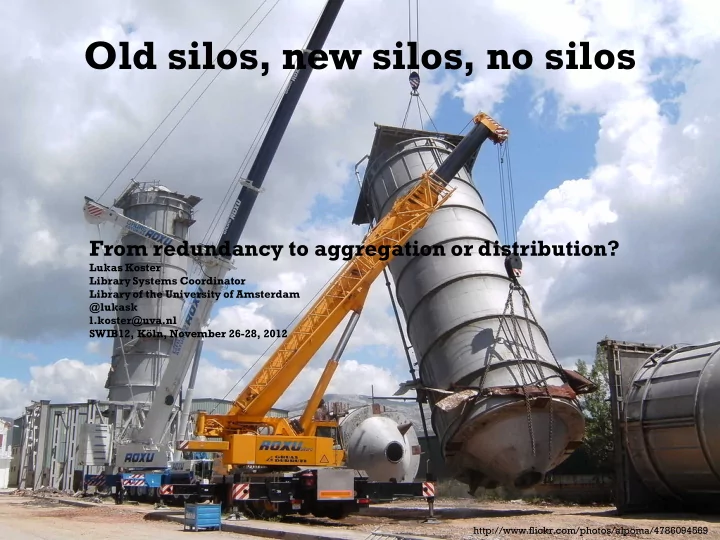
Old silos, new silos, no silos From redundancy to aggregation or distribution? Lukas Koster Library Systems Coordinator Library of the University of Amsterdam @lukask l.koster@uva.nl SWIB12, Kln, November 26-28, 2012


slide-1
SLIDE 1

Old silos, new silos, no silos

From redundancy to aggregation or distribution?

Lukas Koster Library Systems Coordinator Library of the University of Amsterdam @lukask l.koster@uva.nl SWIB12, Köln, November 26-28, 2012

http://www.flickr.com/photos/alpoma/4786094569

slide-2
SLIDE 2

What is a silo?

Old silos, new silos, no silos - SWIB12 - @lukask 2

http://www.flickr.com/photos/7716310@N03/1472185959

“System incapable

  • f reciprocal
  • peration with
  • ther, related

information systems”

http://en.wikipedia.org/wiki/Information_silo

slide-3
SLIDE 3

Old silos, new silos, no silos - SWIB12 - @lukask 3

data access

SILO NO SILO

“System containing data, only accessible via internal system calls”

slide-4
SLIDE 4

Old silos, new silos, no silos - SWIB12 - @lukask 4

API

(LOD)

system call data call Application Programming Interface

Direct access

http://twitter.com/hochstenbach/status/268033173366124544 http://twitter.com/jindrichmynarz/status/269089964103434242

slide-5
SLIDE 5

Focus

Old silos, new silos, no silos - SWIB12 - @lukask 5

Traditional library content: publications

http://commons.wikimedia.org/wiki/File:Latin_dictionary.jpg

slide-6
SLIDE 6

Story

Old silos, new silos, no silos - SWIB12 - @lukask 6

slide-7
SLIDE 7

http://igelu.org/wp- content/uploads/2010/10/smug4eu_issue2.pdf Old silos, new silos, no silos - SWIB12 - @lukask 7

slide-8
SLIDE 8

Old silos, new silos, no silos - SWIB12 - @lukask 8

!

A: Federated search systems are dead But you won’t get those kids back that you have already lost. They will stay with Google B: But what is the alternative? Build big databases like Google does? Harvest data till you drop? Probably we do need both. Big databases as well as federated search. C: Perhaps only a limited number of distributed harvested indexes around the world. Federated search can survive and be used for accessing those indexes!

7 years ago!

slide-9
SLIDE 9

Old silos, new silos, no silos - SWIB12 - @lukask 9

!

A: Federated search systems are dead But you won’t get those kids back that you have already lost. They will stay with Google B: But what is the alternative? Build big databases like Google does? Harvest data till you drop? Probably we do need both. Big databases as well as federated search. C: Perhaps only a limited number of distributed harvested indexes around the world. Federated search can survive and be used for accessing those indexes!

7 years ago!

slide-10
SLIDE 10

Old silos, new silos, no silos - SWIB12 - @lukask 10 http://igelu.org/wp- content/uploads/2010/10/smug4eu_issue4.pdf

slide-11
SLIDE 11

Old silos, new silos, no silos - SWIB12 - @lukask 11

If libraries describe their philosophy they’ll certainly also talk about integration – integration of services, integration of assets and resources. To make an excellent service all these tools need to function as an integrated

  • system. Not only with each other, but also interacting with the rest, such as the

institutional website, the institutional portal, third party’s learning environments. Technically speaking, integration may result in a functioning or a unified whole. A “functioning whole” may be understood as an integrated structure of cooperating tools in which the different parts (like in this case SFX, MetaLib or

  • ther tools) can be distinguished as such, whereas a “unified whole” would

mean that the end users experience one “new” system or user interface that conceals the integrated parts. When libraries are talking about integration, they are not only thinking about the user’s perspective, but also about the backend of their business, where internal workflows are in focus. In general, our aim is to reduce duplicating work, to store the same information only once, to cooperate closely. Combining different databases in real or virtual collections that can be accessed by a number of integrated or nonintegrated tools.
slide-12
SLIDE 12

Old silos, new silos, no silos - SWIB12 - @lukask 12

Libraries – integration of services, assets and resources.

Integrated systems

  • Functioning whole: an integrated structure of cooperating,

distinguishable tools

  • Unified whole: one new system of concealed integrated parts

Backend integration of internal workflows

  • Reduce duplicating work
  • Store the same information only once
  • Cooperate closely

Combined databases

  • Real collections
  • Virtual collections

Data management

  • Harvest data
  • Big data
  • Distributed harvested indexes
slide-13
SLIDE 13

Story

Old silos, new silos, no silos - SWIB12 - @lukask 13

slide-14
SLIDE 14

Old silos, new silos, no silos - SWIB12 - @lukask 14

Libraries: local collections of physical printed publications

http://www.flickr.com/photos/88526197@N00/4218544261/

slide-15
SLIDE 15

Old silos, new silos, no silos - SWIB12 - @lukask 15

Catalogues: finding publications and their locations

http://www.flickr.com/photos/88526197@N00/4218548045/

slide-16
SLIDE 16

Old silos, new silos, no silos - SWIB12 - @lukask 16

http://www.flickr.com/photos/cat-sidh/457060770

slide-17
SLIDE 17

Old silos, new silos, no silos - SWIB12 - @lukask 17

http://www.flickr.com/photos/dukeyearlook/7046582583 http://en.wikipedia.org/wiki/File:Screenshot_of_Dynix_library_automation_software_in_green.png

slide-18
SLIDE 18

Old silos, new silos, no silos - SWIB12 - @lukask 18

slide-19
SLIDE 19

Old silos, new silos, no silos - SWIB12 - @lukask 19

http://www.flickr.com/photos/oliver_leitzgen/2967000266/
slide-20
SLIDE 20

Old silos, new silos, no silos - SWIB12 - @lukask 20

slide-21
SLIDE 21

Old silos, new silos, no silos - SWIB12 - @lukask 21

http://www.flickr.com/photos/msueasrecords/6242093298/

Silos

Data traps

slide-22
SLIDE 22

Silo origins

Old silos, new silos, no silos - SWIB12 - @lukask 22

Technology Economics Licenses Tradition Psychology

http://www.flickr.com/photos/kotomi-jewelry/5035479051/
slide-23
SLIDE 23

Serious Story

Old silos, new silos, no silos - SWIB12 - @lukask 23

slide-24
SLIDE 24

Old silos, new silos, no silos - SWIB12 - @lukask 24

ILS REPO ILS REPO ILS REPO DB DB EJ EJ EJ DB ILS = Library Catalogue REPO = Institutional Repository DB = Database EJ = EJournal

Bibliographic data

slide-25
SLIDE 25

Old silos, new silos, no silos - SWIB12 - @lukask 25

ILS REPO ILS REPO ILS REPO DB DB EJ EJ EJ DB ILS = Library Catalogue REPO = Institutional Repository DB = Database EJ = EJournal

Federated search

slide-26
SLIDE 26

Old silos, new silos, no silos - SWIB12 - @lukask 26

ILS REPO ILS REPO ILS REPO Union Catalogue Repository Gateway Worldcat DB DB EJ EJ EJ AGG AGG AGG Google Scholar DB ILS = Library Catalogue REPO = Institutional Repository DB = Database EJ = EJournal AGG = Aggregation

Aggregations

slide-27
SLIDE 27

Old silos, new silos, no silos - SWIB12 - @lukask 27

ILS REPO ILS REPO ILS REPO Union Catalogue Repository Gateway Worldcat DB DB EJ EJ EJ AGG AGG AGG Google Scholar DB ILS = Library Catalogue REPO = Institutional Repository DB = Database EJ = EJournal AGG = Aggregation

Federated search

slide-28
SLIDE 28

Old silos, new silos, no silos - SWIB12 - @lukask 28

ILS REPO ILS REPO ILS REPO Union Catalogue Repository Gateway Worldcat DB DB EJ EJ EJ AGG AGG AGG Google Scholar DB ILS = Library Catalogue REPO = Institutional Repository DB = Database EJ = EJournal AGG = Aggregation

Aggregated search

slide-29
SLIDE 29

Old silos, new silos, no silos - SWIB12 - @lukask 29

ILS REPO ILS REPO ILS REPO Union Catalogue Repository Gateway Worldcat DB DB EJ EJ EJ AGG AGG AGG DI DI Google Scholar DB ILS = Library Catalogue REPO = Institutional Repository DB = Database EJ = EJournal AGG = Aggregation DI = Discovery Index DL = Discovery Layer DI DL DL DL

Discovery

slide-30
SLIDE 30

Old silos, new silos, no silos - SWIB12 - @lukask 30

ILS REPO ILS REPO ILS REPO Union Catalogue Repository Gateway Worldcat DB DB EJ EJ EJ AGG AGG AGG DI DI Google Scholar DB ILS = Library Catalogue REPO = Institutional Repository DB = Database EJ = EJournal AGG = Aggregation DI = Discovery Index DL = Discovery Layer DI DL DL DL

Bibliographic data

slide-31
SLIDE 31

Old silos, new silos, no silos - SWIB12 - @lukask 31

ILS REPO ILS REPO ILS REPO Union Catalogue Repository Gateway Worldcat DB DB EJ EJ EJ AGG AGG AGG DI DI Google Scholar DB ILS = Library Catalogue REPO = Institutional Repository DB = Database EJ = EJournal AGG = Aggregation DI = Discovery Index DL = Discovery Layer DI DL DL DL

B H C B B B B B B B B B B B B B B B B B B B B B B B B B

Bibliographic data Holdings data Circulation data

H H H H H H H H H H H H H H H H H C C C C C C C H C C H C C C

slide-32
SLIDE 32

Old silos, new silos, no silos - SWIB12 - @lukask 32

ILS REPO ILS REPO ILS REPO Union Catalogue Repository Gateway Worldcat DB DB EJ EJ EJ AGG AGG AGG DI DI Google Scholar DB ILS = Library Catalogue REPO = Institutional Repository DB = Database EJ = EJournal AGG = Aggregation DI = Discovery Index DL = Discovery Layer NG = Next Generation ILS DI DL DL DL

B H C B B B B B B B B B B B B B B B B B B B B B B B B B

Bibliographic data Holdings data Circulation data

H H H H H H H H H H H H H H H H H C C C C C C C H C C H C C C

NG NG NG

slide-33
SLIDE 33

Old silos, new silos, no silos - SWIB12 - @lukask 33

ILS REPO ILS REPO ILS REPO Union Catalogue Repository Gateway Worldcat DB DB EJ EJ EJ AGG AGG AGG DI DI Google Scholar DB ILS = Library Catalogue REPO = Institutional Repository DB = Database EJ = EJournal AGG = Aggregation DI = Discovery Index DL = Discovery Layer NG = Next Generation ILS DI DL DL DL

B H C B B B B B B B B B B B B B B B B B B B B B B B B B

Bibliographic data Holdings data Circulation data

H H H H H H H H H H H H H H H H H C C C C C C C H C C H C C C

NG NG NG

B B B H H H C C C

slide-34
SLIDE 34

Old silos, new silos, no silos - SWIB12 - @lukask 34

REPO REPO ILS REPO Union Catalogue Repository Gateway Worldcat DB DB EJ EJ EJ AGG AGG AGG DI DI Google Scholar DB ILS = Library Catalogue REPO = Institutional Repository DB = Database EJ = EJournal AGG = Aggregation DI = Discovery Index DL = Discovery Layer NG = Next Generation ILS DI DL DL DL

B H C B B B B B B B B B B B B B B B B B B B B B B B

Bibliographic data Holdings data Circulation data

H H H H H H H H H H H H H H H C C C C C H C C H C C C

NG NG NG

B B B H H H C C C

slide-35
SLIDE 35

Not very efficient

Old silos, new silos, no silos - SWIB12 - @lukask 35

Free market leads to efficiency? Not really!

Huge redundancies Missing data Obscure, cloudy situation Unequal access

slide-36
SLIDE 36

Old silos, new silos, no silos - SWIB12 - @lukask 36

Library crisis

$ 245 a

slide-37
SLIDE 37

Silutions?

Old silos, new silos, no silos - SWIB12 - @lukask 37

http://www.flickr.com/photos/thelightningman/5494666930

slide-38
SLIDE 38

Old silos, new silos, no silos - SWIB12 - @lukask 38

Stand-alone Aggregation Redundant Complementary Redundant Complementary Complementary aggregations Stand-alone aggregation Redundant Aggregations

slide-39
SLIDE 39

Completely distributed

Old silos, new silos, no silos - SWIB12 - @lukask 39

  • Redundancy risk
  • Performance risk
  • Persistence risk
  • Inconsistent indexes
  • Trust
  • Less redundancy
  • Up to date
  • Trust
  • Share workload

http://en.wikipedia.org/wiki/Fallacies_of_Distributed_Computing

slide-40
SLIDE 40

Is linked data the answer?

Old silos, new silos, no silos - SWIB12 - @lukask 40

Karen Coyle at EMTACL12: “The web is awash in bibliographic data” “Most of what we would contribute would be duplication of data that already exists” “It is library holdings that is key to providing service and furthering knowledge creation”

http://www.kcoyle.net/presentations/thinkDiff.pdf

slide-41
SLIDE 41

Old silos, new silos, no silos - SWIB12 - @lukask 41

Completely centralised

slide-42
SLIDE 42

Completely aggregated

Old silos, new silos, no silos - SWIB12 - @lukask 42

  • Speed
  • Consistency
  • No redundancy
  • Share workload
  • Persistence risk
  • Trust
slide-43
SLIDE 43

Distributed aggregation

Old silos, new silos, no silos - SWIB12 - @lukask 43

  • Speed
  • Consistency
  • Share workoad
  • Persistence risk
  • Reduncancy risk
  • Silos
slide-44
SLIDE 44

Next Generation ILS in the cloud

Old silos, new silos, no silos - SWIB12 - @lukask 44

Community /shared zone Library zone

FRBR

Work Expression Manifestation Items Holdings

ILS Union Catalogue Worldcat http://thoughts.care-affiliates.com/2012/10/impressions-of-new-library-service.html

slide-45
SLIDE 45

LoC Bibliographic Framework

Old silos, new silos, no silos - SWIB12 - @lukask 45

Work Expression Manifestation Items Holdings

http://www.loc.gov/marc/transition/

slide-46
SLIDE 46

Old silos, new silos, no silos - SWIB12 - @lukask 46

Community /shared zone Library zone

ILS Union Catalogue Worldcat

slide-47
SLIDE 47

Old silos, new silos, no silos - SWIB12 - @lukask 47

Worldcat Google Scholar

Community /shared zone Library zone

slide-48
SLIDE 48

Brave new world

Old silos, new silos, no silos - SWIB12 - @lukask 48

slide-49
SLIDE 49

Library roles

  • Reconsider objectives
  • Shift focus
  • Communicate with system vendors
  • Communicate with content vendors
  • Engage in framework transition
  • Cooperate

Old silos, new silos, no silos - SWIB12 - @lukask 49

slide-50
SLIDE 50

Old silos, new silos, no silos - SWIB12 - @lukask 50

Don’t think systems Think data

http://www.flickr.com/photos/57402879@N00/261930788/