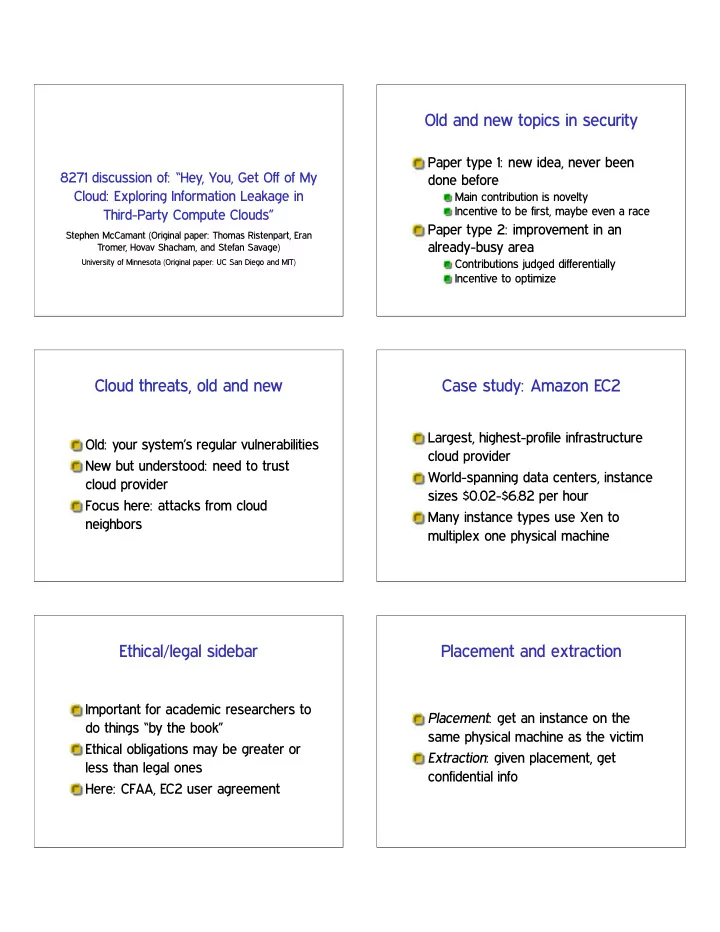
Old and new topics in security Paper type 1: new idea, never been - - PDF document

old and new topics in security
SMART_READER_LITE
LIVE PREVIEW

Old and new topics in security Paper type 1: new idea, never been - - PDF document

Old and new topics in security Paper type 1: new idea, never been 8271 discussion of: Hey, You, Get Off of My done before Cloud: Exploring Information Leakage in Main contribution is novelty Incentive to be first, maybe even a race


slide-1
SLIDE 1

8271 discussion of: “Hey, You, Get Off of My Cloud: Exploring Information Leakage in Third-Party Compute Clouds”

Stephen McCamant (Original paper: Thomas Ristenpart, Eran Tromer, Hovav Shacham, and Stefan Savage)

University of Minnesota (Original paper: UC San Diego and MIT)

Old and new topics in security

Paper type 1: new idea, never been done before

Main contribution is novelty Incentive to be first, maybe even a race

Paper type 2: improvement in an already-busy area

Contributions judged differentially Incentive to optimize

Cloud threats, old and new

Old: your system’s regular vulnerabilities New but understood: need to trust cloud provider Focus here: attacks from cloud neighbors

Case study: Amazon EC2

Largest, highest-profile infrastructure cloud provider World-spanning data centers, instance sizes $0.02-$6.82 per hour Many instance types use Xen to multiplex one physical machine

Ethical/legal sidebar

Important for academic researchers to do things “by the book” Ethical obligations may be greater or less than legal ones Here: CFAA, EC2 user agreement

Placement and extraction

Placement: get an instance on the same physical machine as the victim Extraction: given placement, get confidential info

slide-2
SLIDE 2

Network probing

TCP traceroutes, port 80 and 443 scans, DNS resolution Instances have one name, but separate public and internal IP addresses

Network mapping

Internal addresses reflect topology Disjoint by availability region, clustered by instance type Dom0s in an adjacent block

Network-based co-residence checks

Dom0 in traceroute (easiest) Close IP addresses Smallest packet round-trip times All found to have “effectively zero” false positives

Hard disk usage channel

Measure contention for hard disk (e.g., seek times) between VMs “No attempt to optimize” bandwidth: 0.0005 bits/sec (33 mins per bit) Why so slow?

Covert channels and side channels

“Covert channel”: generally send and receiver cooperate

One classification: storage channels, timing channels

“Side channel”: “sender” is passive victim

Can again include timing, also error messages, power usage, etc.

Observed placement locality

Sequential locality: new instance likely to use same machine as old dead one Parallel locality: instances started close in time more likely to share Non-locality: one account never given two instances on same machine

slide-3
SLIDE 3

Evaluating brute-force placement

Chose 1686 victims

Small instances in zone 3 with public web servers

Launched probe instances and checked co-residence

510 probes: hit 127 victims 1785 probes: hit 141 victims, 8.4%

Using locality

Idea: use parallel locality, try to start probes soon after victim

Perhaps can trigger victim start, such as if it’s based on demand

About 40% coverage for 20 victims and 20 probes Also demonstrated against demos of commercial services

Cache: Prime✰Trigger✰Probe

  • 1. (Prime) Fill cache with my data
  • 2. Busy loop until preempted (recognize

with TSC)

  • 3. Measure time to re-read my data

Must play tricks to defeat CPU pre-fetch Differential coding to resist noise

Load and traffic estimation

Check for co-residence using system load as a covert channel Estimate traffic load on co-resident web server

Keystroke timing attack (classic)

Fine-grained keystroke timing can reveal information about text typed Especially given per-user training Demonstrated in lab against passwords typed over SSH, without breaking crypto

50✂ speedup over exhaustive search

Keystrokes in Xen

Lab installation with CPU pinning,

  • therwise idle; not real EC2

Threshold cache activity level

More than idle, less than otherwise busy

5% false negatives, 0.3 false positives per second Timing resolution 13ms, enough for prior attacks

slide-4
SLIDE 4

Countermeasures: limited

Randomize and isolate network structure

Timing measurements still possible

Block or add noise to covert channels

Hard, and how to know you have them all?

Avoid locality in placement algorithm

Reduces but does not eliminate attacks

Countermeasure: pay for isolation

Pay extra to have machines all to yourself Argument: fair cost upper-bounded by cost of one physical machine Not implemented

Though compare: GovCloud