Oklahoma Statewide Autism Conference 2018 PARENT/CAREGIVER - - PDF document

oklahoma statewide autism conference 2018
SMART_READER_LITE
LIVE PREVIEW

Oklahoma Statewide Autism Conference 2018 PARENT/CAREGIVER - - PDF document

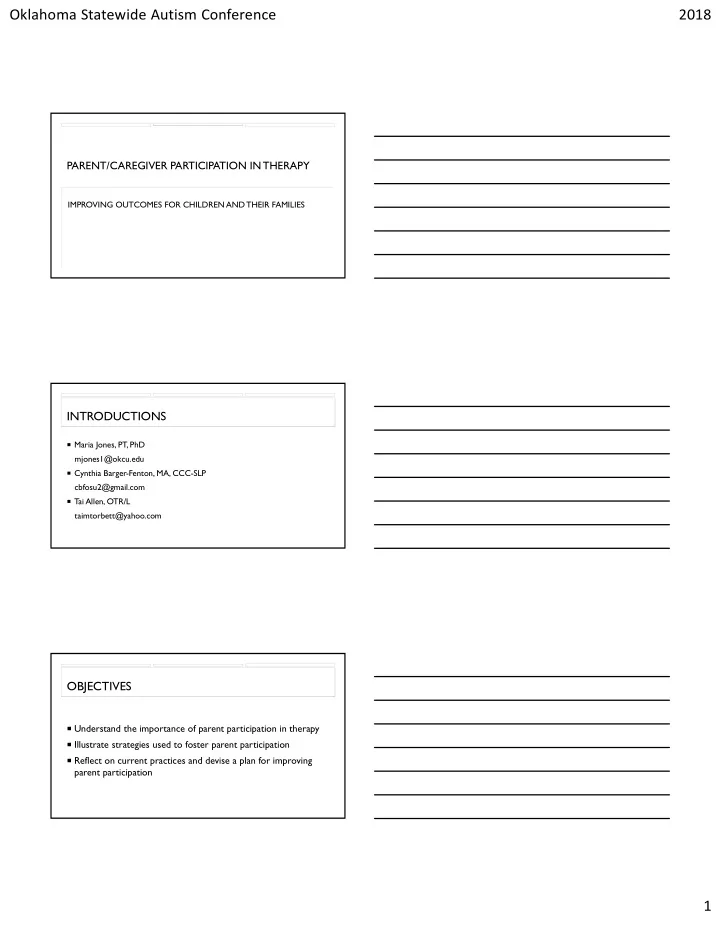
Oklahoma Statewide Autism Conference 2018 PARENT/CAREGIVER PARTICIPATION IN THERAPY IMPROVING OUTCOMES FOR CHILDREN AND THEIR FAMILIES INTRODUCTIONS Maria Jones, PT, PhD mjones1@okcu.edu Cynthia Barger-Fenton, MA, CCC-SLP


slide-1
SLIDE 1

Oklahoma Statewide Autism Conference 2018 1

PARENT/CAREGIVER PARTICIPATION IN THERAPY

IMPROVING OUTCOMES FOR CHILDREN AND THEIR FAMILIES

INTRODUCTIONS

 Maria Jones, PT, PhD

mjones1@okcu.edu

 Cynthia Barger-Fenton, MA, CCC-SLP

cbfosu2@gmail.com

 Tai Allen, OTR/L

taimtorbett@yahoo.com

OBJECTIVES

 Understand the importance of parent participation in therapy  Illustrate strategies used to foster parent participation  Reflect on current practices and devise a plan for improving

parent participation

slide-2
SLIDE 2

Oklahoma Statewide Autism Conference 2018 2

PARENT PARTICIPATION

WHAT IS IT?

DEFINITION -TERMINOLOGY MATTERS

Parent Involvement

 Doing to  Lead with mouth  Telling parents what they should do  One-way communication  Ownership remains with therapist/teacher/school  Focus on results in select or isolated situations/environments

Parent participation/engagement

 Doing with  Lead with ears  Listening to parents and eliciting ideas and strategies from them  Two-way conversation  Ownership is shared  Recognizes the need for efforts that extend across multiple situations/environments

Family- Centered Care

Acknowledging the family as a constant in the child’s life Encouraging family to family and peer support Promoting an individual approach Recognizing the importance

  • f community-

based services Honoring cultural diversity and family traditions Building on family strengths Developing policies, practices, and systems that are family- friendly and family-centered Celebrating successes Supporting child’s transition to adulthood Supporting the child in decision- making www.theberylinstitute.org

slide-3
SLIDE 3

Oklahoma Statewide Autism Conference 2018 3

Parent Participation/ Family- Centered Care

Better Health Outcomes Child and Family Satisfaction Clinician and Staff Satisfaction Improved Allocation of Resources Family Capacity Building

PARENT PARTICIPATION – WHY IMPORTANT?

 Honor the parent/family expertise  Parents/families are central to the child’s life  Parents/families have a unique set of values and relationships  Parents/families are in the lead and have ownership  Family life provides rich sources for child learning and development  Improved outcomes when families participate in interventions  Practice opportunities

PRACTICE AND REPETITION ARE IMPORTANT!!!

 A typically developing child will have been exposed to oral language for approximately 4,380 waking hours by the time s/he begins speaking at ~18 months of age.  If someone is using a different symbol set and only has exposure to it two times a week, for 20 – 30 minutes each, it will take 84 years for that person to have the same experience!!!  Language competency occurs around 9 – 12 years of age after being immersed in and practicing oral language for ~36,500 waking hours.  At twice a week, 20 – 30 minutes, it will 701 years for a person using an alternative system to have the same experience.

Jane Korsten (2011) QIAT Listserv 4th April

slide-4
SLIDE 4

Oklahoma Statewide Autism Conference 2018 4

PARENT PARTICIPATION

WHAT DO VARIOUS PROFESSIONS SAY ABOUT IT?

PARENT PARTICIPATION

 Oklahoma Parent Organizations  American Occupational Therapy Association  American Physical Therapy Association  American Speech and Language Association  Oklahoma State Department of Education  Oklahoma SoonerStart Early Intervention  Others?

AMERICAN OCCUPATIONAL THERAPY ASSOCIATION (AOTA)

 AOTA’s Occupational Profile  AOTA’s Code of Ethics  AOTA’s Standards for Continuing Competency  AOTA’s Standards of Practice for Occupational Therapy  Professional Literature

slide-5
SLIDE 5

Oklahoma Statewide Autism Conference 2018 5

AMERICAN PHYSICAL THERAPY ASSOCIATION (APTA)

 Guide to Physical Therapist Practice  Code of Ethics of the APTA  Standards of Conduct  Academy of Pediatric Physical Therapy – Fact Sheets  Providing Physical Therapy Under Parts B and C of the Individuals with

Disabilities Education Act

 Professional Literature

AMERICAN SPEECH-LANGUAGE-HEARING ASSOCIATION (ASHA)

 ASHA’s Preferred Practice Patterns  Professional literature

OK STATE DEPARTMENT OF EDUCATION – FAMILY AND COMMUNITY ENGAGEMENT

Core Belief 1 All parents have dreams for their children and want the best for them. Core Belief 2 All parents have the capacity to support their children’s learning. Core Belief 3 Parents and school staff should be equal partners. Core Belief 4 The responsibility for building partnerships between school and home rests primarily with school staff, especially school leaders.

slide-6
SLIDE 6

Oklahoma Statewide Autism Conference 2018 6

SOONERSTART EARLY INTERVENTION

 Mission  What is SoonerStart?

PARENT PARTICIPATION – WHEN?

Evaluation of Effectiveness /Measuring Outcomes Intervention Plan development /Goal Setting Assessment

HOW TO BEGIN THE CONVERSATION

 T ell me about….  your dreams, hopes, and goals  a typical weekday  a typical weekend  special times your family has shared together  family traditions and celebrations  How do you feel about daily routines?  Child’s participation  Satisfied  What works?  What doesn’t?  Priorities  Avoid yes/no questions

Family Interview Guide; Principles to Practice Indicators; Werner-DeGrace, 2004;

slide-7
SLIDE 7

Oklahoma Statewide Autism Conference 2018 7

PARENT PARTICIPATION – HOW DO YOU IMPLEMENT?

 Strategies  Obstacles and barriers

PARENT PARTICIPATION – HOW? IMPLEMENTATION

WHAT STRATEGIES DO YOU CURRENTLY USE?

STRATEGIES

Bearss et al, 2015

slide-8
SLIDE 8

Oklahoma Statewide Autism Conference 2018 8

Parent Training

 Led by professional with pre- established plan  Parent or teacher required to carry-

  • ut activities with child

 Requires interpretation when therapist not present  Measured in terms of “compliance” (did they do it or not)

Coaching

 Interaction style based on adult- learning strategies  Requires joint planning and reflection  How do you think this worked?  What might be some alternatives or what else did you try?  Therapist observes and models  Measured in terms of success

PARENT PARTICIPATION- STRATEGIES

Joint Planning Observation Action/Practice Reflection Feedback

PARENT PARTICIPATION- STRATEGIES

Coaching interactions involve: PARENT PARTICIPATION-STRATEGIES

MEALTIME CHALLENGES:  The EAT

  • UP ™ program (Easing Anxiety Together with Understanding and Perseverance) (Cosbey and

Muldoon, 2018) Key Components:  Each family given an individualized mealtime plan which included options for interventions  Each family selected options most appropriate and comfortable for their family AND free to reject any

  • ption/intervention they did not feel was appropriate for their child or family.

 Individualized training given for each intervention strategy (including prompting techniques, behavior strategies, and a visual hierarchy that allowed the parent AND child to actually see the expected interactions.  Duration: six months of intervention (twice weekly); actual number of sessions provided for each child ranged from 31 to 36 sessions.

slide-9
SLIDE 9

Oklahoma Statewide Autism Conference 2018 9

PARENT PARTICIPATION-STRATEGIES

PRAGMATIC LANGUAGE INTERVENTIONS  Parsons et al. (2017) reviewed 22 studies (including 15 different interventions) on interventions for pragmatic issues for people with autism The studies reviewed:  Included preschool-aged children with autism and elementary-aged children (ages 5-12)  No studies reviewed focused on adolescents  Durations of the interventions varied Findings:  Location, modality and age did not influence results of the intervention.  Interventions that included BOTH parents and child had a significant effect on pragmatic language abilities.  Interventions that included parent training only (without the child present) had little to no effect.

IMPLEMENTATION

WHAT BARRIERS HAVE YOU ENCOUNTERED?

BARRIERS REPORTED BY FAMILIES (COOPER-DUFFY & EAKER, 2017)

 Feeling the professionals do not listen  Not understanding the jargon used by the therapists or other members of their child’s team  Feeling that their children are talked about in terms of their deficits  Parents report that the attitude coming from the “professionals” was “You can’t possibly know what you’re talking about.”  Not recognizing the parents’ expertise concerning their child.  Feeling like they are “token participants” in discussions about their child.  Being presented with prewritten goals without consulting with the family first.  Feeling blindsided by recommendations and goals presented to them.

slide-10
SLIDE 10

Oklahoma Statewide Autism Conference 2018 10

PERCEIVED BARRIERS

Families may appear uninterested or disengaged or families are “uncoachable” (Rush, 2018)

 Families may feel that the therapy session is the clinician’s “time” to work with

their child.

 Feeling overwhelmed by the needs of their child  Families may feel that they lack the specialized training to “get” their child to

do what the clinician is able to do.

 A mismatch between expectations and priorities: the family doesn’t see the

need to do or be a part of what the clinician does; the clinician’s priorities may not be compatible with the family’s priorities.

PARENT PARTICIPATION – WHERE? EVALUATION THE EFFECTIVENESS?

Ongoing process All phases Prioritized Goals Measures to Use

slide-11
SLIDE 11

Oklahoma Statewide Autism Conference 2018 11

OUTCOMES PARENT PARTICIPATION-OUTCOMES

 Positive outcomes from carefully structured parental training and

coaching along with parental implemented strategies.

 Improvements in parents stress, self-efficacy, and skill acquisition of the

child with as little as 8-18 hours of training or coaching.

Dunn, Cox, Foster, Mische-Lawson, & Tanquary, 2012 Miller-Kuhaneck, Watling, 2018

MYTHS

 The strategies discussed don’t work with ALL families  The families I work with are uninterested or disengaged  You are trying to make parents be the therapist  I work in a clinic/school/etc, so this won’t work in my setting  I have to use standardized testing as an outcome measure  Families need a break or have so much on their plates that the

least I can do is provide a little relief by working with the child.

slide-12
SLIDE 12

References Adams, R.C., Tapia, C., & Council on Children with Disabilities. (2013). Early intervention, IDEA Part C services, and the medical home: Collaboration for best practices and best outcomes. Pediatrics, 132(4), 1073-1088. doi:10.1542/peds.2013-2305 American Occupational Therapy Association. (2014). Occupational therapy practice framework: Doman & process. Amercian Journal of Occupational Therapy, 69(Supplement 1), S1-S51. Bruder, M.B., & Dunst, C.J. (1999). Expanding learning opportunities for infants and toddlers in natural environments: A chance to reconceptualize early intervention. Zero to Three, December 1999/January 2000, 34-36. Campbell, P.H., & Halbert, J. (2002). Between research and practice: Provider perspectives on early

  • intervention. Topics in Early Childhood Special Education, 22(4), 213-226.

Childress, D., Hill, C., Jackson, S., Miller, T., & Plitt, M. E. (2015). Virginia’s coaching facilitation guide. Retrieved from Virginia Common Wealth University, Virginia Early Intervention Professional Development Center website: http://www.veipd.org/main/pdf/coaching_fac_guide_5.26.16.pdf Cooper-Duffy, K., & Eaker, K. (2017). Effective team practices: Interprofessional contributions to communication issues with a parent’s perspective. American Journal of Speech- Language Pathology, Volume 26, 181-192. Cosbey, J. & Muldoon, D. (2017) EAT-UP ™ family-centered feeding intervention to promote food acceptance and decrease challenging behaviors in children with Autism Spectrum Disorder: A single case experimental design replicated across three families of children with Autism Spectrum Disorder. Journal of Autism and Developmental Disorders, 47(3), 564-578. https://doi.org/10.1007/s10803-016-2977-0. Cosbey, J., & Muldoon, D. (2018) EAT-UP ™ family-centered feeding intervention to promote food acceptance and decrease challenging behaviors in children with Autism Spectrum Disorder: Report of follow-up data on a train-the-trainer model using EAT-UP™. American Journal of Speech-Language Pathology, 27(1). 278-287. https://doi.org/10.1044/2017_AJSLP-17- 0105. Crais, E.R. (1991). Moving from “parent involvement” to family-centered services. American Journal of Speech-Language Pathology, 1, 5-8. Fava, L., Strauss, K., Valeri, G., D’Elia, L., Arima, S., & Vicari, S. (2011). The effectiveness of a cross- setting complementary staff-and parent-mediated early intensive behavioral intervention for young children with ASD. Research in Autism Spectrum Disorders, 5(4), 1479-1492. Darrah, J., Law, M., & Pollock, N. (2001). Family-centered functional therapy: A choice for children with motor dysfunction. Infants and Young Children, 13(4), 79-87. Dunn, W., Cox, J., Foster, L. Mische-Lawson, L., & Tanquary, J. (2012). Impact of a contextual intervention on child participation and parent competence among children with autism spectrum disorders: A pretest-posttest repeated measures design. Amercian Journal of Occupational Therapy, 66(5), 520-528. Dunst, C.J. & Raab, M. (2004). Parents' and practitioners' perspectives of young children's everyday natural learning environments. Psychological Reports, 93, 251-256. Dunst, C. J. & Trivette, C. M. (2012). Moderators of the effectiveness of adult learning method practices. Journal of Social Sciences, 8(2), 143-148. Early Intervention Program for Infants and Toddlers With Disabilities; Assistance to States for the Education of Children With Disabilities; Final Rule and Proposed Rule, Volume 76, Number 188, 34 C.F.R. § 303.118 (2011). Foster, L., Dunn, W., & Lawson, L.M. (2013). Coaching mothers of children with autism: A qualitative study for occupational therapy practice. Physical & Occupational Therapy in Pediatrics, 33(2), 253-263. doi:10.3109/01942638.2012.747581 Friedman, M., Woods, J., & Salisbury, C. (2012). Caregiver coaching strategies for early intervention providers: Moving towards operational definitions. Infants and Young Children, 25(1), 62-82. doi:10.1097/IYC.0b013e31823d8f12

slide-13
SLIDE 13

Graham, F., Rodger, S., & Ziviani, J. (2013). Effectiveness of occupational performance coaching in improving children’s and mothers’ performance and mothers’ self-competence. American Journal

  • f Occupational Therapy, 67(1), 10–18.http://dx.doi.org/10.5014/ajot.2013.004648

Graham, F., Rodger, S., & Ziviani, J. (2009). Coaching parents to enable children's participation: An approach for working with parents and their children. Australian Occupational Therapy Journal, 56(1), 16-23. Jansen, L.M., Ketelaar, M., Vermeer, A. (2003). Parental experience of participation in physical therapy for children with disabilities. Developmental Medicine & Child Neurology, 45, 58-69. Kellegrew, D. H. (1998). Creating opportunities for occupation: An intervention to promote the self-care independence of young children with special needs. American Journal of Occupational Therapy, 52, 457-465. Kucharczyk, S., Shaw, E., Smith Myles, B., Sullivan, L., Szidon, K., & Tuchman-Ginsberg, L., (2012) Guidance & coaching on evidence-based practices for learners with autism spectrum disorders. Chapel Hill: the University of North Carolina, Frank Porter Graham Child Development Institute, National Professional Development Center on Autism Spectrum Disorders. Law, J., Plunkett, C., Taylor, J., & Gunning, M. (2009). Developing policy in the provision of parenting programmes: Integrating a review of reviews with the perspectives of both parents and

  • professionals. Child Care, Health and Development, 35(3), 302-312.

Little, L. M., Pope, E., Wallisch, A., & Dunn, W. (2018). Occupation-based coaching by means of telehealth for families of young children with autism spectrum disorder. American Journal of Occupational Therapy, 72(2),1-7. https://doi.org/10.5014/ajot.2018.024786 McGroder, S., M., However, E.C., Fishman, M., Rankin, V.E., & Helsel, F.K. (2014). Putting the pieces together: A program logic model for coaching in Head Start. From the Descriptive Study of the Head Start Early Learning Mentor Coach Initiative. OPRE Report #2014-06; Washington, DC: U.S. Department of Health and Human Services, Administration for Children and Families, Office

  • f Planning, Research and Evaluation.

Miller-Kuhaneck, H., & Watling, R. (2018). Parental or teacher education and coaching to support function and participationof children and youth with sensory processing and sensory integration challenges: A systematic review. American Journal of Occupational Therapy, 72(1), 1-11. https://doi.org/10.5014/ajot.2018.029017 Oklahoma Autism Network. (2014). ConnectedKids: Training Parents To Use Developmental and Behavioral Strategies with Their Child with Autism Spectrum Disorder. Unpublished report. Oklahoma Family Support Partnership Council. (2002). Oklahoma individual and family support principles to practice indicators. Oklahoma City, OK: Center for Learning and Leadership, College

  • f Medicine, University of Oklahoma Health Sciences.

Oono, I. P., Honey, E. J., & McConachie, H. (2013). Parent‐mediated early intervention for young children with autism spectrum disorders (ASD). Evidence‐Based Child Health: A Cochrane Review Journal, 8(6), 2380-2479. Palisano, R.J., Snider, L.M., & Orlin, M.N. (2004). Recent advances in physical and occupational therapy for children with cerebral palsy. Seminars in Pediatric Neurology, 11(1), 66-77. Parson, L., Cordier, R., Munro, N., Joosten, A., & Speyer, R. (2017). A systematic review of pragmatic language interventions for children with autism spectrum disorder. PLoS ONE 12(4), e0172242. https://doi.org/10.1371/journal.pone.0172242 Phillips, M.D. & Glickman, C.D. (1991). Peer coaching: Developmental approach to enhancing teacher

  • thinking. Journal of Staff Development, 12(2), 20-25.

Rush, D. (2018). From couching to coaching. The ASHA Leader (23)10, 46-52. https://doi.org/10.1044/leader.FTRI.2310.2018.46 Rush, D. D. & Shelden, M. (2011). The early childhood coaching handbook. Baltimore: Paul H. Brookes. Rush, D.D., & Shelden, M.L. (2006). Coaching Practices Rating Scale for Assessing Adherence to Evidence-Based Early Childhood Intervention Practices. CASEinPoint, 2(2), 1-7. Retrieved from: http://fipp.org/static/media/uploads/casetools/casetools_vol2_no2.pdf Rush, D. D., Shelden, M. L. (2005). CASEinPoint: Evidence-based definition of coaching practices. CaseinPoint, 1(6). Rush, D. D., Shelden, M.L., & Hanft, B.E. (2003). Coaching families and colleagues: A process for collaboration in natural settings. Infants and Young Children, 16(1), 33-47.

slide-14
SLIDE 14

Rush D. D., Shelden M. L., & Raab M. (2008). A framework for reflective questioning when using and a coaching interaction style. CASEtools, 1(4), 1-6. Rycroft-Malone, J., Kitson, A., Harvey, G., McCormack, B., Seers, K., Titchen, A., & Estabrooks, C. (2002). Ingredients for change: revisiting a conceptual framework. Quality & Safety in Health Care, 11(2), 174–180. http://doi.org/10.1136/qhc.11.2.174 Segal, R. (2004). Family routines and rituals: A context for occupational therapy interventions. Amercian Journal of Occupational Therapy, 58(5), 499-508. Shelden, M.L., & Rush, D.D. (2001). The ten myths about providing early intervention services in natural

  • environments. Infants and Young Children, 14(1), 1-3.

Snyder, P. A., Hemmeter, M. L., & Fox, L. (2015). Supporting implementation of evidence-based practices through practice-based coaching. Topics in Early Childhood Special Education, 35(3), 133-143. Trivette, C.M., Dunst, C.J., & Hamby, D. (2004). Sources of variation in and consequences of everyday activity settings on child and parent functioning. Perspectives in Education, 22(2), 17-35. Vismara, L. A., Young, G. S., & Rogers, S. J. (2013). Community dissemination of the Early Start Denver Model: Implications for science and practice. Topics in Early Childhood Special Education, 32(4), 223-233. Weatherby, A.M., Guthrie, W., Woods, J., Schatschneider, C., Holland, R.D., Morgan, L., & Lord, C. (2014). Parent-implemented social intervention for toddlers with autism: An RCT. Pediatrics, 134(6),1084-1093. Werner DeGrace, B. (2004). The everyday occupation of families with children with autism. American Journal of Occupational Therapy, 58(5), 543–550. Whipple, W. (2014). Key principles of early intervention and effective practices: A crosswalk with statements from discipline specific literature. Retrieved from http://ectacenter.org/~pdfs/topics/eiservices/KeyPrinciplesMatrix_01_30_15.pdf Wilcox, M.J., & Woods, J. (2011). Participation as a basis for developing early intervention outcomes. Language, Speech, and Hearing Services in Schools, 42, 365–378. Workgroup on Principles and Practices in Natural Environments, OSEP TA Community of Practice: Part C Settings. (2008, March). Agreed upon mission and key principles for providing early intervention services in natural environments. Retrieved from http://ectacenter.org/~pdfs/topics/families/Finalmissionandprinciples3_11_08.pdf