
SLIDE 1
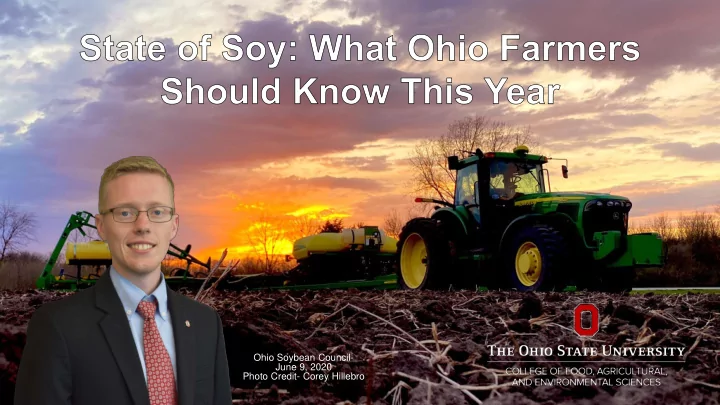
Ohio Soybean Council- June 9, 2020 Photo Credit- Corey Hillebro
Ohio Soybean Council- June 9, 2020 Photo Credit- Corey Hillebro - - PowerPoint PPT Presentation
Ohio Soybean Council- June 9, 2020 Photo Credit- Corey Hillebro The outlook might be grim, but this helped me to remember the positives- it is without a doubt, the most fertile country, with the most varied soil, the best watered, and that
Ohio Soybean Council- June 9, 2020 Photo Credit- Corey Hillebro
Photo Credits: Easy Stock Market, Pinnacle Agriculture, and American Soybean Association
Global Growth China Trade Growing Stocks
African Swine Fever
Meat Demand
South Amer. Acres
US Dollar US Acreage Increase Fund Positions
Credit to INTL FCStone for concept
50 100 150 200 250 300 350 400
1996 1998 2000 2002 2004 2006 2008 2010 2012 2014 2016 2018 2020
Million Metric Tons
Global Soybean Production
Rest of World East Asia US South America
Source: USDA FAS
New Record at ~363
15 20 25 30 35 40 45 50 55 $6.00 $8.00 $10.00 $12.00 $14.00 $16.00 $18.00 4/5/2013 4/5/2014 4/5/2015 4/5/2016 4/5/2017 4/5/2018 4/5/2019 4/5/2020 Brazilian Real/Bushel USD/ Bushel
Soybean Prices in to US and Brazilian Producers in Domestic Currency
Author Calculation using CEPEA and USDA AMS Data
133
670
128
290 394
315 571
370 115 17
568
200 400 600 800 Million Bushels
Change in US Soybean Production from Previous Year
Data Source: Author Calculation using USDA FAS Data
160 171.754 100 110 120 130 140 150 160 170 180 190 Sept Oct Nov Dec Jan Feb Mar Apr May Jun Jul Aug
Million Bushels
NOPA Soybean Monthly Crush Reports
Previous 5-Yr Range 5-yr average 2018/19 2019/20
Data Source: National Oilseed Processors
NOPA Represents 95% of US Soybean Crush
50 100 150 200 250 Cents per Pound
Daily Soybean Crush Margin
Data Source: DTN Prophet X
2,194 2,144 2,098 2,100 2,115 2,127 2,140 2,146 2,040 2,060 2,080 2,100 2,120 2,140 2,160 2,180 2,200 2,220 Sep Oct Nov Dec Jan Feb Mar Apr May Jun Jul Aug Million Bushels
Implied 2019/20 Marketing Year Soybean Crush- by Month
Author Calculation using NOPA and USDA- NASS Data
USDA May Estimate- 2,125
Source: Author Calculation using USDA Agricultural Marketing Service Data
200,000 250,000 300,000 350,000 400,000 450,000 500,000 Weekly Hog Slaughter
US Federally Inspected Hog Slaughter- 6 Day Moving Average 2019 2020 5-Year Average
43% Drop ❖ Another 1.9 million people filed for unemployment for the first time last week. ❖ Roughly 39 million people have been laid off, furloughed,
job in just 10 weeks. ❖ Official unemployment rate is 16.3% for May- down from 19.7% in April. ❖ Roughly 40% of total people either working or looking for work (workforce) were not receiving pay. – benefits? ❖ What type of income effects will we see later in 2020?
5 20 27 26 21 5 8 4 8 7 6 7 3 2 2 2 2 6 7
5 10 15 20 25 30
Aug Sep Oct Nov Dec Jan Feb Mar Apr May Jun Jul Aug Sep Oct Nov Dec Jan Feb Mar Apr 2018 2019 20
Reported Cases
Number of Reported Cases in China of African Swine Fever
Data Source: Chinese Ag Ministry
❖ Cases have started to rise in China again. ❖ Outbreaks in Poland and Eastern European countries. ❖ China announced ban of pork from
Data Sources: Historical- U.S. Energy Information Agency, Forecast- Author calculation using estimates for percentage declines in month gasoline consumption reported by US gasoline retailors to historical use.
❖ Consumption of motor gasoline is increasing from a low of almost 213 million gallons/ day or a 46% reduction from expected. ❖ Likely will not return to pre-COVID fuel use in 2020. ❖ 11% decline in annual fuel demand. ❖ Assumes no flare-up later in 2020. ❖ Forecasted gasoline demand in 2021 and how the EPA sets the Renewable Volume Obligation (RVO) are going to be important for all biofuels in marketing year 20/21. ❖ Low oil prices have two effects- ❖ Increase gasoline use ❖ Decrease short-term biofuel competitiveness (~$0.02/gal.)
390.0 396.5 407.2 212.7 317.1 150 200 250 300 350 400 450 Jan Feb Mar Apr May Jun Jul Aug Sep Oct Nov Dec Million Gallons per Day
Weekly Demand of Finished Motor Gasoline
5-Year Average 2019 2020 2020 Forecast
55%-65% 65%-75% 75%-85% 85%-95% 95%-100% Unsure
25272928 24 29 24 293034 3942 3737 45 5048 5956 47 43
10 20 30 40 50 60 70
Million Metric Tons
United States Soybean Commitments September thru May
Rest of the World China
Data Source: USDA FAS Source: Intl FCStone
Credit: Karen Braun
Cycle Broken ASF
Projected Change in Brazilian Land Use and Cropland in Response to a 25% Increase in Tariffs on US Soybean Exports to China
Richards, P, F. Taheripour, E. Arima, and W.E.Tyner.
Impact on Land Use Change and Greenhouse Gas Emissions in South Africa. “Choices. Quarter. 2.
0% 5% 10% 15% 20% 25% 30%
10 20 30 40 50 60 70 1990/91 1991/92 1992/93 1993/94 1994/95 1995/96 1996/97 1997/98 1998/99 1999/00 2000/01 2001/02 2002/03 2003/04 2004/05 2005/06 2006/07 2007/08 2008/09 2009/10 2010/11 2011/12 2012/13 2013/14 2014/15 2015/16 2016/17 2017/18 2018/19 2019/20 2020/21 Stocks to Use Ratio Carry Out (Million Metric Tons)
South America Carryout and Stocks to Use Ratio
Data Source: USDA FAS
Source: FAPRI-MU; U.S. Agricultural Market Outlook; Trade Friction Baseline and a Phase 1 Scenario. FAPRI-MU Report #01-20. March 2020.
490 1,534 490 1,561 1,402 423 1,423 427 1,892 1,957 1,913 1,988 500 1,000 1,500 2,000 2,500 No Deal Phase 1 No Deal Deal 2020/21 2021/22 Million Bushels
Impact on Total US Soybean Exports
Yes No, but more than 2017 baseline No, and less than 2017 baseline Unsure
Data Source: USDA FSA, Concept Credit: John Newton AFBF
1,194 2,252 1,583 1,358 786 789 1,054 651 610 774 823 1,126 414 388 493 523 717
500 1,000 1,500 2,000 2,500 Oct Nov Dec Jan Feb Mar Apr May Jun Jul Aug Sep Million Dollars
US Ag Sales to China- Fiscal Year
Actual Sales Sales Needed Seasonal Forecast
Key Reminders ❖ USDA lowered 2020 Fiscal Year exports to China to $13 billion as result of COVID. ❖ Phase 1 is on a calendar year not fiscal year. ❖ Phase 1 for 2020 is 12.5 billion more than 2017 baseline of $19.5 billion.
USDA- May 2019-20 Planted Acres 76.1 Harvested Acres 75.0 Yield 47.4 Beginning Stocks 909 Production 3,557 Imports 15 Total Supply 4,481 Crushing 2,125 Seed 97 Residual 4 Total Domestic 2,226 Exports 1,675 (-100) Total Use 3,901 Ending Stocks 580 (+100) Stocks to Use 14.9% Farm Cash Price $8.50 USDA-May 2020-21 83.5 82.8 49.8 580 4,125 15 4,720 2,130 100 35 2,265 2,050 4,315 405 9.4% $8.20
New Crop Estimates 6.7.2020
2020-21 Bearish Bullish 83.5 85.5 84.0 82.5 84.5 83.0 50.5 51 50.5 595 670 570 4,166 4,310 4,192 15 20 20 4,776 5,000 4,782 2,135 2,135 2,135 90 90 90 20 20 20 2,245 2,245 2,245 1,950 1,800 2,100 4,195 4,045 4,345 581 955 437 13.8% 24% 10.1% $8.45 $7.75 $9.05 Ben’s 2019-20 76.1 75.0 47.4 909 3,558 15 4,482 2,135 (+10) 97 5 2,237 1,650 (-25) 3,912 595 14.6% $8.55
USDA-May 2019-20 Planted Acres 89.7 Harvested Acres 81.4 (-0.1) Yield 167.8 (-0.2) Beginning Stocks 2,221 Production 13,663 Imports 45 Total Supply 15,928 Feed Use and Res. 5,700 (+25) Food, Seed, Ind. 6,355 Ethanol 4,950 (-100) Total Domestic 12,140 Exports 1,725 (+50) Total Use 13,830 (-35) Ending Stocks 2,098 (+6) Stocks to Use 15.1% Farm Cash Price $3.60
Ben’s
2019-20 89.7 81.3 (-0.1) 168 2,221 13,658 45 15,924 5,750 (+50) 6,215 4,800 (-150) 11,965 1,725 13,690 2,234 16.3% $3.60
New Crop Estimates 6.7.2020
2020-21 Bearish Bullish 95.1 97.0 94.5 87.2 89.0 86.2 178.5 180.0 170.0 2,234 2,234 2,234 15,565 16,020 14,654 50 50 50 17,849 18,304 16,938 5,625 5,625 5,675 6,515 6,515 6,865 5,100 5,100 5,400 12,140 12,140 12,490 2,200 2,000 2,575 14,340 14,140 15,115 3,509 4,164 1,823 24.5% 29.4% 12.1% $2.90 $2.50 $4.10 USDA-May 2020-21 97.0 89.6 178.5 2,098 15,995 25 18,118 6,050 6,600 5,200 12,650 2,150 14,800 3,318 22.4% $3.20
❖ For Soybeans- USDA is very optimistic with Chinese global soybean demand as their current estimate for next year is 5% above pre-ASF outbreak levels. Chinas hog herd remains about ½ of that time frame. ❖ 2020/21 domestic corn production came close to the expected 16 billion bushels in May, but USDA got creative on the demand side (feed & residual, exports) to soften the blow. ❖ Focus now shifts to weather and final acreage. ❖ Two areas of interest for acreage- North Dakota and Eastern Corn-Belt ❖ Good Crops are currently expected, but probability of dryness is increasing. ❖ Will China be a player in the US demand story? ❖ Large crops both domestically and globally are going to continue to weigh on commodity prices. ❖ Not many profitable moments at current futures price. ❖ Soybean harvest basis is still relatively strong. This is likely the lowest soybean stocks number of the year and prices will start to reflect that without any weather issues.
Yes, already been to the FSA Office Yes, need to go to FSA Office still I understand there are programs for producers, but I don’t know how they work. I am not aware of programs available to producers. Unsure
$9.5 Billion from CARES Act- Passed in March
increased marketing expenses associated with the COVID-19 Pandemic” $6.5 Billion from the Commodity Credit Corporation (CCC) “Funding will compensate producers due to on-going market disruptions and will assist with the transition to a more orderly marketing system as the pandemic wanes.” $16 billion in total payments. ❖ The Coronavirus Aid, Relief, and Economic Security (CARES) Act passed Congress and signed into law March 27, 2020. ❖ U.S. Secretary Sonny Perdue announces Coronavirus Food Assistance Program (CFAP) April 17, 2020. Two parts:
❖ USDA releases CFAP details for Direct Assistance May 19, 2020. ❖ Application period opened May 26, 2020 and continues through August 28, 2020.
CARES Funding CCC Funding
Condition 1: Eligible Inventory Condition 2: Unpriced Inventory Condition 3: Subject to Price Risk
The lower of: 1) self-certified unpriced inventory; vested
15, 2020
2) 50% of 2019 production. Corn chopped for silage in 2019 counts toward 2019 corn production and if held
counts for corn payment. (Tons x 7.94= bushels) “production that is not subject to an agreed upon price in the future through a forward contract, agreement or similar binding document” (Final Rule- USDA FSA) . “must still be at risk of price fluctuations after January 15, 2020 to be eligible”
Non-Specialty Crop Marketing Contract Eligibility for CFAP
Type of Contract in Existence
Explanations
Contracts Eligible for CFAP Basis Contract
Producer locks in a basis leaving the future price to be set later.
Basis Fixed Contract No Price Established
Producer delivers commodity without setting a sales price.
Delayed Price Deferred Price Contract Contracts Ineligible for CFAP
Cash Contract Producer receives a cash price for a commodity when sold. Fixed Price Contract Forward Price Contract Producer receives a cash price for a commodity based on a future delivery. Cash Forward Contract Minimum Price Contract Producer locks in the cash price and buys a call option to establish a minimum price. The net cash price will never be less than the original cash value minus the cost of the call option. Option Contract Window Contract Hedge to Arrive (HTA) Producer locks in a futures price leaving the basis to be set later. Futures Fixed Contract Futures Contract Source: USDA.gov/CFAP
Commodity Unit CARES Act Payment Rate ($/unit) CCC Payment Rate ($/unit) Average Payment Rate for Grain* Barley (malting) bushel $0.34 $0.37 $0.355 Canola pound $0.01 $0.01 $0.01 Corn bushel $0.32 $0.35 $0.335 Durum Wheat bushel $0.19 $0.20 $0.195 Hard Red Spring Wheat bushel $0.18 $0.20 $0.19 Millet bushel $0.31 $0.34 $0.325 Oats bushel $0.15 $0.17 $0.16 Sorghum bushel $0.30 $0.32 $0.31 Soybeans bushel $0.45 $0.50 $0.475 Sunflowers pound $0.02 $0.02 $0.02 Upland Cotton pound $0.09 $0.10 $0.095
* Since the formula is 50% of eligible bushels times each payment rates, the formula can be simplified to the simple average of the CARES Act and CCC payment rates time 100% of eligible bushels.
Crop 50% of 2019 production (bushels)
inventory (bushels) Rate per bushel Total Corn 50,000 40,000 $0.335 $13,400 Soybean 10,000 18,000 $0.475 $4,750 Total $18,150 80% First Installment $14,520 20% Second Installment $3,630 Formula Reminder (50% * (Lesser of 50% of 2019 production or inventory Jan. 15) * CFAP Rate) + (50% * (Lesser of 50% of 2019 production or inventory Jan. 15) * CCC Rate) Simplified Formula 100% * (Lessor of 50% of 2019 production or inventory Jan. 15) * average payment rate
Ohio Corn Impacts Pre COVID1 $3.90/bu. Post COVID2 $3.58/bu. Change
Reference Price $3.70/bu. Ohio Yield 164 bu./acre Change in Revenue $52.48/acre
1) Reported in FAPRI-MU 10-year baseline with Phase 1 Deal January 2020 2) Reported in FAPRI-MU COVID Impacts Report April 2020 3) Paid in October 2020, PLC payments based on individual FSA Farm Yield
Ohio Soybean Impacts Pre COVID1 $8.97 Post COVID2 $8.57/bu. Change
Reference Price $8.40/bu. Ohio Yield 49 bu./acre Change in Revenue $19.60/acre
1) Reported in FAPRI-MU 10-year baseline with Phase 1 Deal January 2020 2) Reported in FAPRI-MU COVID Impacts Report April 2020 3) Paid in October 2020, PLC payments based on individual FSA Farm Yield
Ohio Wheat Impacts Pre COVID1 $4.54/bu. Post COVID2 $4.50/bu. Change
Reference Price $5.50/bu. Ohio Yield 56 bu./acre Change in Revenue $2.80/acre
1) Reported in FAPRI-MU 10-year baseline with Phase 1 Deal January 2020 2) Reported in FAPRI-MU COVID Impacts Report April 2020 3) Paid in October 2020, PLC payments based on individual FSA Farm Yield
Eligibility: crop producers who experienced yield losses due to excess moisture or eligible causes in 2018 and 2019.
Enrollment: USDA signup began March 23, 2020- deadline ??? Unable to process applications as of now. Farmers can call local FSA office to apply. Application: Eligible individuals or entities, conservation compliance provisions are met, and a crop insurance or NAP coverage agreement and production records by crop, type, practice, and intended use (insurance records count)**. **must purchase insurance or NAP for two years at least 60% Payments: WHIP+ Payment= (Expected value of Crop x WHIP Factor) minus (Actual Value of Crop Harvested x Payment Factor) and NAP or Insurance Indemnity Payment. Only the WHIP Factor is known at this time and is based on insurance coverage level. Payment Factors and Crop Values are unknown.
Producers not in an eligible county but can prove losses occurred because of qualifying disaster can qualify.
Ben Brown, brown.6888@osu.edu, 660-492-7574 Peggy Kirk Hall, hall.673@osue.du, 937-645-3123 David Marrison, Marrison.2@osu.edu Dianne Shoemaker, shoemaker.3@osu.edu Barry Ward, ward.8@osu.edu, 614-688-3959
Corn Soybeans 2018 2019 2020 F 2018 2019 2020 F
Yield per acre
194 151 188 65 49 59
Price per bushel
$3.67 $3.81 $3.20 $8.83 $9.26 $8.30
Crop Revenue
$712 $575 $601 $574 $454 $490
ARC/PLC with respective year
$1 $20 $39 $1 $20 $39
MFP
$2 $66 $0 $107 $66 $0
CFAP- 2019 Only
$2 $14 $0 $1 $8 $0
Gross Revenue
$717 $697 $640 $683 $558 $529
Variable and Non-land Costs
$475 $494 $466 $262 $288 $249
Cash Rent
$230 $226 $226 $230 $226 $226
Farmer Return
$12
$191 $44 $54
The Author would like to give a special thanks to the farm panel members that help create these representative farms.
Graphic Idea: Gary Schnitkey
Only if there is financial need. Yes- greater than $50/acre Yes- less than $50/acre No Unsure
❖ Some changes in input costs. (Not a lot) ❖ Debt service is cheaper. ❖ Fuel costs ❖ Land and Cash Rent Prices- Holding (82% of Farms Assets held in land) ❖ Change in Market Year Average Prices
❖ 2019: Corn -$0.20, Soy -$0.25 ❖ 2020: Corn -$0.35, Soy -$0.60
❖ Great concern around working capital. ❖ $19.90/acre loss in old crop
payments, but same crop insurance. ❖ $53/acre loss in the 2020 contribution margin since January. ❖ 2018 & 2019 MFP Payments Helped ❖ 2020 CFAP for 2019 crops ❖ 2nd Round of a similar Coronavirus Food Assistance Program for 2020?
$3.23 $8.58 $7.75 $8.00 $8.25 $8.50 $8.75 $9.00 $9.25 $9.50 $9.75 $2.75 $2.95 $3.15 $3.35 $3.55 $3.75 $3.95 $4.15 Dec-19 Jan-20 Feb-20 Mar-20 Apr-20 May-20 Jun-20 Cash Soybean Price $/Bu. Cash Corn Price $/Bu.
Ohio Cash Prices for Corn and Soybeans December 2, 2019- June 5, 2020
❖ Land values appear to be steady-at the moment. ❖ Demand- Those that can, will be “picky” about what they buy. (price, fit, location) ❖ Supply- Number of transactions slightly
higher tax basis) ❖ Auctions ❖ Lower attendance due to social distancing causing slow down. ❖ Online auctions sometimes change the mix of attendees. ❖ Cash Rents ❖ Acquire about variable cash leases. ❖ Maybe, if owner will allow, a clause with and without stimulus money.
Slide from 2019 Ohio Grain Farmers Symposium
About the same 0-5% lower 5-10% higher Different Amount Unsure
❖ However, remember the lessons of 2019.
❖ There have been opportunities of relatively strong basis and futures have increased.
❖ The reality is participation is not mutually exclusive.
❖ Outside a major weather event, it is difficult seeing prices become overly bullish in the next 12-14 months. ❖ If concerned about selling at a loss- remember to calculate your ARC/PLC income support.
❖ At Ohio State we serve both tenants and landlords, but from the tenant's perspective- be careful to set too high of cash rents just to “keep” land.
College of Food, Agriculture, and Environmental Sciences Department of Agriculture, Environmental, and Development Economics 2120 Fyffe Road, Columbus, OH 43201-1067 660-492-7574- Mobile brown.6888@osu.edu 614-688-8686- Phone aede@osu.edu