OHCA ACCA Masterclass 2017 Jan Blohlvek ECMO team Prague-GUH, - - PowerPoint PPT Presentation

ohca
SMART_READER_LITE
LIVE PREVIEW

OHCA ACCA Masterclass 2017 Jan Blohlvek ECMO team Prague-GUH, - - PowerPoint PPT Presentation

Sudden death rescued with the help of a pump. Extracorporeal CPR for OHCA ACCA Masterclass 2017 Jan Blohlvek ECMO team Prague-GUH, Prague EMS Complex cardiovascular center General University Hospital, 1 st Medical Faculty Charles


slide-1
SLIDE 1

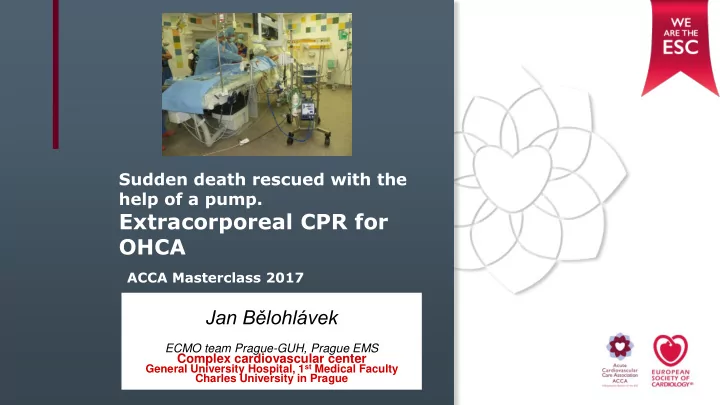
Sudden death rescued with the help of a pump.

Extracorporeal CPR for OHCA

ACCA Masterclass 2017

Jan Bělohlávek

ECMO team Prague-GUH, Prague EMS

Complex cardiovascular center

General University Hospital, 1st Medical Faculty Charles University in Prague

slide-2
SLIDE 2

DISCLOSURE

Relevant Financial Relationship(s) „Prague OHCA study“ supported by: Ministry of Health grant IGA NT13225-4/2012

MAQUET – provided PLS system for ECLS and custom-made circuits Covidien – provided INVOS device Benechill – provided Rhinochill devices and cooling liquid for a reduced price Received honoraria from Maquet, Covidien and Physio- Control

Off Label Usage : None

slide-3
SLIDE 3

ECPR is a struggle…

Everybody, Everywhere, all the time

slide-4
SLIDE 4
slide-5
SLIDE 5

Cardiac arrest in OHCA

50-70/100.000 annually

  • CPR registries
  • INTCAR registry
  • TTM trial

succesfull ROSC patients !!! 30-40%

Where are the 60-70% remaining? Refractory cardiac arrest 10…16….30 minutes ???

Favorable outcome of ≈ 2-4%

Fagnoul et al., Curr Opin Crit Care 2014 Grunau et al., Prehosp Emerg Care 2016

Dying…

slide-6
SLIDE 6

N=1014 6% favorable outcome

slide-7
SLIDE 7

Acute myocardial ischemia

typical cause of treatable refractory cardiac arrest

slide-8
SLIDE 8

Extracorporeal CPR

  • continuation in CPR using mechanical

circulatory support

  • always VA-ECMO

Source: GUH Prague

slide-9
SLIDE 9

ECPR studies in OHCA

Author Year of publication N Time to ECMO (min) Survival Nagao 2000 36 67 25 % Haneya 2012 26 70 15 % Kagawa 2012 42 59 24 % Nagao 2010 171 66 12 % Le Guen 2011 51 120 4% Avalli 2012 18 77 6 % Fagnoul 2013 53 66 21 % Maekawa 2013 53 49 32 % Leick 2013 28 44 39 % SAVE-J Sakamoto 2014 260

  • 12 %

CHEER

2014

11

  • Impl. 20

27% Choi 2016

320 54 9%

Prague OHCA randomized S vs. H

2016

65 (29) 56 (Impl. 14) 28 %

slide-10
SLIDE 10

An „optimal“ patient for ECPR

  • refractory cardiac arrest (>16 min)
  • no comorbidities
  • witnessed cardiac arrest

– EMS – public place

  • assumption of correctable cause (ACS)
  • shockable rhythm (VF/VT)
  • intermittent ROSC
slide-11
SLIDE 11

Prerequsites for ECPR

  • resuscitation team
  • 24/7 (15 min) available ECMO team

(intensivist/cardiologist/perfusionist/surgeon?)

  • close cooperation with EMS in cases of OHCA
  • early alert system for ECMO/cathlab teams
  • be able to admitt and cath under ongoing CPR

(mechanical CPR)

  • monitor brain tissue saturations (NIRS)
  • immediatelly available ABG/ECHO/vascular US
  • primed ECMO device on cathlab/ER 24/7
slide-12
SLIDE 12

Refractory OHCA

ECMO center ECMO

„Load and go strategy“ „Stay and play strategy“

slide-13
SLIDE 13

Not for everybody…

ECMO to OHCA OHCA to ECMO

Lamhaut L et al., Resuscitation 2013

slide-14
SLIDE 14

„Load and go“/OHCA to ECMO strategy

  • in hospital selection (team)
  • freely available specialists - cathlab/ER
  • all cathlab equipment (wires) available,

no space/personal restrictions

  • immediate angiography
  • early ECHO diagnostics available
  • ECMO may be postponed if mechanical

CPR adequate

  • may immediately proceed with PCI
slide-15
SLIDE 15

Prague EMS

1.25 milion people

  • ne dispatch center

„rendez-vous“ system „Smart car“

slide-16
SLIDE 16

Bystander CPR in OHCA in Prague 2003-2015

Courtesy of dr. Franěk – Prague EMS

slide-17
SLIDE 17

Initial prehospital care

Witnessed cardiac arrest Telephone assisted bystander CPR EMS crew dispatched EMS dispatch center ALS > 5 min CA > 15-20 min Call to cardiac center Check for eligibility If no ROSC Early SMS alert to cardiac center ECMO team capacity confirmed

slide-18
SLIDE 18

Telephone assisted CPR Age Time

Early SMS alert to cardiac center

slide-19
SLIDE 19

„Prague hyperinvasive“ approach to refractory OHCA

  • early alert to cardiac center
  • mechanical chest compressions

LUCAS

  • intra-arrest cooling

RhinoChill

  • extracorporeal life support

ECMO

  • neuromonitoring

NIRS-INVOS

  • immediate invasive assesment

CAG/PCI and treatment

PuAG

SMS

slide-20
SLIDE 20

Supported by grant of Ministry of Health IGA NT13225-4/2012

slide-21
SLIDE 21

Guidelines ERC 2015

Extracorporeal CPR (ECPR) should be considered as a rescue therapy…. There is an urgent need for randomised studies of eCPR…

Hyperinvasive approach uses ECPR as a one of several stepwise interventions within changed prehospital and early hospital logistics

slide-22
SLIDE 22

ECHO Defibrillator

Suction device

Ventilator

INVOS LUCAS carbon plate

Rhinochill

ECMO

Cathlab prepared for admitting a patient with refractory cardiac arrest

slide-23
SLIDE 23

Specialized team

Intensivist Interventional cardiologist Perfusionist ICU nurse Cathlab nurse ICU nurse Interventional cardiologist Cathlab nurse Cathlab nurse

slide-24
SLIDE 24
slide-25
SLIDE 25

# 46 45 min

vessel view under X-ray

slide-26
SLIDE 26

Cannulation blind ultrasound guided X-ray guided insertion stiff wire no dilatation

slide-27
SLIDE 27

# 46 45 min

Acute occlusion?

slide-28
SLIDE 28

Is it ethical to put a patient on a device to extend CPR?

  • uncertain risk-benefit profile
  • inability to obtain informed consent
  • high cost
  • Grave prognosis
  • Potential Harms
  • failed recovery….“bridge to nowhere“
  • prolonged ICU stay
  • judge: averting death with ECPR may

foreclose the chance for „good death“

Riggs, Resuscitation 2015

slide-29
SLIDE 29

ECPR - conclusion

  • rescue method for refractory cardiac arrest
  • refractory VF/VT
  • witnessed cardiac arrest
  • intermittent ROSC
  • recommended in ERC 2015 guidelines
  • crucial to continue in randomized studies
  • ECPR programme may yield additional

survivors of cardiac arrest

  • cost demanding
  • organ donorship as a byproduct
slide-30
SLIDE 30

Clinical consequencies

  • Not ECLS alone,

but „comprehensive approach“ including ECLS may have an impact on logistics for OHCA patients

  • patients who need ECLS for refractory OHCA

have often severe unresolvable cause

  • we have technology, now we have to find right

patients and optimize logistics.

  • future?
  • EPR – emergency preservation and resuscitation

» Drabek et al., 2014

slide-31
SLIDE 31

73 minutes of mechanical CPR for refractory arrhythmias before ECMO

# 26

slide-32
SLIDE 32

# 26

slide-33
SLIDE 33

Provided informed consent

# 26

slide-34
SLIDE 34

# 48 75 min

Provided informed consent

slide-35
SLIDE 35

# 46 45 min

slide-36
SLIDE 36

# 52 51 min

slide-37
SLIDE 37

# 52 51 min

slide-38
SLIDE 38

# 52 51 min

Provided informed consent

slide-39
SLIDE 39

# 52 51 min

Provided informed consent

slide-40
SLIDE 40

Zero chance not to have complications

slide-41
SLIDE 41

# 55 78 min

Refractory MODS