SLIDE 1 1
Spectrum-Roentgen-Gamma International Experiment
STAR Global Conference 2012, March 19-21, Amsterdam
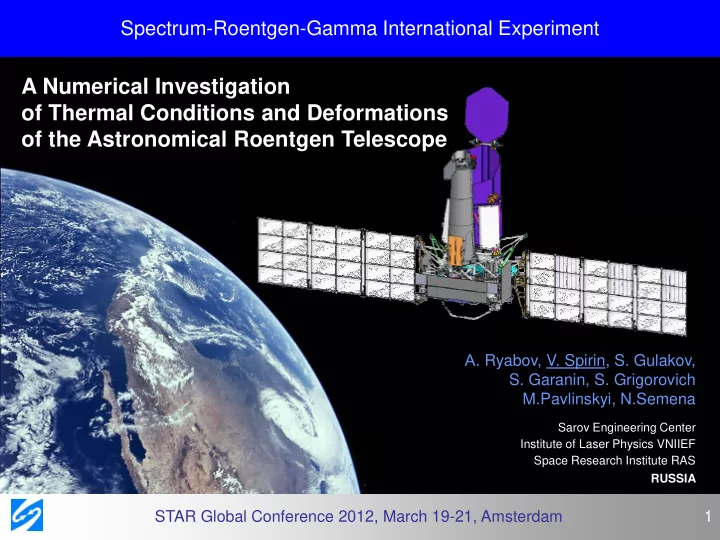
A Numerical Investigation
- f Thermal Conditions and Deformations
- f the Astronomical Roentgen Telescope
А. Ryabov, V. Spirin, S. Gulakov,
- S. Garanin, S. Grigorovich
M.Pavlinskyi, N.Semena
Sarov Engineering Center Institute of Laser Physics VNIIEF Space Research Institute RAS RUSSIA
SLIDE 2
2 STAR Global Conference 2012, March 19-21, Amsterdam
International Spacecraft Platform
SLIDE 3
3
The main purpose of ART-XC telescope (Astronomical Roentgen
Telescope – X-ray Concentrator) with X-ray optical system is searching of space under a hard X-ray range to solve scientific problems in frame of “Spectrum-RG” international experiment. One of the major requirements for the telescope is to ensure restricted temperatures and minimal thermal deformations of the construction from solar irradiation and heating effects of spacecraft during orbital flight. Therefore, a detailed computer simulation of temperature conditions and thermal deformation of telescope parts in outer space is carried out at a development stage using STAR-CCM+.
STAR Global Conference 2012, March 19-21, Amsterdam
Astronomical Roentgen Telescope-ART-XC
SLIDE 4
4
ART-XC Orbital Motion and Solar Irradiation
STAR Global Conference 2012, March 19-21, Amsterdam
Shadow and Sunlight interchange depending on a Spacecraft Orientation
SLIDE 5 5
Operating Modes and Requirements
STAR Global Conference 2012, March 19-21, Amsterdam
- The telescope is in orbit under solar irradiation that heats its different
construction zones depending on a spacecraft orientation. In addition, some heaters of thermal control system may breakdown in flight.
- Separate parts of the telescope optical system are capable to run in
a certain temperature range that imposes stringent requirements for the thermal control system during off-line operation in outer space.
- To meet these requirements 9 thermal modes are calculated:
minimal and maximal mode (depending on solar radiation presence), 7 scenarios of a survival mode (emergency modes – in case of some heater or its circuit breakdown).
- Simulation of each mode adds up to finding the minimum required
power of heaters and their location that ensure an acceptable range of
construction temperatures.
SLIDE 6
6
Methodology of Numerical Simulations
STAR Global Conference 2012, March 19-21, Amsterdam
Temperatures (STAR-CCM+) Thermal deformations & Displacements (Abaqus) Meshing (pro-STAR)
SLIDE 7
7
Computer Models of Real Structure
STAR Global Conference 2012, March 19-21, Amsterdam
SLIDE 8
Multi-band radiant heat exchange by Plank’s law for separate simulation of the solar and heat radiation, temperature dependence of material properties, an anisotropic solid model causes extremely sophisticated and non-linear problem formulation. The solar and heat radiation are considered separately for better accounting of the direct and reflected solar radiation action. 512 rays (1024 by default) are assumed for the considering construction that has about 700 thousand patches. This combination is acceptable for the accuracy, computational time and memory requirements.
Description of Computer Models
8 STAR Global Conference 2012, March 19-21, Amsterdam
SLIDE 9
The problem of heat conduction in anisotropic solids along with multi-band radiative heat transfer was numerically implemented in STAR-CCM+ using the fully implicit algorithm. AMG method was used with an increased number of iterations at "coarse" levels (W cycle) with the following parameters: maximum number of cycles: n = 150, convergence rate: N = 0,001. The selected solver parameters allow to obtain a converge solution for about three thousand of iterations.
9 STAR Global Conference 2012, March 19-21, Amsterdam
Description of Computer Models
SLIDE 10
10
1.2 million cells 9.7million cells Temperatures in a Tube
STAR Global Conference 2012, March 19-21, Amsterdam
Research of Grid Solution Convergence. Temperatures correspond to Minimal Mode
SLIDE 11
11
X-Ray Mirror Spider and Detector Plate
1.2 million cells 9.7million cells
STAR Global Conference 2012, March 19-21, Amsterdam
Research of Grid Solution Convergence. Temperatures correspond to Minimal Mode
SLIDE 12
12
Temperatures of a Protective Unit
STAR Global Conference 2012, March 19-21, Amsterdam
Minimal Mode Temperatures Orbital Transfer Mode (Heaters turned off)
SLIDE 13
13
Temperatures of Mirrors and Spider
STAR Global Conference 2012, March 19-21, Amsterdam
Minimal Mode Temperatures Orbital Transfer Mode (Heaters turned off)
SLIDE 14
14
Thermal deformations
STAR Global Conference 2012, March 19-21, Amsterdam
Maximal calculated thermal displacements of the optical channel parts are almost the same for all considered temperature modes and they are: for X-ray mirrors – 0.25 mm, for block of X-ray detectors – 1.2 mm
SLIDE 15
1. Several computer models have been developed for numerical simulations of ART-XC steady and unsteady thermal states. The convergence of the solution and adequacy of the numerical results were examined and confirmed on the basis of these models. 2. The anisotropic computer model of X-mirror heat equivalent has been developed and numerically proved. This model allows reflecting the actual construction adequately, without significant distortion of the temperature field. Incorporating of this heat equivalent to the telescope computer model allowed significantly saving of the required computational cost.
Conclusions
15 STAR Global Conference 2012, March 19-21, Amsterdam
SLIDE 16
- 3. Several thermal modes were analyzed: minimal and maximal
modes, seven scenarios of the survival mode. Minimum required powers and location of 29 heat elements was defined for each mode, providing the acceptable temperature range of the construction.
- 4. The influence of surface emissivity variation (for a polished
surface of aluminum alloy=0.06…0.19, for carbon fiber= 0.74…0.92, for a polished surface of steel parts=0.1…0.47) on the telescope thermal modes has been investigated by numerical experiments, it causes temperature variation of the main parts of about 2% or less than 5K.
- 5. Calculated maximal thermal deformations of X- mirror shells
and other telescope parts ensure the specified geometric characteristics of the optical channels.
Conclusions
16 STAR Global Conference 2012, March 19-21, Amsterdam
SLIDE 17
17
Assembly of ART-XC Spacecraft Platform
STAR Global Conference 2012, March 19-21, Amsterdam With best wishes for upcoming flight! Sarov Engineering Center