of the Heart Jean Hardwick Ithaca College Loewi, O. (1921). On the - - PDF document

of the heart
SMART_READER_LITE
LIVE PREVIEW

of the Heart Jean Hardwick Ithaca College Loewi, O. (1921). On the - - PDF document

Otto Loewi Vagusstoff Neural Regulation of the Heart Jean Hardwick Ithaca College Loewi, O. (1921). On the humoral propagation of cardiac nerve action. Pflugers Arch. 189 : 239-242. Control of Heart Rate


slide-1
SLIDE 1

1

Neural Regulation

  • f the Heart

Jean Hardwick Ithaca College

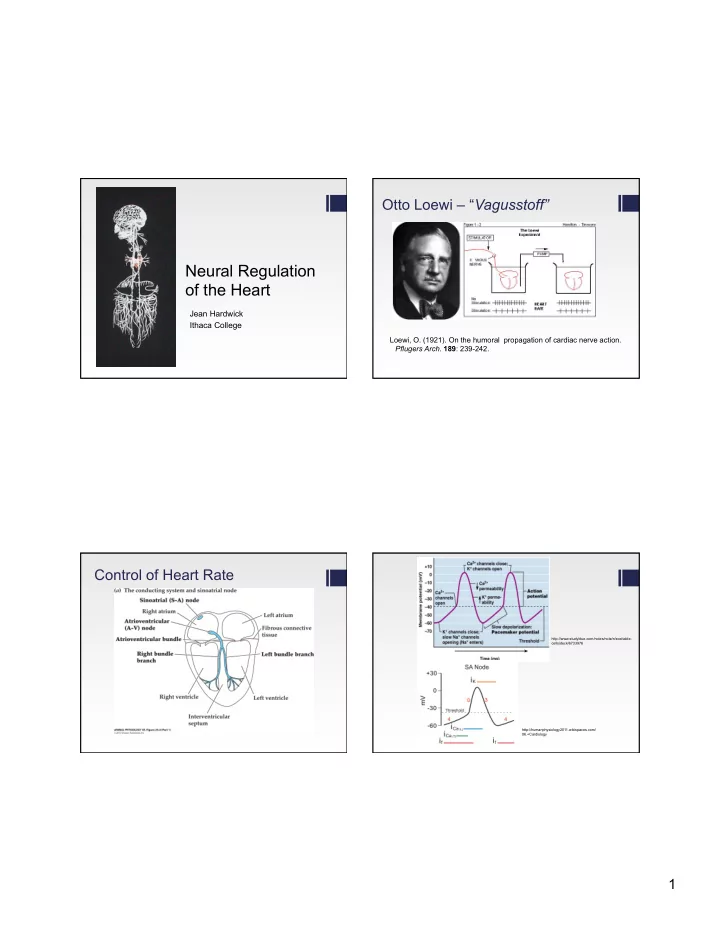
Otto Loewi – “Vagusstoff”

Loewi, O. (1921). On the humoral propagation of cardiac nerve action. Pflugers Arch. 189: 239-242.

Control of Heart Rate

http://humanphysiology2011.wikispaces.com/ 06.+Cardiology http://www.studyblue.com/notes/note/n/excitable- cells/deck/6733976

slide-2
SLIDE 2

2

http:// humanphysiology2011.wikispaces.co m/06.+Cardiology

Target Target Preganglionic neuron Postganglionic neuron

Cardiac Ganglion

slide-3
SLIDE 3

3

Sensory innervation

Sensory Inputs

  • BP
  • pH
  • pO2

CNS Preganglionic Neurons Parasympathetic Postganglionic Neurons Cardiac Target Cells Sympathetic Postganglionic Fibers Cardiac Sensory Neurons

Parasympathetic Cardiac Ganglion

§ Fast synaptic transmission (ionotropic)

§ ACh (nicotinic receptors)

§ Other signals (metabotropic)

§ ACh (muscarinic receptors) § NE § Neuropeptides § Locally-generated signals

§ Nitric Oxide (NO) § Inflammatory signals

Neuropeptides

§ Neuropeptides § Sensory peptides (sensory neurons from spinal cord) § Substance P § CGRP § PACAP (neurons from brainstem, neurons within ganglion)

slide-4
SLIDE 4

4

Nitric Oxide

§ Three isoforms of nitric oxide synthase

§ Neuronal NOS (nNOS) § Endothelial NOS (eNOS) § Inducible NOS (iNOS)

Nitric Oxide

NOS

NO

Ca++ Guanylate Cyclase

cGMP

Cardiac Mast Cells

§ Found in high density in mammalian heart § Stimulated by:

§ Antigen exposure § Sensory neuropeptides § Chemoreceptors

§ pH changes, low oxygen

§ Upon stimulation, release

§ Histamine § Prostaglandins

Parasympathetic Cardiac Ganglion

Preganglionic Fibers Postganglionic Fibers Sensory Afferents Mast cells Sympathetic Postganglionic Fibers

slide-5
SLIDE 5

5

Model System

§ Guinea pig cardiac ganglion

Mawe, et al (1996) Cell Tissue Res 285:281.

slide-6
SLIDE 6

6

MAP2 Substance P

PACAP 27 MAP2

Histamine MAP2

slide-7
SLIDE 7

7

Nitric Oxide in the Heart

nNOS MAP2

Guinea pig cardiac ganglion

“puffer” containing test substance Preganglionic fiber Postganglionic neuron Phasic Neuron

Tonic Neuron

Neuromodulation

§ Acute changes

§ Changes in excitability § Changes in sensitivity to individual chemicals § Changes in synaptic function

§ Long term changes

§ Changes in phenotype

slide-8
SLIDE 8

8

Histamine

Depolarization Mechanism?

Sodium Channels: Ion substitution

Amplitude Duration N Control 5.6 ± 2.8 46.9 ± 29.4 19 50% NMG 4.0 ± 1.5 54.3 ± 18.4 6 100% NMG 2.0 ± 1.1 33.9 ± 35.1 9

Membrane Depolarization

Stimulus (nA)

0.0 0.2 0.4 0.6

AP Frequency (Hz)

2 4 6 8 10 12 14

Control Histamine, # # # # # #

slide-9
SLIDE 9

9

§ How can you change the firing properties of a neuron? § What ionic mechanisms could produce this? Excitability Changes: Ion Channel Inhibitors

§ Barium § Blocks many K channels, including some leakage channels and m-current § 4-aminopyridine § Blocks A-current (K channel) § TEA § Blocks some Ca-dependent K channels § Cs § Blocks H-current (hyperpolarization- activated cation channel)

Control

1 mM Cs+ 1 mM Ba2+ 1 mM 4-AP 5 mM TEA

Cs+ Ba2+ 4-AP TEA

slide-10
SLIDE 10

10

Remove external Ca2+ 200 µM Cd2+

Muscarinic Receptors

§ Preganglionic fibers (from brainstem) § ACh - nicotinic (fast) and muscarinic (slow)

§ Bethanechol – muscarinic agonist

Control Beth

Adrenergic Receptors

§ Adrenergic postganglionic fibers § NE – increase excitability

Control NE

Single Action Potentials

slide-11
SLIDE 11

11

PACAP

slide-12
SLIDE 12

12

Excitability Changes

§ Histamine

§ Dependent on influx of extracellular Calcium ions § TRPC channel? § Muscarinic (bethanechol) § TEA-sensitive channels § BK channels? M-current?

§ Adrenergic

§ Calcium-dependent § Indirect inhibition of BK channels? § VDCC?

§ Neuropeptides

§ PACAP § H channels, Calcium-dependent mechanism

Synaptic Function

Preganglionic fiber Postganglionic neuron

Synaptic Transmission

EPSP Amp (mV)

Control 4.1 + 1.6

(N=6)

SNP 7.4 + 3.5*

(N=6)

§ Nitric Oxide * p < 0.02, paired T test § Chronic heart disease § Number one cause of death in the United States

§ 2010 data: 595,444 deaths due to heart disease

§ ~24% of all deaths § Ischemic heart disease (heart attacks) most common form

How does neuronal control of the heart change with chronic heart disease?

Long term changes: Remodeling
slide-13
SLIDE 13

13

Models of Heart Disease

§ Myocardial infarction (MI)

§ Ligate left ventricular coronary artery § 6-9 weeks recovery

§ Pressure Overload (PO)

§ Band descending dorsal aorta § Produces left ventricular hypertrophy § 8-10 weeks recovery

§ Sham surgery

Horackova, M. et al. (2004) Am J Physiol Heart Circ Physiol 287: H1599-H1608

Regulation of NOS levels

Control Chronic MI nNOS and MAP2

Regulation of NOS levels

%nNOS cells 5 10 15 20 25 Control MI Sham surgery PO

# #

IHC - % nNOS Neurons

0 ¡ 0.5 ¡ 1 ¡ 1.5 ¡ 2 ¡ 2.5 ¡ 3 ¡ 3.5 ¡ 4 ¡ 4.5 ¡ 5 ¡ Control ¡ Sham ¡ MI ¡ PO ¡ Rela9ve ¡Change ¡in ¡mRNA ¡Expression ¡

qPCR – nNOS mRNA

Synaptic Function

Preganglionic fiber Postganglionic neuron

slide-14
SLIDE 14

14

Synaptic Function

CONTROL MI PO RMP (mV)

  • 49.5 ± 7.9
  • 41.8 ± 5.8
  • 46.7 ± 9.1

EPSP amplitude (mV) 6.8 ± 0.4 6.6 ± 0.6 5.6 ± 0.8 N 17 19 17

  • EPSPs

No significant differences

Synaptic Function

FTS 20 Hz

  • Suprathreshold stimulations
  • 20 Hz, 2 sec duration

What could produce this change in synaptic function?

slide-15
SLIDE 15

15

Synaptic Changes

§ No changes in EPSP amplitudes with chronic disease § No apparent changes in synaptic function in animals with MI § Enhanced synaptic function ONLY in animals with PO § Increased function is not inhibited by atropine (not due to increased sensitivity to muscarinic activity)

Drug Treatment

§ Implant osmotic pump

§ NE blocker § Timolol

§ Blocks β-adrenergic receptors

Drug Treatment

§ Induce heart disease § 2 weeks later, implant pump § Total drug treatment period of 6 weeks § Control animals, just drug, no disease

slide-16
SLIDE 16

16

Adrenergic Blocker: Timolol Adrenergic Blocker: Timolol MI Time Course

§ Induce MI

§ Examine tissue at

§ 4 Days § 7 Days § 14 Days

MI Time Course

slide-17
SLIDE 17

17

Acknowledgements

§ National Institutes of Health § Heart, Lung, and Blood Institute § Rod Parsons - UVM § Jeffrey Ardell – ETSU § Marie Southerland, DVM – ETSU

Student Collaborators

Shannon Ryan ‘12, Kristen Levin ’12, Natasha Petersen ‘12, Rich Kintzing ‘12 Chris Palmer ‘11, Samantha Corrado ‘11, Phil Feinberg ‘11 Melanie Powers Fraites ‘01, Ally Girasole ‘10 Not Pictured: Caitlin Baran ‘09 Lauren Houdek ’09 Stephanie Hinsvark ‘12 The Heart Nebula……..