of homecare in 2019 Colin Angel, Policy Director United Kingdom - - PowerPoint PPT Presentation

of homecare in 2019
SMART_READER_LITE
LIVE PREVIEW

of homecare in 2019 Colin Angel, Policy Director United Kingdom - - PowerPoint PPT Presentation

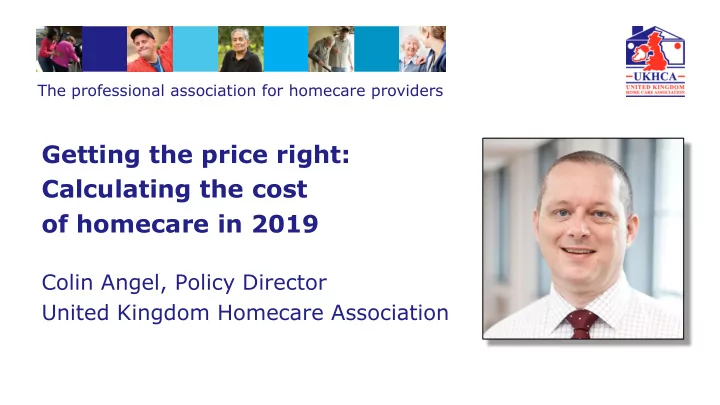
The professional association for homecare providers Getting the price right: Calculating the cost of homecare in 2019 Colin Angel, Policy Director United Kingdom Homecare Association Why getting the price right is important for councils


slide-1
SLIDE 1

The professional association for homecare providers

Getting the price right: Calculating the cost

  • f homecare in 2019

Colin Angel, Policy Director United Kingdom Homecare Association

slide-2
SLIDE 2

@ukhca @ukhca @colintwangel

Why getting the price right is important for councils

 Budget cuts and increased demand for services  Social care is now usually a council’s biggest spend  “Market-shaping” responsibilities from Care Act 2014  Evidence of providers handing-back contracts  Tenders not attracting bids, or subject to challenge  Political aspirations for the (voluntary) UK or London Living Wages

and/or guaranteed hours contracts

slide-3
SLIDE 3

@ukhca @ukhca @colintwangel

People affected by market failures, 2017 & 2018

2,413 7,366 3,583 4,588 2,329 225 2,921 393

Contract handed-back Provider ceased trading Figures relate to a six-month period in each year. Estimates produced by UKHCA using data from ADASS Budget Surveys, recalculated to show the possible national impact if all councils in England had supplied data. For illustrative purposes only. Homecare Residential Homecare Residential

2017 2018

Fewer financial failures More care packages handed-back

slide-4
SLIDE 4

@ukhca @ukhca @colintwangel

Why getting the price right is important for providers

Supply and demand pressures

 Terms and conditions poor:

 Wages; travel costs; workload

 Competition with other local

employers (+ impact of Brexit)

 Self-funders willing to pay

higher rates than councils Cost pressures and risk

 Risk of financial failure  Obligation to comply with NMW  Increasing costs:

 Workplace pensions  Apprenticeship levy

slide-5
SLIDE 5

@ukhca @ukhca @colintwangel

Few councils are meeting providers’ costs

UKHCA: “The Homecare Deficit 2018”

£18.20 £18.20 £17.23 £16.99 £16.78 £16.54 £15.75 £15.65 £15.51 £14.60 £14.15 £13.70

UKHCA’s Minimum Price for Homecare 2017-18

slide-6
SLIDE 6

@ukhca @ukhca @colintwangel

Care and Support Statutory Guidance

Paragraph 4.31 (applies to councils in England)

Contract terms, conditions and fee levels should provide the delivery of the agreed care packages at agreed quality of care. This should:

 Allow the provider to meet at least the National Minimum Wage  Provide effective training and development of staff  Allow retention of staff  Encourage innovation and improvement  Provide a rate of return, so that a sufficient pool of providers remains

sustainable

slide-7
SLIDE 7

@ukhca @ukhca @colintwangel

UKHCA’s Minimum Price for Homecare

£18.93 per hour (April 2019 to March 2020)

 Methodology verified by experienced finance

directors from different organisations

 Explains the assumptions used to create

the figures in this presentation

 Assumptions verified against best

available data

 Works with UKHCA’s on-line costing model

slide-8
SLIDE 8

@ukhca @ukhca @colintwangel

Gross Pay NI & Pension

Other wage- related on-costs

Travel costs Business costs Profit Careworkers’ mileage Profit or surplus Contact time Travel time Employer’s NI Pension contribution Holiday pay Training time Sickness & notice pay

Staffing & recruitment Premises & utilities

Consumables and

  • ther overheads

Calculating the minimum price of homecare:

£18.93 per hour (April 2019 to March 2020)

slide-9
SLIDE 9

@ukhca @ukhca @colintwangel

UKHCA’s Minimum Price for Homecare

Significant updates from April 2019

Statutory Minimum Wage National Living Wage: +38p / hour National Minimum Wage: +32p / hour Scottish, UK & London Living Wages Outside London: +25p / hour London: +35p / hour Workplace pensions Employers’ minimum contribution increases from 2% to 3% of gross pay Careworkers’ travel time Our assumption has increased from 11.4 to 11.7 minutes per hour of care Careworkers’ mileage Our assumption has decreased from 4.0 to 3.89 miles per hour of care

slide-10
SLIDE 10

@ukhca @ukhca @colintwangel

A minimum price is not the same as a fair price

£18.93 per hour can achieve compliance with the law. However, this rate does not include incentivising careworkers to undertake unsocial hours working, nor the need to pay workers above the statutory minimum wage in order to remain competitive in the local labour market.

slide-11
SLIDE 11

@ukhca @ukhca @colintwangel

Key issues for homecare costings

 Councils only pay for “contact time”

 But providers must cover careworkers’ entire working time at or above NMW

 The costs of non-working time must be covered in the hourly price

 Including holiday pay, training, supervision, etc

 Careworkers’ mileage should be reimbursed

 Failure to do so can lead to non-compliance with NMW

 Business costs include paying the staff needed to deliver services safely  Making a profit or surplus is essential for survival

 Profit is the incentive for people to invest their money in care, rather than elsewhere  Surplus is what voluntary sector providers use to reinvest in their services

slide-12
SLIDE 12

@ukhca @ukhca @colintwangel

38p on NLW and 1% extra on pension contributions will add at least 92p per hour from April 2019

Inflation (CPI)  2.2%

29p +

Travel time, NI, pensions and other wage on-costs

+ 26p

Office staff and running the business

= 92p Minimum increase required

38p NLW increase 32p NMW increase

37p

blended average

+

Homecare costs  5.11% │

slide-13
SLIDE 13

@ukhca @ukhca @colintwangel

Requirements of a sustainable price

 Cover workforce costs, including careworkers’ travel time, to

ensure compliance with National Minimum Wage Regulations

 Recognise wage expectations of local labour markets to

secure a sufficient workforce to meet demand

 Cover costs of regulation, supervision, organisation and training to

meet quality and safety requirements

 Ensure businesses receive a profit/surplus to maintain market

stability, innovate and reinvest in services

slide-14
SLIDE 14

@ukhca @ukhca @colintwangel

Cost of homecare at minimum and living wage rates

£8.15

£1.59 £2.64 £1.36

£4.64

£0.55

NMW & NLW £18.93 / hour UK & Scottish Living Wages

£9.00

£1.76 £2.93 £1.36

£5.10

£0.60

£20.75 / hour

£10.55

£2.06 £3.43 £1.36

£5.87

£0.70

London Living Wage £23.97 / hour

Contact time  All wage on-costs  Travel time  Mileage  Business costs  Profit / surplus 

slide-15
SLIDE 15

@ukhca @ukhca @colintwangel

Total working time

+

Complying with Minimum Wage

(Highly simplified)

The basic rate of pay is used: Enhancements for unsocial hours or short visits do not count towards compliance with NMW Average pay

  • ver reference

period of up to 1 month

Total pay before enhancements

Total contact time Travel time + Training

>=£8.21

(workers 25+) The time spent providing care in the service user’s home Includes: Travel between visits and time spent on training approved by the employer Excludes: Journeys to and from worker’s home and other ‘non-working’ time

slide-16
SLIDE 16

@ukhca @ukhca @colintwangel

15

minutes

15

minutes

15

minutes

10

minutes

10

minutes Travel from home Travel from home

How short visits affect careworkers’ wage costs

30

minutes

30

minutes

30

minutes

10

minutes

10

minutes Council pays for

90 minutes of care

Employer must also pay

20 minutes of travel

Travel time adds

22%

to careworker’s pay Employer must also pay

20 minutes of travel

Council pays for

45 minutes of care

Travel time adds

44%

to careworker’s pay Travel from home Travel back home

slide-17
SLIDE 17

@ukhca @ukhca @colintwangel

Guaranteed hours contracts

In order to offer a guaranteed hours contract:

 Providers must cover all of careworkers’ “working time”

 Time spent delivering care + travel time + any down-time

 Councils must pay enough to cover NMW for the span of duty

 Paying solely for “contact time” is incompatible with guaranteed hours

slide-18
SLIDE 18

@ukhca @ukhca @colintwangel

Other issues affecting the viability of contracts

 Unrealistic maximum prices in the invitation to tender  Contract terms stacked in the favour of the council  No guarantee of price increases during the life of the contract  Cost-saving strategies which impact workforce:

 Eg. ‘Per-minute’ billing

 Vague or unquantifiable liabilities:

 Untested payment-by-results mechanisms

slide-19
SLIDE 19

@ukhca @ukhca @colintwangel

CIPFA guidance

Working with care providers to understand costs

 Explains the principles of costing

homecare and residential services

 Encourages commissioners to work with

providers to determine and agree actual local costs

 Endorsed by Department of Health, LGA,

ADASS and Care Provider Alliance

slide-20
SLIDE 20

@ukhca @ukhca @colintwangel

A model for engagement and costing exercises

 Councils should engage with providers to understand costs  Start early to allow sufficient time to agree changes  Share relevant information on numbers and costs

 Compare like-with-like data on costs  Reflect actual costs incurred in modelling

 Consider options to:

 Minimise transaction costs and make timely payments  Incentivise increased capacity and allow innovation

 Publish findings and maintain an evidence trail

slide-21
SLIDE 21

@ukhca @ukhca @colintwangel

Contingency panning for market failure

Recommendations for councils

 Act now to avoid future failure

 Open and transparent cost of care exercises leading to sustainable rates

 Advanced contingency planning for market failure

 Know which providers are likely to be able to provide cover at short notice

 Act quickly to retain the workforce in the event of failure

 Careworkers have to pay their bills – they don’t hang around if unpaid

 Don’t set more providers up to fail

 Avoid flooding providers with more care than they can deliver safely  New providers just as likely to fail if the Ts & Cs are the same

slide-22
SLIDE 22

@ukhca @ukhca @colintwangel

Watch and share the webinar and handouts

www.ukhca.co.uk/pricewebinar

slide-23
SLIDE 23

@ukhca @ukhca @colintwangel

Links to useful documents

Calculating the cost of homecare

 UKHCA’s Minimum Price for Homecare, Version 6.0 www.ukhca.co.uk/downloads.aspx?ID=434  Getting the Price Right: Calculating the Cost of Homecare Webinar and handout: www.ukhca.co.uk/pricewebinar  UKHCA’s on-line Costing Model www.ukhca.co.uk/CostingModel

 Working with Care Providers to Understand Costs (CIPFA)

www.cipfa.org/policy-and-guidance/reports/working-with-care-providers-to-understand-costs

slide-24
SLIDE 24

@ukhca @ukhca @colintwangel

United Kingdom Homecare Association E-mail: policy@ukhca.co.uk Website: www.ukhca.co.uk Twitter: @ukhca and @colintwangel Phone: 020 8661 8188