
SLIDE 1
1
Odfjell Capital Markets Day 2017 1 SAFETY ALWAYS FIRST No alarms - - PowerPoint PPT Presentation
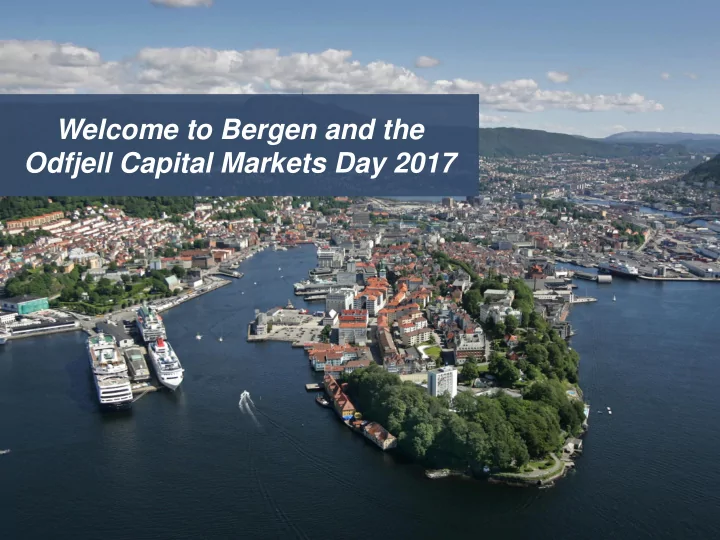
Welcome to Bergen and the Odfjell Capital Markets Day 2017 1 SAFETY ALWAYS FIRST No alarms are due for test if alarm goes off you should assume it is real Identify muster point. Follow your host and adhere to instructions Do
1
2
3
4
Time Topic Representative 12:00 - 13:30 Our story and our markets Kristian Mørch CEO Odfjell SE The Odfjell Compass Kristian Mørch CEO Odfjell SE 1Q 2017 results Kristian Mørch / Terje Iversen CEO / CFO Odfjell SE 13:30 - 14:30 Chemical Tankers Harald Fotland SVP Odfjell Tankers and Ship Management 14:30 - 15:30 Odfjell Terminals Frank Erkelens / Koert Schoeten CEO / CFO Odfjell Terminals 15:30 - 16:00 Finance strategy Terje Iversen CFO Odfjell SE
5
6
Our heritage
have a proud tradition for being one of the leading companies in the industry What we do
the world’s most sensitive environments Why we do it
global industry to function
transported on our vessels How we do it
us
What we deliver to
cost What we aim to deliver to our shareholders
7
8
9
Chemical tankers
10
capacity
Industry specific Common
– GDP growth, world trade – Imbalances between demand and supply
Terminals
– Supply – Demand
11
12 1. Vessels with full or partial stainless steel capacity 2. Vessels with no stainless steel capacity
Total fleet1: 4,315 vessels 103.9m dwt Regional (<18k dwt) 2,202 vessels 18.6m dwt Deep-Sea (>18k DWT) 2,113 vessels 85.4m dwt Stainless steel1 461 vessels 12.0m dwt Coated2: 1,652 vessels 73.4m dwt IMO3 683 vessels 31.4m dwt IMO26 969 vessels 42.0m dwt 18-27k dwt 312 vessels 2.7m dwt 27-36k dwt 82 vessels 2.7m dwt 36k+ dwt 67 vessels 6.6m dwt Degree of involvement in Chemical trade 6%
Core market
9% 9% 9% 3% 7% 25% 31% 27% 22%
Partly competing
Order book share of current fleet (dwt)
13
1-year TC rates, USD per day
Source: Maersk Brokers
5,000 10,000 15,000 20,000 25,000 30,000 Q1 2015 Q1 2014 Q1 2013 Q1 2009 Q1 2008 Q1 2007 Q1 2006 Q1 2017 Q1 2016 Q1 2012 Q1 2011 Q1 2010 33,000 dwt SS 20,000 dwt SS
14 Source: Maersk Brokers
30 35 40 45 50 55 60 65 70 75 80
Q1 2017 Q1 2016 Q1 2015 Q1 2014 Q1 2013 Q1 2012 Q1 2011 Q1 2010 Q1 2009 Q1 2008 20k SS, 20 tanks 38k SS, 30 tanks
Newbuild prices, USD million
15
Fleet development, million dwt
Source: Odfjell
60 80 70 20 50 10 90 40 30 12.6 2012A 66.2 54.2 12.0 2011A 64.9 53.2 11.7 2010A 62.8 51.7 2009A 59.3 48.9 10.4 69.8 +7.1% 2008A 53.5 44.1 9.4 2007A 45.4 37.0 8.5 13.0 2016A 84.1 67.9 16.1 2015A 78.7 11.1 14.5 2014A 73.7 60.7 2013A 57.2 64.2 Core Chemical Swing
Chemical operators HHI index1 development
16 Source: Odfjell 1. The HHI-index is a common measure of market concentration. It is calculated by squaring each operators’ market share (measured by DWT), and then summing up all the individual squared market shares
100 200 300 400 500 600 700 800 900 1,000 1,100 1,200 1,300 2015A 2014A 2013A 2012A 2011A 2010A 2009A 2008A 2007A 2016A
the market. Many look for an exit or for M&A
by: – Scale advantages – Customer demands
acquisition of JO Tankers has kick-started many industry discussions
17
Market share measured in dwt as of March 20171, % of total
Source: Odfjell 1. Includes core owners and operators
4.0% 4.1% 6.1% 7.8% 11.1% 12.9% 14.4% Other Operators 40.0% Examples
18
Fleet development1, million dwt
Source: Odfjell 1. Assumed 30 year lifetime for European built tonnage and 25 year lifetime for remaining vessels
80 90 70 100 60 50 40 30 20 10 16.1 2015A 78.7 64.9 53.2 11.7 2010A 2018E 90.8 72.3 18.5 2017E +7.1% 2012A 66.2 54.2 12.0 64.2 14.5 2014A 73.7 60.7 2011A 88.0 70.5 17.5 2016A 62.8 51.7 11.1 2009A 59.3 48.9 10.4 2008A 53.5 44.1 9.4 +2.9% 2019E 91.7 72.6 19.0 84.1 67.9 13.0 2013A 69.8 57.2 12.6 2007A 45.4 37.0 8.5 Swing Core Chemical CAGR
19
Odfjell and other data providers supply growth 2016A – 2019E, compound annual growth rate
Source: Odfjell, various brokers Note there are different definition of core fleet between sources
2.9% 2.7% 3.1% 2.9% 2.1% Consensus supply growth Steensland Maersk Broker Clarksons Odfjell
– Supply – Demand
20
21 Source: Odfjell, Clarksons 1. Includes lubricants
Organic chemicals Inorganic chemicals Finished products Textiles, paper, packaging, electrical, automotive and building materials Veg oils Other1 Oil and natural gas Raw material We ship: Minerals Specialty chemicals Examples Propylene Oxide, Hexene,Isocyanates, HexaMethylDiamine Agriculture Personal & home care, green energy Acetic acid, styrene, Benzene, Xylene, Methanol, Ethanol Phosphoric acid, Urea / Ammonium, Caustic soda 45% 15% 28% 13% Diversified Palm oil, soybean oil, animal fats Lubricants Molasses Personal & home care, green energy
%
Share of 2016 total market
22
Source: Clarksons, Thomsons Datastream
50 100 150 200 250 300 20 25 30 35 40 45 50 55 60 65 70 75 80 16 15 14 13 12 11 10 09 08 07 06 05 04 Seaborne chemical trade, million tons World GDP (trillion USD), current prices 03 02 01 00 99 98 97 96 95 94 93 92 91 90 89 88 87 86 85 84 83
World GDP and seaborne chemical trade, unit specified below
chemical trade and GDP growth closely related
between 1.0x - 1.5x
23
World GDP constant USD, year on year % change
Source: Oxford Economics/ Thomsons Datastream,
3.4% 2016A 2019E 2018E 2017E 3.2% 3.3% 2015A 2013A 2011A 2012A 2014A 4.1% 5.3% 3.2% 3.0% 3.4% 3.7% 3.5% 2010A 2007A 3.0% 2008A 2009A 5.4%
24 Source: Clarksons and Drewry
10 35 30 25 20 15 5 40 45 50 4 2 2 1H2018 6 1H2017 4 2H2016 1 2 2 2H2017 12 6 3 3 2H2019 2H2018 2 1H2021 14 14 1H2020 2 3 2 5 1H2019 Total production growth 48 Other Chemicals Methanol Iran 4 Saudi Arabia 4 China 5 US Korea Vietnam 1 4 India 30 1H2019 2H2018 2H2020 1H2020 2H2019 2H2016 1H2018 2H2017 1H2017
Estimated timing of new chemical projects, million tonnes Geographic location of new chemical projects, million tonnes
2017:
2018:
Petrochemical
2019:
Methanol
2020-2021:
Chemical
25
Source: Clarksons, US assumption: 50% of capacity from new projects being exported
Chemical Exports, million tonnes US chemical exports, million tonnes Middle East Chemical exports, million tonnes
40 37 35 33 31 32 32 31 32 29 25 22 +6.8% +5.3% 2019E 2018E 2017E 2016A 2015A 2014A 2013A 2012A 2011A 2010A 2009A 2008A 2010A 19 19 19 18 17 17 16 2008A 15 2018E 2014A 2013A 2012A 2017E 2009A 2015A 2016A 2011A 2019E +11.9% +4.0% 29 26 23 21
26
Overview of high and low cost petrochemical production
Low cost Low cost High cost High cost High cost
USG – Far East 10,000 N. Miles 34 days ME – Far East 6,000 N. Miles 19 days Global fleet average haul = 3,497 N. Miles
27
Demand seaborne chemical trade, ton-mile
Source: Odfjell
1,034 986 953 915 917 893 879 834 773 746 2014A 2012A 2013A 2007A 2008A 2009A 2010A 2011A 2015A 2018E 2016A 2017E +3.7% +4.0% 2019E CAGR
28
Odfjell and other data providers demand growth 2016A – 2019E, compound annual growth rate
Source: Various brokers
4.0% 4.1% 3.5% 5.0% 3.4% 4.3% Consensus World GDP Steensland Maersk Broker Clarksons Odfjell
29
2017 - 2018 2018 and beyond
We expect 2017 to be difficult
We expect the market to be fairly balanced from 2018 onwards
30
Professional
Pro-Active
Sustainable
Innovative
31
We shall be a leading, preferred, environmental friendly and profitable global provider of transportation and storage of bulk liquid chemicals, acids, edible oils and
Our core business is handling hazardous liquids – safely and more efficiently than anyone else in the industry
32
33
1. We do not compromise on safety 2. Chemical Tankers and Terminals are our core business 3. In order to be world-class, we need to have world-class ambitions in everything we do. Every day!
1 2 3
Industry leading EBITDA margin Average revenue growth of 10% per year Target an operated fleet of 100 vessels Zero incidents
34
Safety performance Size Revenue / Top-line Profitability
35
Growth
High quality service
Operational excellence
Financial strength
Terminals – back to meaningful profitability levels
36
Odfjell chemical tankers gross revenue, USD million 832 940 1,042 1,028 1,066 1,056 999 1,021 1,247 2008 2009
2012 2011 2010 2016 2015 2014 2013 93 95 86 98 96 81 77 74 73 Number
vessels
37
From current to target G&A per operated ship day, USD per day
Target Current
38
first quarter, despite a challenging and depressed market
mill in fourth quarter last year
compared with previous quarter. Clarkson Platou Spot market index was up 1.9%
USD 36 mill which is identical to fourth quarter 2016
steel chemical tankers nearly completed
Highlights
300 250 200 150 100 50 2016 2017 2015 2014 2013 2012 2011 2010 2009 2008
Chemical tankers Tank terminals LPG/Ethylene
Annualised EBITDA1, USD mill
39
«We expect 2017 to remain challenging, but our underlying
quarters we have taken crucial steps in renewing our core fleet at a very low point in the price cycle»
Kristian Mørch, CEO Odfjell SE
the first dedicated ethylene export terminal in the US at our Houston facility in Texas. Final investment decision is not taken
explore the potential sale of our share of Odfjell Terminals Singapore
approved at the Company's Annual General Meeting 11 May
Highlights
40
Odfix quarterly average Index, 1990=100
60 70 80 90 100 110 120 130 140 150 2016 2015 2014 +1.3% 2017 2010 2011 2013 2008 2012 2009 +1.9%
Odfix index Odfix average 2008-2016 Chemical tanker spot earnings index (midcycle = 100) Source: Clarkson Platou
Financials USD millions
1Q 2017 4Q 2016 Gross revenue 243 238 Voyage expenses (82) (76) TC expenses (48) (42) Operating expenses (45) (48) General and administrative expenses (22) (24) Operating result before depr. (EBITDA) 46 48 Depreciation (29) (32) Impairment
Capital gain (loss) on non-current assets 45 Operating result (EBIT) 18 45 Net finance (15) (1) Taxes (1) (1) Net result 2 43
41
Financials Quarterly Gross Revenue and EBITDA, USD millions
Slightly increased revenue but reduced EBITDA due to increased voyage expenses and divestment of the Oman terminal in December 2016
243 238 240 241 249 253 276 279 260 Q1 2016 Q4 2015 Q1 2017 Q3 2015 Q2 2015 Q1 2015 Q3 2016 Q2 2016 Q4 2016 46 48 60 61 69 45 57 53 35 Q1 2016 Q4 2015 Q3 2015 Q2 2015 Q4 2016 Q1 2017 Q3 2016 Q2 2016 Q1 2015
Gross Revenue EBITDA
42
USD millions 1Q 2017 4Q 2016 Gross revenue 213 204 Voyage expenses (81) (74) TC expenses (48) (42) Operating expenses (31) (33) General and administrative expenses 2 (17) (19) Operating result before depr. (EBITDA) 36 36 Depreciation (20) (23) Impairment
Capital gain/loss on fixed assets 1 Operating result (EBIT) 16 8
Financials
1. Proportional consolidation method 2. Including corporate functions 43
Financials
1Q 2017 versus 4Q 2016 1Q 2017 versus 1Q 2016
1.3 2.0 0.4 2.8 5.7 36.3 1Q 2017 36.0 G&A OPEX TC exp.
Bunker der. Gross rev. Bunker cl.
Voy exp. 4Q 2016 Quarterly EBITDA, USD millions
44
0.5 1.9 1.3 12.2 55.7 TC exp. OPEX G&A 36.0 1Q 2017 Bunker der.
Voy exp.
Bunker cl. Gross rev.
1Q 2016
45
Financials Vessel operating expenses (OPEX), USD/day
12 000 10 000 8 000 6 000 4 000 2 000 2008 2014 2013 2012 2011 2010 2009
2017 2016 2015
Crew cost Non-crew OPEX
12 000 10 000 8 000 6 000 4 000 2 000 4Q15 3Q15 2Q15 1Q15
1Q17 4Q16 3Q16 2Q16 1Q16
Yearly development, 2008 - 2017 Quarterly development, 1Q 2015 - 1Q 2017
Total Crew cost
Average 2008-2014 Average 2015-2017
Financials
21.4 21.0 26.7 15.5 11.4 9.9 28.0 35.8
3.3 6.2 38.6 1Q17 34.1 4Q16 3Q16 36.7 2Q16 32.9 1Q16 37.8
Quarterly net bunker cost USD millions 1Q 2016 - 1Q 2017 Platts 3.5% FOB Rotterdam January 2013 - April 2017
USD per metric tonne
46
Bunker clauses
Bunker purchase Bunker hedging
100 200 300 400 500 600 700 2017 2016 2015 2013 2014 2018
USD millions 1Q 2017 4Q 2016 Gross revenue 28 31 Operating expenses (13) (14) General and administrative expenses (5) (6) Operating result before depr. (EBITDA) 9 11 Depreciation (8) (10) Impairment
Capital gain/loss on fixed assets
Operating result (EBIT) 1 42
Financials
47
Financials
EBITDA, USD millions YTD EBITDA Tank Terminals 1Q 2017 4Q 2016 Europe 1 2 North America 5 4 Asia 3 3 Middle East 2 Total EBITDA 9 11
3 5 1 Europe North America Asia
48
million in 1Q17
Assets, USD millions Ships and newbuilding contracts 1 212 Other non-current assets/receivables 23 Investment in associates and JV’s 341 Total non-current assets 1 576 Cash and cash equivalent 212 Other current assets 116 Total current assets 328 Assets held for sale 5 Total assets 1 909 Equity and liabilities, USD millions Total equity 723 Non-current liabilities and derivatives 44 Non-current interest bearing debt 883 Total non-current liabilities 927 Current portion of interest bearing debt 192 Other current liabilities and derivatives 67 Total current liabilities 259 Liabilities held for sale
1 909 Financials
49
USD 60 mill bond repayment in April 2017
Harald Fotland Bergen, May 22nd 2017
Chemical Tankers
50
51
Ship owning Ship management Chartering &
Being a fully integrated shipping company... ...enables control across all aspects of our operations
1 2 3 4 Safety Reliability and predictability Operational excellence Sustainable cost 5 Growth Integrated processes promote safe, reliable and efficient operations
52
53
Management to secure: – Safe and efficient operations – World-class quality of our service – Maximise lifetime of our vessels – High performing vessels throughout lifespan – Synergies with Odfjell Tankers and Odfjell Terminals
super-segregators
54
Bergen (HQ)
management
Manila
centre Singapore
with FE operation pattern Sao Paulo
South America fleet
55
New building feasibility studies, specifications and supervision Insurance claims handling Ship inspection and vetting Project management Superintendency and purchasing Crewing
Fully integrated services and a ship-owners’ perspective on all aspects of the
56
1. Lost time injury (graph is showing Lost time injury frequency) 2. Total recordable cases Source: Shipping Benchmarking Initiative 2016
Odfjell vs. market average in safety KPIs, units defined below LTIs1 per million exposure hours TRC2 per million exposure hours
Sample of 1,038 tankers Sample of 1,038 tankers Odfjell Market average
Odfjell Market average
57
chemical tankers competence
practice by many oil majors
58
...average time with Odfjell for our captains 21 years ...average time with Odfjell for our chief officers 15 years ...retention rate for our crew 96% ...of onshore training performed every year by our crew ~10,000 days ... training sessions for crew on-board our vessels Weekly
59
Our goals Integrated systems and procedures
Performance monitoring
60
CDI vetting Port State Control
The figures represent the number of observations after an on-board inspection either by an oil major (Sire), the Chemical Distribution Institute (CDI) or by a Port State Control (PSC)
SIRE vetting
2016 2015 2014 2013 2016 2015 2014 2013 2016 2015 2014 2013
61
1. Indexed to 100
segregators – New propeller blades – New rudder bulb and fairing cone – Gear optimisation
– 8 – 10% reduction in bunker consumption
– Up to 5% reduction in bunker consumption
– Reversed osmosis plants on all vessels Ship management initiatives... ...with environmental and economic benefits Annual bunker consumption1
86 92 100 2014 2015 2016
Propeller upgrade
62
Terminals
1 2 3 4
63
64
and spot cargos
differentiate ourselves from competition by having: – Long-term relationships with all stakeholders – Operational excellence – Strong cooperation and synergies with Ship Management and Odfjell Terminals
65
Any liquid Anywhere Anytime Always prepared Always safe Leading Efficient Preferred
66
Basic chemical tanker Sophisticated super-segregator
1W 1P 2W 2P 3W 3P 4W 4P 5W 5P 6W 6P
13WP 13WS 8WP 8WS 7WS 7WS 6WP 6WSContinuous monitoring of performance Pool and cargo optimization Standardized and cost efficient Scale effect on basic equipment across similar ships Tailor-made and responsive Experienced crew with cost focus Experienced crew with cost focus, comprehensive technical competencies and training Complex and flexible equipment
67
68
Asia Pacific
USG-SAM
smaller tonnage NWE- SAM
smaller tonnage Middle East Export/ Import
with products out of Middle East Example frequencies Example trade areas Regional Asia
69
Our stage Selected customers
70
Monthly volumes loaded, thousand metric tonnes Average CoA Mar 17 Feb 17 Jan 17 Dec 16 Nov 16 Oct 16 Sep 16 Aug 16 Jul 16 Jun 16 May 16 Apr 16 Mar 16 Spot CoA
71
Odfjell 20k dwt stainless steel TCE vs. Clarksons 1-year TC benchmark, USD per day Oct-15 Nov-15 Dec-15 Jan-16 Feb-16 Mar-16 Apr-16 May-16 Jun-16 Jul-16 Aug-16 Sep-16 Oct-16 Nov-16 Dec-16 Jan-17 Feb-17 Mar-17 Odfjell chempool 20
Source: Clarksons
Clarksons 20k 1-year TC
72
73
integration
procurement processes Growth Operational excellence Sustainable costs
around 100 vessels
performance monitoring II III Safety
‒ Training ‒ Procedures ‒ Systems ‒ Maintenance I IV
74
Training Culture/ routines Data/ systems
value chain
and reporting
Safety
I
Super-segregators (Kvaerner & Poland) 40 47 Large stainless steel (27 - 36k dwt) 33 18 Medium stainless steel (19 - 26k dwt) 21 22 Coated (MIPO & SLS) 48 24 South America and other1 27 24 Regional-Asia 11 17
75
Fleet overview as of March 2017 1. Includes Bow Atlantic and Bow Pioneer
Tonnage category Control type 22 2 6 9 5 8 19 4 1 20 10 22 9 9 6 Vessel details TC Own/BB Average size Average tanks
Growth
II
76
Illustration of Odfjell Target fleet
2 2 6 +14 Target fleet 100 Fleet including concluded orders 86 Time-charters BB charters Newbuild orders Current fleet 76 Comments ∑ = 10 vessels Growth
II
77
Q2 19, Q3 19, Q4 19 and Q1 20 Q2 and Q3 2020 Q4 19 and Q2 20 Q4 18 and Q1 19 Owned Owned 10 years 8 years 49,000 38,000 36,000 35,500 54,600 45,000 40,000 37,300 33 40 28 28 Hudong-Zhonghua Shipbuilding Hudong-Zhonghua Shipbuilding Undisclosed Shin-Kurushima Delivery Charter period Dwt Cbm Cargo tanks 4 x Hudong 2 x Hudong 2 x BB 2 x TC Yard
Growth
II
78
38k 30 tanks newbuild price, USD million
Source: Maersk Brokers
30 35 40 45 50 55 60 65 70 75 80 Q1 2017 Q1 2016 Q1 2015 Q1 2014 Q1 2013 Q1 2012 Q1 2011 Q1 2010 Q1 2009 Q1 2008
Growth
II
Super-segregators (Kvaerner & Poland) 22
Large stainless steel (27 - 36k dwt) 10
Medium stainless steel (19 - 26k dwt) 20
vessels with higher sophistication Coated (MIPO & SLS) 6
MRs with higher sophistication South America and other1 9
Regional-Asia 9
79
Tonnage market characteristics Current fleet Tonnage category
Growth
II
Fleet overview as of March 2017 1. Includes Bow Atlantic and Bow Pioneer
80
3 2 1 4 5 6 7 8 9 10 11 12 13 14 Example voyage: Bow Mekka, 201504, USG
X X Stop at anchorage Stop at berth
plans and assumptions Operational excellence
III
81
Project Moneyball Type of initiatives
improve vessels operational performance
efficiency to increase Odfjell’s fleet utilization
− Commercial and cargo program − Operational efficiency − Leverage possibilities from increased data availability
such as customers, terminals, port authorities and brokers
processes and new tools
up capacity
Operational excellence
III
Implementation of Project Moneyball is 83% completed Port efficiency is 7% better than historic benchmark and 3% better than target
93%
Actual 2016- 2017YTD Target 2016- 2017YTD 96% Historic benchmark (Baseline) 100%
82
83% 100% 2017YTD status Full implementation
Project Moneyball status, End of first quarter 2017 Project implementation progress Odfjell port efficiency index
Operational excellence
III
Source: IMOS; Team analyses
02 12 11 10 09 06 08 02 05 07 03 01 11 10 12 09 08 07 04 05 04 06 03 10 03 01 12 11 01 02 2015
83
2014 2016 2017 Moneyball period Actual Prediction Operational excellence
III
Safety
84
Key focus areas for our customers: + 2 Reliability + Predictability + 2 Price / cost of services +
Example customer benefits:
exposure
end-users
Operational excellence
III
85
transmission
processing
usage Vessel Onshore Connection / real time data Expected benefits Customer service Energy efficiency Improved planning
Reduced maintenance
Operational excellence
III Improved control
86
Operational excellence
III
87
Budget 2017 Actual 2016 Budget 2016 Budget 2015 Budget 2014 Crew Non-crew Historic OPEX performance and 2017 budget, USD per day
Pre-Felix Post-Felix
Sustainable costs
IV
88
Weather routing effects 2016: 628 nautical miles longer distance BUT: 106.3 hours and USD 125k saved
Sustainable costs
IV
89
Sustainable costs
IV
90
Odfjell Tankers Odfjell Ship Management 1 2 3 4 Consolidating suppliers Improving planning and logistics planning Bundling of purchases across business units Continuously developing procurement process Example levers we are working with Both organizations Complete cost base Voyage Expenses Operating Expenses
Sustainable costs
IV
91
1 2 3 4
Frank Erkelens/Koert Schouten Bergen, May 22nd 2017
92
93
94
petroleum industry (PID)
services for liquid chemicals, oil, biofuels, edible oils and gases, adding value to all relevant stakeholders
Rotterdam and Houston. A key objective is to harvest synergies with Odfjell Tankers
South America, partly owned by related parties
terminals1 ~950 tanks1
million CBM1
millon Turnover2
millon EBTIDA2 Key figures
Company profile
It is our mission to provide safe, clean, efficient and reliable storage and handling services for liquid chemicals, oil, biofuels, edible oils and gases. We realize we have a serious responsibility to store and handle products that can endanger people’s health and the environment if not taken care of appropriately. We want to be respected by all stakeholders, from customers, partners, authorities, local communities to our shareholders and employees. Our long term sustainability depends on our ability to respond to changing demands from
95
Company profile
Terminal Share JV partner(s) Capacity Singapore 50 % Oiltanking Ulsan 50 % KPIC Dalian 50 % Dalian Port Authority Jiangyin 55 % Garson Investment Tianjin 49 % Tianjin NIZ Ports Quanzhou1 50 % Founder Commodities Changxing1 40 % Dalian Port Authority, CXI Committee
96
JV Fully
Under development 120 138 100 402 314 Chemical Mineral
Storage capacity, CBM thousand
Terminal Share Capacity Houston 100 % Charleston 100 % 79 380 Terminal Share JV partner Capacity Rotterdam 100% Antwerp 25 % Noord Natie Holding 1 100 348 536
Company profile
97
Business improved significantly in 2016: – All terminals delivered stable earnings – Distillation business has seen a gradual ramp up of utilization of the new expanded capacity in 2016 – Rotterdam showed significant improved full year positive operating result – Increased occupancy rates in Houston – Opening of new terminal in Tianjin, November 2016 – Divestment of share in Oman terminal in December 2016. Proceeds ~$130m, resulting in a net gain of ~$86m Highlights 2017: – Q1 2017 EBITDA of $18.4m vs. $17.4m1 in the previous quarter – Average occupancy rate Q1 2017 was 93%, compared to 94% last quarter – Basic engineering phase (FELIII) initiated in February 2017 for Ethylene export facility in the US – Without LTI’s for 14 consecutive months Strategic focus on terminals where we have managerial control of the assets, and growth
Continue focus on utilization of the assets: – Contango in the petroleum market until mid 2017 Implementation of new strategy for Rotterdam, including gradual introduction of new tank capacity Divestment of non-operated terminals evaluated to finance major investment projects – Process to explore a possible sale of our shares in the Singapore terminal initiated2 Developments Focus going forward Developments
quality, health, safety, environment, and sustainability
– Minimizing our environmental footprint, – Being a responsible member of the communities we
– By doing the right things, the right way, every time
zero incident philosophy
98
…our performance shows that we truly mean it Safety is a value and impact everything we do…
QHSSE KPIs 2016 Lagging KPI’S Lost time injury frequency (LTIF) Total recordable injury frequency (TRIF) Process safety event rate (PSER) Safety observation rounds(SOR) SOR corrective action closed (%) Completion rate inspection Safety Critical Equipment Management walk throughs Near miss reports Leading KPI’S Result Target 0.26 0.30 1.18 1.20 1.0 1.0 2 597 81% >80% 98.6% >99% 1 266 467 Result Target Developments
Odfjell Terminals currently operates its terminals without LTI’s for 14 consecutive months
99
Gross revenue1 EBITDA1 CAPEX1 51.0 53.4 58.3 60.4 59.2 56.7 59.1 53.0 52.1 46.0 5.0 47.3 4.8 48.2 51.8 53.9 5.1 55.3 4.8 5.2 4.9 5.2 4.9 54.3 53.1 14.9 7.2 Q1 2017 7.1 26.0 15.0 11.2 17.4 Q4 2015 Q3 2016 Q2 2016 Q3 2015 9.4 Q4 2016 17.2 13.9 Q1 2015 Q1 2016 11.5 13.7 25.7 17.0 5.0 17.2 11.3 Q2 2015 21.0 22.7 19.3 22.3 23.8 18.4 16.9 18.3 23.3 15.8 19.6 3.5 13.3 18.8 3.5 3.5 14.8 3.6 20.0 3.7 3.6 3.8 17.4 19.0 3.7 Gross revenue, EBITBA and CAPEX on proportional basis, USD millions Developments Oman
100
Capacity tcbm1 Through- put tMT Distillation Volumes tMT3 699 780 100% 95% 0% 4 792 1 283 2 396 2 566 1 243 1 264 589 3 516 1 294 1 294 2 794 1 294 428 2 736 438 2 673 589 93% 2 897 2 693 1 263 589 1 294 2 692 488 584 2 656 Q4 2016 Q1 2017 190 Q2 2015 78 Q1 2015 134 107 141 Q3 2015 Q3 2016 168 Q2 2016 296 Q1 2016 165 214 Q4 2015 2 689 4 490 2 225 1 121 1 801 3 346 5 571 3 098 3 283 2 446 3 302 3 329 1 991 5 321 5 748 4 601 2 473 2 891 2 808 2 838 1 711 4 893 2 732 2 161 5 646 Storage capacity, throughput and distillation 100% basis
Occupancy Rate Available - Oman Available Unemployed Unavailable Expansion2
Developments Oman
101
Global demand for energy and chemicals is rising on the back of global population and GDP growth Geographical product imbalances are increasing Markets and product flows change continuously Storage not considered core business for oil producers and chemical manufacturers New entrants into the bulk liquid storage space on the back of cheap capital Strategic storage companies benefit from scale and network
102
Market update
103
Globalization drives demand for storage, specially in Hub locations Oil producers from Middle East need geographical attractive import hubs in NWE Environmental legislation might impact future demand in regions, but will also create demand through increase in product specifications Storage demand for oil products heavily dependents on supply and demand balances Physical and paper trade drives demand for storage in major hubs Contango/backwardation impact trading and storage demand Cheap capital creates risk of future overcapacity
Market update
104
Production moving towards cheap feedstock areas and is increasing in scale, creating imbalances between regions Producers in the Middle East integrating down the value chain US will be long in many products driving exports Strong focus on reducing cost of ownership along the value chain High complexity in storage of specialized chemicals
Market update
Outlook next 3-5 years Key success criteria's to benefit from market growth: Terminal close to production, with sufficient jetty capacity Available land for new developments. Houston running short. Short in storage capacity expected in Houston, with export surge expected from 2017 to 2025 Significant amount of planned production expansions coming on stream until 2025 Outlook for the storage industry considered very positive, especially Gulf Coast area US European export expected to fall, but balance for chemical storage remains positive Rotterdam best positioned for commodities and Antwerp for intermediates and specialties Still available land for development of new storage capacity Shift of chemical production to US and Middle East, drives demand for storage capacity Increased competition with capacity still being added, especially for oil storage
ARA Market update
105
Singapore will remain the most important regional hub, on the back of globalization, supported by a major production base, despite China becoming self supporting Effected by the 'slowdown' of the Chinese economy which is settling in their new growth rate Limited availability of land for new developments China becoming more self sufficient, Korean transit hub will remain Korean chemical industry investing in additional production capacity leading to higher exports Some overcapacity resulting in rate pressure Effect of new cheap production in US and ME expected to drive imports Storage demand to be driven by centralizing production to 7 petrochemical zones in next 5- 10 years , slower than anticipated Currently oversupply of storage capacity with an industry average occupancy of 70% will be absorbed by 6% demand growth p.a.
Singapore China S Korea
Outlook next 3-5 years Market update
106
107
We aim to become the best in class provider of tank storage and associated services for liquid chemicals, oil, biofuels, edible oils and gases, adding value to all relevant stakeholders. We differentiate ourselves from competition by:
Strategy
108
Prioritizing Houston and Rotterdam 1 Other operated entities 2 Non-operated entities 3 Executing Value Creation Program
and appropriate management tools and systems to manage and measure performance
1
developing long-term sustainable business opportunities 2
current footprint 3
Strategy
109
Strategy
SERVICE EFFICIENCY SAFETY
110
Area D Area C Area B Area A OTM PID J10 J9 J 6/7
Three main pillars in OTR’s 5-year strategic plan Safe operations Product-specific commercial strategy and associated investments Operational performance improvements 1 2 3
Strategy - OTR
111
markets
switching costs
market
level indicators
prioritization of market attractiveness and terminal capabilities
chosen products
preferably with some “home- terminal” customers
Current market approach Opportunistic Terminal Future market approach Product Specialist Terminal
112
Strategy - OTR
Commercial strategy
Improved service level Cost improvements Targeted market approach to become a product specialist terminal Integrated planning Facilitating improved operations through limiting noise Organization Strengthening organization, especially within operations
time (barges, vessels, trucks)
customer requests
downtime on terminal assets
costs
related costs
Strategy - OTR
113
114
Ethylene is the world’s most widely used petrochemical feedstock Centrally located at the entrance of the Houston Ship Channel, adjacent to existing Odfjell facility Positioned to capitalize on existing ethylene pipeline infrastructure Required permits secured Dedicated infrastructure with capacity to export 750,000 MT of ethylene per year State-of-the-art design enabling efficient ship turnaround Project currently in basic engineering phase, and final investment decision expected Q2-Q3 2017
Ethylene US
115
Global demand for ethylene is increasing US production of ethylene is increasing, driven by US shale boom Pricing of US ethylene favorable compared to other regions Global ethylene consumption MT thousands US production MT thousands Regional ethylene prices, 2017 USD per MT 175 000 250 000 2017 2027E +43%
Source: Odfjell Research
45 000 2027E 2017 33 800 US Production US 763 1 060 South Korea 979 900 Southeast Asia
1 061 Japan Ethylene US
Terje Iversen Bergen, May 22nd 2017
Finance strategy
116
117
Secure an efficient capital structure
capital - but at the same time is efficient provides attractive shareholder returns Manage risk
related to our business
Accommodate our
Secure growth and flexibility
arise Deliver attractive returns for our shareholders
Have access to attractive capital sources
and a competitive cost of capital
Elements to achieve our objectives:
118
Growth capital Financial leverage Operational flexibility Financing Duration Access to capital markets
a b c d e f
Tank Terminal JV Dividends / re-pricing of share
g +
Secure an efficient capital structure Manage risk Accommodate our
Secure growth and flexibility Deliver attractive returns for our shareholders Have access to attractive capital sources
USD millions Remaining 2017 2018 2019 2020 2021 Chemical Tankers Newbuildings 4 x 49,000 dwt¹ 6 24 144 42
12 6 12 87
9 12 12 12 12 Other investments * 6 7 7 7 7 Total 33 49 175 148 19 Odfjell Gas, 100%2 Sinopacific, 2 x 22,000 cbm TBD Tank Terminals, 100% Planned capex 53 57 39 29
1 Construction cost USD 60/58 mill per vessel, payment terms 3 x 10 +70, delivery June 2019 - 2020 2 The construction of gas newbuildings is substantially delayed and we expect to cancel the two remaining vessel
* Includes propeller upgrade and ballast water treatment systems
119
Debt Portfolio, USD millions Debt Repayments, USD millions 50 100 150 200 250 300 350 2021 2020 2018 2017 2019
NOK Bond 12/18 Secured loans Leasing Balloon NOK bond 12/17 NOK Bond 16/19 NOK Bond 17/21
120
800 1 000 600 200 400 2020 2019 2017 2018 2021
Ending balance Repayment
Interest bearing debt Currency 31.03.2017 Per cent 31.03.2016 Secured, vessels USD 617 million 48% 623 million Leasing, vessels USD 151 million 12% 296 million Tank terminals USD 210 million 16% 253 million Bond, unsecured USD 318 million 24% 224 million Total USD 1 296 million 1 396 million
121
122
123
communicating these improvements to the market
limiting supply, demand for Odfjell bonds in the secondary market increased driving spreads down even further
Guts of the deal
Odfjell SE
NOK 500 million
NOK 1,000 million
3-month LIBOR + 6.00%
20.09.2019
Unsecured
Free liquid assets min. $50 mill or 6% of total interest bearing debt. Leverage less than75% Way forward
Jury
124
Source: Danske Bank
125
Alternative capital sources should be evaluated regularly with respect to
Sale and leaseback alternatives
Debt raising
Capital raise alternatives
buildings
126
Leaner
Smarter
Stronger
More focused
Clear Strategy