
SLIDE 1
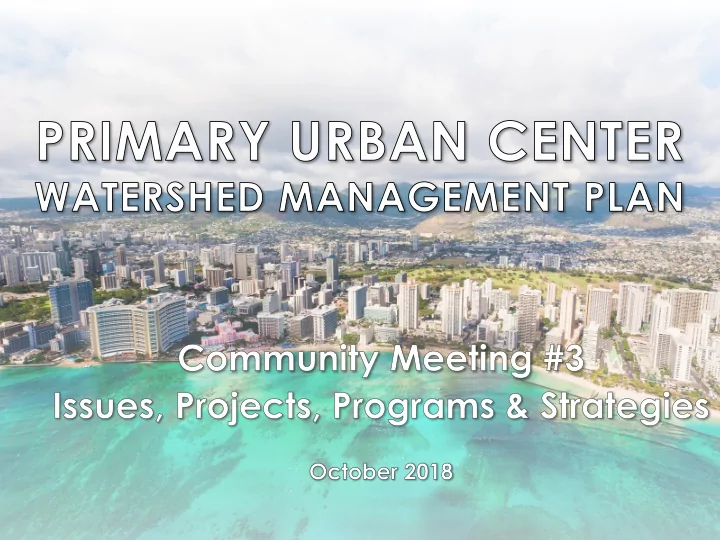
October 2018 PRIMARY URBAN CENTER WATERSHED MANAGEMENT PLAN 1
October 2018 P RIMARY U RBAN C ENTER W ATERSHED M ANAGEMENT P LAN 1 - - PowerPoint PPT Presentation
October 2018 P RIMARY U RBAN C ENTER W ATERSHED M ANAGEMENT P LAN 1 PRESENTATION TOPICS Introduction & Project Overview Issues and Watershed Management Projects, Programs, and Strategies Priority Watersheds and Catalyst Projects
October 2018 PRIMARY URBAN CENTER WATERSHED MANAGEMENT PLAN 1
October 2018 PRIMARY URBAN CENTER WATERSHED MANAGEMENT PLAN 2
October 2018 PRIMARY URBAN CENTER WATERSHED MANAGEMENT PLAN 3
October 2018 PRIMARY URBAN CENTER WATERSHED MANAGEMENT PLAN 4
NORTH SHORE (2016) KOʻOLAU LOA (2009) KOʻOLAU POKO (2012) WAIʻANAE (2009) CENTRAL OʻAHU (in progress) ʻEWA (in progress) EAST HONOLULU (in progress) PRIMARY URBAN CENTER (in progress)
Management Plans
→ Oʻahu Water Management Plan → Required by State Water Code and mandated by County Ordinance
October 2018 PRIMARY URBAN CENTER WATERSHED MANAGEMENT PLAN 5
To formulate an en envi vironmentally ly holis listic ic, communit ity-based, and ec economically via viable watershed management plan that will provide a balance between: Preservation and management
watersheds Sustainable water use and development to serve present users and future generations
B A L A N C E
October 2018 PRIMARY URBAN CENTER WATERSHED MANAGEMENT PLAN 6
implementation
October 2018 PRIMARY URBAN CENTER WATERSHED MANAGEMENT PLAN 7
October 2018 8 PRIMARY URBAN CENTER WATERSHED MANAGEMENT PLAN
Three Main Drainage Areas
October 2018 PRIMARY URBAN CENTER WATERSHED MANAGEMENT PLAN 9
17 Neighborhood Boards 4 Series of Community Meetings (12 total meetings)
1st
st Series
(Ma (May 2017)
Overview and Critical Issues
2nd
nd Seri
ries
(Ma (March 2018)
and Future Water Demands
3rd
rd Series
(Oct (Oct 2018)
PUC Watershed Projects ts, Programs an and St Strategie ies
4th
th Seri
eries
(1 (1st
st Qtr
tr 2019) 2019)
Public Review Draft 50+ In-person talk story with entities,
and individuals
October 2018 PRIMARY URBAN CENTER WATERSHED MANAGEMENT PLAN 10
October 2018 11 PRIMARY URBAN CENTER WATERSHED MANAGEMENT PLAN
COMMUNITY OUTREACH
October 2018 12 PRIMARY URBAN CENTER WATERSHED MANAGEMENT PLAN
Water- related Issues and Concerns
Watershed Health
Climate Change Sea Level Rise Flooding Water Quality Water Quantity
Traditional and Customary Practices
Development and Future Water Supply
October 2018 13 PRIMARY URBAN CENTER WATERSHED MANAGEMENT PLAN
conditions of some of the forest lands
invasive plant species, feral pigs and recreational activities
in some areas due to climate change
October 2018 14 PRIMARY URBAN CENTER WATERSHED MANAGEMENT PLAN
❑ Native Forest Ecosystem Restoration ❑ Fencing and Ungulate Control ❑ Mānoa Valley Loʻi Restoration, Education, and Stewardship ❑ Hoʻoulu ʻĀina
❑ Albizia Removal and Reuse ❑ Native Plant Propagation and Outplanting Program ❑ Coordinated Pig Hunting Program ❑ Stream Restoration and Maintenance
Issue: Watershed Health Objective #1: Promote Sustainable Watersheds
Sub-Objective 1.1 Improve the
water-absorbing capacity of PUC forest lands.
October 2018 15 PRIMARY URBAN CENTER WATERSHED MANAGEMENT PLAN
“non-native” (USGS GIS data)
– Oʻahu Invasive Species Committee (OISC) and Koʻolau Mountains Watershed Partnership (KMWP) target specific non- native plant species
management projects:
– Authorization to fund 4% of CIP budget (or approximately $3.3 million) a year – FY16-18, about $754k for Koʻoalu specific watershed projects, including to OISC, KMWP, and DOFAW
View of Kōnāhuanui Photo credit: Katie Ersbak
Issue: Watershed Health
October 2018 16 PRIMARY URBAN CENTER WATERSHED MANAGEMENT PLAN
Photos from 2017 King Tide
October 2018 17 PRIMARY URBAN CENTER WATERSHED MANAGEMENT PLAN
Hawaii Sea Level Rise Viewer
October 2018 18 PRIMARY URBAN CENTER WATERSHED MANAGEMENT PLAN
Hawaii Sea Level Rise Viewer
October 2018 19 PRIMARY URBAN CENTER WATERSHED MANAGEMENT PLAN
Hawaii Sea Level Rise Viewer
October 2018 20 PRIMARY URBAN CENTER WATERSHED MANAGEMENT PLAN
NOAA Sea Level Rise Viewer
October 2018 21 PRIMARY URBAN CENTER WATERSHED MANAGEMENT PLAN
Critical infrastructure in the SLR-XA with 3.2 feet of sea level rise Source: Hawaiʿi Sea Level Rise Vulnerability and Adaptation Report (2017)
October 2018 22 PRIMARY URBAN CENTER WATERSHED MANAGEMENT PLAN
❑ Execute the Mayor’s City- wide Directive on Climate Change and Sea Level Rise ❑ City-wide Infrastructure Resiliency- Integrated Response to Sea Level Rise and Flooding due to Climate Change
Issue: Impacts of Sea Level Rise on Infrastructure and Development Objective #1: Promote Sustainable Watersheds
Sub-Objective 1.2 Adapt to and plan for climate change and sea level rise, particularly its impacts on coastal infrastructure and people of the PUC.
October 2018 23 PRIMARY URBAN CENTER WATERSHED MANAGEMENT PLAN
– Responsibilities for implementation – References the Commission’s Guidance and Brief, and State’s Report and Hawaii Sea Level Rise Viewer – Revisions to amend shoreline rules and regulations – SLR targets
mid-century
2100, es espec eciall lly for crit critic ical l in infr frastructure with ith lon long g exp xpected lif lifes espans and lo low risk risk tole
Issue: Impacts of Sea Level Rise on Infrastructure and Development
October 2018 24 PRIMARY URBAN CENTER WATERSHED MANAGEMENT PLAN
land uses on nearshore and surface waters, and ground water
October 2018 25 PRIMARY URBAN CENTER WATERSHED MANAGEMENT PLAN
❑ Pearl Harbor Estuary Water Quality Improvement & Ecosystem Restoration ❑ Abandoned Well-Sealing Program ❑ Red Hill Fuel Tanks Rehabilitation ❑ Potable Source Water Protection
Issue: Water Quality Objective #2: Promote and Enhance Water Quality and Quantity
Sub-Objective 2.1 Reduce polluted urban runoff and to improve the quality of the PUC’s nearshore waters. Sub-Objective 2.2 Protect the quality of the PUC's ground water resources from urban land uses.
PR PROGRAMS/STRATEGIES
❑ Stream Restoration and Maintenance ❑ Incorporate Low Impact Development Techniques ❑ Upgrade Cesspools to Septic Systems or Connect to Sewer System
October 2018 PRIMARY URBAN CENTER WATERSHED MANAGEMENT PLAN 26
October 2018 PRIMARY URBAN CENTER WATERSHED MANAGEMENT PLAN 27
Disposing dirt/leaves to storm drains Pet Waste Litter Household Chemicals Cesspool Hosing down dirt/oil Fertilizer/ Pesticide Erosion, Sediment Runoff Fluid leaks From vehicles
October 2018 PRIMARY URBAN CENTER WATERSHED MANAGEMENT PLAN 28
Disposing dirt/leaves to storm drains Pet Waste Litter Household Chemicals Cesspool Hosing down dirt/oil Fertilizer/ Pesticide Erosion, Sediment Runoff Fluid leaks From vehicles Reduce sediment runoff: Forest and Stream Restoration Public Education Low Impact Development Techniques/ Stormwater Capture and Reuse Upgrade Cesspools
Project, Programs and Strategies to Protect Water Quality
October 2018 29 PRIMARY URBAN CENTER WATERSHED MANAGEMENT PLAN
and not
ll main aintain ined str tream ch channels ls
alth an and sa safety, an and property
October 2018 30 PRIMARY URBAN CENTER WATERSHED MANAGEMENT PLAN
❑ Ala Wai Flood Mitigation ❑ Ala Wai Watershed Collaboration
Issue: Flooding Objective #2: Promote and Enhance Water Quality and Quantity
Sub-Objective 2.3 Restore the function of perennial streams of the PUC, including Mānoa Stream and Nu'uanu Stream. Sub-Objective 2.4 Use a watershed approach to improve water quality and mitigate major flooding of the Ala Wai Canal and its tributaries.
PR PROGRAMS/STRATEGIES
❑ Stream Restoration and Maintenance
October 2018 31 PRIMARY URBAN CENTER WATERSHED MANAGEMENT PLAN
* Special Flood Hazard Area: 100-year flood plain * * * * * *
October 2018 32 PRIMARY URBAN CENTER WATERSHED MANAGEMENT PLAN
Study with EIS (May 2017)
(2018) for the design and construction of the project; need a “local sponsor” to commit to funding 35% of design
Issue: Flooding
October 2018 33 PRIMARY URBAN CENTER WATERSHED MANAGEMENT PLAN
the PUC’s natural ground water su supply is is bein ing use sed for human consumption.
limate ch change may decrease rain ainfall ll in in th the PUC, reducin ing th the su sustain inable le yie yield ld of
aq aquifers.
Freshwater Aquifer
October 2018 34 PRIMARY URBAN CENTER WATERSHED MANAGEMENT PLAN
❑ Native Forest Ecosystem Restoration ❑ Fencing and Ungulate Control ❑ Nuʻuanu Hydroelectric and Managed Aquifer Recharge
Issue: Water Quantity Objective #2: Promote and Enhance Water Quality and Quantity
Sub-Objective 2.5 Protect and enhance the sustainability of PUC ground water aquifers.
PR PROGRAMS/STRATEGIES
❑ Incorporate Low Impact Development Techniques
October 2018 35 PRIMARY URBAN CENTER WATERSHED MANAGEMENT PLAN
Reservoir
into Kalihi aquifer
aquifer recharge
to sustain or increase pumping levels
– Increase water supply by 1 to 2 million gallons per day (mgd)
feasibility study and environmental review
Issue: Water Quantity
Kalihi Supply Wells Nuʻuanu Reservoir #1 Injection Wells Water Table Natural Recharge Groundwater Aquifer
October 2018 36 PRIMARY URBAN CENTER WATERSHED MANAGEMENT PLAN
spring and stream flows
farming and aquaculture practices
Mānoa Valley
October 2018 PRIMARY URBAN CENTER WATERSHED MANAGEMENT PLAN 37
Conservancy of Hawaii’s historical fishponds
Harbor)
– Many destroyed, overgrown, filled in and built upon
October 2018 38 PRIMARY URBAN CENTER WATERSHED MANAGEMENT PLAN
Issue: Impacts to Traditional and Customary Practices
❑ Loko Iʻa Restoration, Education, and Stewardship ❑ Mānoa Valley Loʻi Restoration and Cultural Learning Site ❑ Kalauao- Loʻi Restoration, Education, and Stewardship ❑ Hoʻoulu ʻĀina
Objective #3: Protect Native Hawaiian Rights and Traditional and Customary Practices
Sub-Objective 3.1 Provide assistance to non-profit entities that are engaged in environmental restoration, teaching and practicing traditional agriculture and aquaculture in the PUC.
PROGRAMS/STRATEGIES
❑ Watershed Talk Stories ❑ Native Plant Propagation and Outplanting Program
October 2018 39 PRIMARY URBAN CENTER WATERSHED MANAGEMENT PLAN
trees, constructed loʻi kalo
place-based education programs, hands-on learning, watershed protection and restoration work.
– Draft Environmental Assessment (EA) is being prepared for BWS
exist within the PUC
Issue: Impacts to Traditional and Cultural Practices
October 2018 40 PRIMARY URBAN CENTER WATERSHED MANAGEMENT PLAN
AALA PARK
October 2018 41 PRIMARY URBAN CENTER WATERSHED MANAGEMENT PLAN
Issue: Development & Future Water Supply
❑ BWS Conservation and Education Programs ❑ Ala Wai Golf Course Water Recycling Facility ❑ Expand Usage of the BWS Kalauao Springs Non- Potable Water System
Objective #5: Meet Public Water Demands at Reasonable Costs
Sub-Objective 5.1 Plan and implement programs that will increase water efficiency, provide a greater diversity of water supplies, and increase resiliency of water sources.
PROGRAMS/STRATEGIES
❑ Gray Water Reuse ❑ Incorporate Low Impact Development Techniques
October 2018 42 PRIMARY URBAN CENTER WATERSHED MANAGEMENT PLAN
10 billion gallons per year are now saved for other uses today vs.1990 O‘ahu’s Water Conservation Success Story
BWS Conservation Program Launched!
Issue: “Is there enough water for future development?”
October 2018 43 PRIMARY URBAN CENTER WATERSHED MANAGEMENT PLAN
✓ To determine how much and when water may be needed in the future
Issue: “Is there enough water for future development?”
✓ To indicate when increased demands might require infrastructure upgrades ✓ To provide guidance for responsible land and water use decisions
October 2018 44 PRIMARY URBAN CENTER WATERSHED MANAGEMENT PLAN
Scenario Summary of Storyline BWS-Served
from 2010 Most Probable (2040)
Development Plan
reducing the per capita water demand for existing and future users (140 gallons per capita per day) from present-day per capita demand + 28,500 (6% increase) Ultimate (2100)
beginning of the 21st century, the impacts of climate change significantly slow growth in the second half of the century
increase in irrigation water demand
the same as in the Most Probable Scenario after the year 2040 + 125,400 (27% increase)
Issue: “Is there enough water for future development?”
October 2018 45 PRIMARY URBAN CENTER WATERSHED MANAGEMENT PLAN
AQUIFER SUSTAINABLE YIELD PEARL HARBOR SECTOR AREA Waipahu-Waiawa (only partially in PUC) 104 Waimalu 45 HONOLULU SECTOR AREA Moanalua 16 Kalihi 9 Nuʻuanu 14 Pālolo 5 Waiʻalae-West (only partially in PUC) 4 TOTAL
197
Issue: “Is there enough water for future development?”
October 2018 46 PRIMARY URBAN CENTER WATERSHED MANAGEMENT PLAN
Issue: “Is there enough water for future development?”
October 2018 47 PRIMARY URBAN CENTER WATERSHED MANAGEMENT PLAN
Year 2040: Potable Water Demand for the “Most Probable” Scenario
Issue: “Is there enough water for future development?” 89.9 89.1 491,164 531,987
460,000 470,000 480,000 490,000 500,000 510,000 520,000 530,000 540,000 550,000 20 40 60 80 100 120 140 160 180 2010 (Actual) 2020 2030 2040 POPULATION MGD Total PUC Potable Water Demand (MGD) Potable Water-Using PUC Population (incl. visitors, not incl. residents absent)
October 2018 48 PRIMARY URBAN CENTER WATERSHED MANAGEMENT PLAN
Year 2040: Potable Water Demand for the “Most Probable” Scenario
Issue: “Is there enough water for future development?” 89.9 89.1 491,164 531,987
460,000 470,000 480,000 490,000 500,000 510,000 520,000 530,000 540,000 550,000 20 40 60 80 100 120 140 160 180 2010 (Actual) 2020 2030 2040 POPULATION MGD Total PUC Potable Water Demand (MGD) Potable Water-Using PUC Population (incl. visitors, not incl. residents absent)
October 2018 49 PRIMARY URBAN CENTER WATERSHED MANAGEMENT PLAN
Year 2040: Potable Water Demand & Supply for the “Most Probable” Scenario
Issue: “Is there enough water for future development?” 89.9 89.1 160.2 158.0 491,164 531,987
460,000 470,000 480,000 490,000 500,000 510,000 520,000 530,000 540,000 550,000 20 40 60 80 100 120 140 160 180 2010 (Actual) 2020 2030 2040 POPULATION MGD Total PUC Potable Water Demand (MGD) Adjusted Sustainable Yield (Potable Water Supply for PUC) Potable Water-Using PUC Population (incl. visitors, not incl. residents absent)
“Adjusted Supply”
October 2018 50 PRIMARY URBAN CENTER WATERSHED MANAGEMENT PLAN
Year 2040: Potable Water Demand & Supply for the “Most Probable” Scenario
Issue: “Is there enough water for future development?” 89.9 89.1 160.2 158.0 491,164 531,987
460,000 470,000 480,000 490,000 500,000 510,000 520,000 530,000 540,000 550,000 20 40 60 80 100 120 140 160 180 2010 (Actual) 2020 2030 2040 POPULATION MGD Total PUC Potable Water Demand (MGD) Adjusted Sustainable Yield (Potable Water Supply for PUC) Potable Water-Using PUC Population (incl. visitors, not incl. residents absent)
“Adjusted Supply”
October 2018 51 PRIMARY URBAN CENTER WATERSHED MANAGEMENT PLAN
Issue: “Is there enough water for future development?”
October 2018 52 PRIMARY URBAN CENTER WATERSHED MANAGEMENT PLAN
89.9 105.0 491,164 625,476
400,000 450,000 500,000 550,000 600,000 650,000 60 80 100 120 140 160 180 2010 (Actual) 2040 2100 POPULATION MGD Total PUC Potable Water Demand (MGD) Potable Water-Using PUC Population (incl. visitors, not incl. residents absent)
Issue: “Is there enough water for future development?”
Year 2100: Potable Water Demand Projection
October 2018 53 PRIMARY URBAN CENTER WATERSHED MANAGEMENT PLAN
89.9 105.0 491,164 625,476
400,000 450,000 500,000 550,000 600,000 650,000 60 80 100 120 140 160 180 2010 (Actual) 2040 2100 POPULATION MGD Total PUC Potable Water Demand (MGD) Potable Water-Using PUC Population (incl. visitors, not incl. residents absent)
Issue: “Is there enough water for future development?”
Year 2100: Potable Water Demand Projection
October 2018 54 PRIMARY URBAN CENTER WATERSHED MANAGEMENT PLAN
Year 2100: Climate Change Projections
Drier = “Worst Case” Wetter = “Best Case”
Issue: “Is there enough water for future development?”
October 2018 55 PRIMARY URBAN CENTER WATERSHED MANAGEMENT PLAN
Year 2100: Climate Change Projections
Drier = “Worst Case” Wetter = “Best Case”
Issue: “Is there enough water for future development?”
October 2018 56 PRIMARY URBAN CENTER WATERSHED MANAGEMENT PLAN
89.9 105.0 160.2 89.5 137.5 491,164 625,476
400,000 450,000 500,000 550,000 600,000 650,000 60 80 100 120 140 160 180 2010 (Actual) 2040 2100 POPULATION MGD Total PUC Potable Water Demand (MGD) Adjusted Sustainable Yield (Potable Water Supply for PUC) Potable Water-Using PUC Population (incl. visitors, not incl. residents absent)
Issue: “Is there enough water for future development?”
Year 2100: Potable Water Demand & Supply Projections
October 2018 57 PRIMARY URBAN CENTER WATERSHED MANAGEMENT PLAN
Issue: “Is there enough water for future development?”
Year 2100: Potable Water Demand & Supply Projections
October 2018 58 PRIMARY URBAN CENTER WATERSHED MANAGEMENT PLAN
– 2010 PCD in PUC: 151 GPCD – Goal 2100 PCD: 100 GPCD
– Example: BWS Hydroelectric and Managed Aquifer Recharge Project
Issue: “Is there enough water for future development?” PCD = Per capita demand GPCD = Gallons per capita per day
October 2018 59 PRIMARY URBAN CENTER WATERSHED MANAGEMENT PLAN
– BWS district-wide water loss in the PUC was ~ 13.9% in 2015 – BWS’ Leak Detection, Repairs, and Maintenance Program: Detect and repair significant leaks – BWS target: Reduce water loss to < 8.1% (2012 national median water loss estimate)
Issue: “Is there enough water for future development?”
October 2018 60 PRIMARY URBAN CENTER WATERSHED MANAGEMENT PLAN
Issue: “Is there enough water for future development?”
October 2018 PRIMARY URBAN CENTER WATERSHED MANAGEMENT PLAN 61
October 2018 62 PRIMARY URBAN CENTER WATERSHED MANAGEMENT PLAN
→ High ground water recharge (“water in”) and ground water production (“water out”) → Generally ALL watersheds in the PUC are BWS priority watersheds
→ A CATALYST for positive action and change
October 2018 63 PRIMARY URBAN CENTER WATERSHED MANAGEMENT PLAN
October 2018 64 PRIMARY URBAN CENTER WATERSHED MANAGEMENT PLAN
– Pearl Harbor Estuary Water Quality Improvement & Ecosystem Restoration
– Iwilei Sea Level Rise Adaptation Action Plan
– Ala Wai Flood Mitigation Project
October 2018 65 PRIMARY URBAN CENTER WATERSHED MANAGEMENT PLAN
Hawaiʻi
from 20% of Oʻahu’s land area
community asset; past and present significance of cultural and natural resources in area
environmental and water quality issues threaten the Pearl Harbor watersheds
October 2018 66 PRIMARY URBAN CENTER WATERSHED MANAGEMENT PLAN
Waiawa Unit of Pearl Harbor National Wildlife Refuge
Photo credit: USFWS Laura M. Beauregard
Waters rshed hed-Ba Based ed Plan lan
October 2018 67 PRIMARY URBAN CENTER WATERSHED MANAGEMENT PLAN
– Sediment Remediation Project – Integrated Natural Resource Management Plan – Oyster project to improve water quality
Credit: Hui O Koʻolaupoko Credit: U.S. Navy; Keanu Kuna Credit: Hui O Koʻolaupoko
RAIN BARREL LOKO PAʻAIAU RAIN GARDEN
October 2018 68 PRIMARY URBAN CENTER WATERSHED MANAGEMENT PLAN
(~25,600 acres)
Moanalua, Kalihi, Kapālama, and Nuʻuanu streams
and Nuʻuanu watersheds)
– Major redevelopment planned with TOD
October 2018 69 PRIMARY URBAN CENTER WATERSHED MANAGEMENT PLAN
October 2018 PRIMARY URBAN CENTER WATERSHED MANAGEMENT PLAN 70
Source: NOAA Sea Level Rise Viewer
October 2018 71 PRIMARY URBAN CENTER WATERSHED MANAGEMENT PLAN
Existing Iwilei Area looking from the Harbor Planned Iwilei Area looking from the Harbor
(Hypothetical)
Source: Iwilei/Kapalama TOD Infrastructure Master Plan Slideshow (January 2016)
October 2018 72 PRIMARY URBAN CENTER WATERSHED MANAGEMENT PLAN
October 2018 73 PRIMARY URBAN CENTER WATERSHED MANAGEMENT PLAN
– Consideration of drainage from mauka areas
October 2018 74 PRIMARY URBAN CENTER WATERSHED MANAGEMENT PLAN
miles (12,064 acres)
Makiki, Mānoa, and Pālolo streams
Conservation District
urbanized, ~200,000 residents
October 2018 75 PRIMARY URBAN CENTER WATERSHED MANAGEMENT PLAN
acres, including 3,000+ properties, estimated $1.4 billion damages to structures
loss
loss of life
October 2018 76 PRIMARY URBAN CENTER WATERSHED MANAGEMENT PLAN
construction
– $345 million
– Commit to fund 35%: approx. $120 million – Operation, maintenance, repair, replacement, and rehabilitation: approx. $985,000 per year
– Watershed district – Stormwater fee
October 2018 77 PRIMARY URBAN CENTER WATERSHED MANAGEMENT PLAN
October 2018 78 PRIMARY URBAN CENTER WATERSHED MANAGEMENT PLAN
October 2018 PRIMARY URBAN CENTER WATERSHED MANAGEMENT PLAN 79
= Community Meetings
Year 2016 2017 2018 2019
Quarter 3 4 1 2 3 4 1 2 3 4 1 2 3 Stakeholder Consultation Watershed Profile Water Demand Analysis Projects and Strategies Implementation Plan Public Review Draft Approvals Process
October 2018 PRIMARY URBAN CENTER WATERSHED MANAGEMENT PLAN 80
October 2018 PRIMARY URBAN CENTER WATERSHED MANAGEMENT PLAN 81
Barry Usagawa 808-748-5900 busagawa@hbws.org Bruce Tsuchida 808-550-3891 bruce@townscapeinc.com
For more information, please visit: http://www.boardofwatersupply.com/water-resources/watershed-management- plan/primary-urban-center-plan
Planning and Engineering Feasibility Studies Initiate implementation of the long-range infrastructure facilities plans and CIP. Utilize the SLRXA research to identify key infrastructure impacts. Conduct vulnerability and risk assessments of SLRXA impacted infrastructure. Develop criteria for selection of priority areas for inundation and coastal erosion. Develop adaptive strategies for hardening/elevating or retreating/redevelopment. Develop drainage master plans for 100-year storm with target SLR (elevating and stormwater pumping). Create a GIS elevation contour map for site-specific grading and drainage. Install interim flood mitigation measures (one-way drainage valves, on-site stormwater pumps, berms). Conform/elevate new development consistent with the drainage master plans. Conform/elevate existing development consistent with the drainage master plans. Initiate P & E to elevate roadways and utilities once nuisance flooding exceeds 24 times/year. Mitigate coastal erosion impact areas; hardening coastal roadways, seawalls, and bridge improvements. Initiate district area EIS and long lead permitting/approvals. Revise and adjust CIP sequencing for site-specific drainage, roadway elevation, pumping, bridge hardening, etc. Incorporate SLR CIP design and construction improvements in annual budgets. Policy/Regulation City Climate Change Commission SLR Guidance and Recommendations Mayor's SLR Directive establishing SLR targets, City agency policies & responsibilities for implementation Governor's SLR Executive Order establishing SLR targets, State agency policies & responsibilities for implementation Amend land use plans to include SLR policies Establish SLRXA Resiliency Districts/Zoning Update Flood Insurance Rate Maps (FIRM) for SLR Add LUO SLR building codes and design criteria for new developments, (Vertical Ordinance 2412) Add SLR requirements to City Agencies long-range infrastructure facilities plans and CIP Adopt county framework for interagency coordination. Consolidate and streamline SLRXA environmental & permit review process.
Draft Sea Level Rise Action Strategy
Brown and Caldwell
82
<-
Financ ancing ing Authorize CIP appropriations for SLR adaptation measures. Develop alternative funding strategies to supplement CIP appropriations. Establish a SLRXA assessment/fee to implement SLR adaptation measures. Authorization and appropriation of Federal matching funding. Develop tax incentive programs for private development to implement SLR improvements. Establish SLR improvement districts to fund site-specific SLR adaptation measures. Research and Monitoring Continue environmental baseline data collection. Refinement of research on SLRXA that will be impacted Continue updates of islandwide SLRXA forecasting/modeling as new data becomes available Expand and continuously monitor tidal and groundwater well network to validate SLRXA modeling