
SLIDE 1
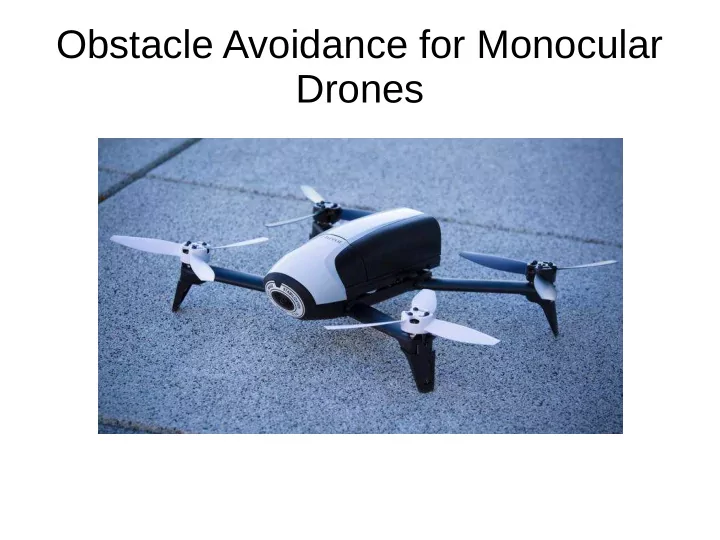
Obstacle Avoidance for Monocular Drones Table of Contents I. - - PowerPoint PPT Presentation
Obstacle Avoidance for Monocular Drones Table of Contents I. Technological context II. Neural Networks for obstacle avoidance i. Deep Reinforcement Learning ii. The two axis of development III. . Depth Net i. FOE Extraction pretraining ii.
Obstacle Avoidance for Monocular Drones 2
III. . Depth Net
iii.Multiple Shift DepthNet iv.BatLib + DepthNet
IV. . Future work
Obstacle Avoidance for Monocular Drones 3
Obstacle Avoidance for Monocular Drones 4
– Follow Me – Flight Plan
Obstacle Avoidance for Monocular Drones 5
avoid obstacles when in these modes.
remains stable and the customer is still happy
have 1 camera and IMU.
Obstacle Avoidance for Monocular Drones 6
high level commands
that we can assume input videos is just translated.
Video stab ? Piloting Motors Video ??
Obstacle Avoidance for Monocular Drones 7
– SLAM – Obstacle detection – PathFinding
problem for consumer products
environment which is a waste of computation
policy to get a smooth obstacle detection
Obstacle Avoidance for Monocular Drones 8
Obstacle Avoidance for Monocular Drones 9
not so much for drones
– It learned to drive by mimicking human piloting : it
was not reinforcement learning
– Made classification to incoming road
Sermanet, R. H. P., Erkan, J. B. A., Scoffier, M., & LeCun, K. K. U. M. Y. Learning Long-Range Vision for Autonomous Off-Road Driving. Muller, U., Ben, J., Cosatto, E., Flepp, B., & Cun, Y. L. (2006). Off-road obstacle avoidance through end-to-end learning. In Advances in neural information processing systems (pp. 739-746).
– It's impossible to relate depth of the pixels according to the horizon, in cluttered
environment, every pixel is an obstacle, what we don't know is its distance
impossible to have a ground truth to work with.
– Human piloting ressources are expensive, and not necessarily perfect – Still got some
interesting results with imitation training
Ross, S., Melik-Barkhudarov, N., Shankar, K. S., Wendel, A., Dey, D., Bagnell, J. A., & Hebert, M. (2013, May). Learning monocular reactive uav control in cluttered natural environments. In Robotics and Automation (ICRA), 2013 IEEE International Conference on (pp. 1765-1772). IEEE.
Obstacle Avoidance for Monocular Drones 11
condensed system, as it only deals with inputs and outputs
drone, too many crashes ! Real world is very complex and we need an efficient way of learning
Obstacle Avoidance for Monocular Drones 12
at the picture output and simple rewards.
states problems such as driving games
Mnih, V., Kavukcuoglu, K., Silver, D., Graves, A., Antonoglou, I., Wierstra, D., & Riedmiller, M. (2013). Playing atari with deep reinforcement learning. In Nature Lillicrap, T. P., Hunt, J. J., Pritzel, A., Heess, N., Erez, T., Tassa, Y., ... & Wierstra, D. (2015). Continuous control with deep reinforcement learning. arXiv preprint arXiv:1509.02971.
13
which is possible for a limited set of possible actions
Bellman equation
Environment Policy Action at State, Reward st, rt-1
Rt =
∑
t '=t T
γ
t'−trt'
at=maxaQ(st,a ,W )
L(W )=[ y−Q(st,at ,W t)]
2
∇W L(W )=[( y−Q (st ,at,W )) ∇W Q(s ,a,W )] y=rt+ γmaxa'Q(st+1,a' ,W t−1)
Obstacle Avoidance for Monocular Drones 14
Environment Actor (µ)
at=maxaQ (st,a ,W )
find a better method to find the best action possible. We design with Q a function that maps directly to actions, maximizing Q regarding the action Critic (Q) st st,rt-1 st at
L(W ')=|max aQ(st,a)−Q (st,μ(st,W '))|
∇W ' L=∇ aQ (s ,a)∇ W 'μ(s,W ') During Inference, only the Actor will be called. We now have a mapping directly from previous states to any continuous action
Obstacle Avoidance for Monocular Drones 15
Gazebo, which behave (hopefully) exactly like the real drone.
safer than real training
not very similar to real video footage. Our system won't work if it's only trained on simulator
Obstacle Avoidance for Monocular Drones 16
do we make it work in real life ?
Obstacle Avoidance for Monocular Drones 17
context-sensitive, even for a simulation
depth map in a supervised training, and then train a simpler network with reinforcement learning
Obstacle Avoidance for Monocular Drones 18
Supervised Reinforcement Network Complexity Environment Complexity Simulator Real Conditions Depth Map Extraction Goal Depth Map for real footage Obstacle Avoidance in simulator
Obstacle Avoidance for Monocular Drones 19
Obstacle Avoidance for Monocular Drones 20
Rigid scene and rotation-less movement only
Obstacle Avoidance for Monocular Drones 21
Dosovitskiy, A., Fischer, P., Ilg, E., Hausser, P., Hazirbas, C., Golkov, V., ... & Brox, T. (2015). Flownet: Learning optical flow with convolutional networks. In Proceedings of the IEEE International Conference on Computer Vision (pp. 2758-2766).
Obstacle Avoidance for Monocular Drones 22
and concatenation
retain spatial information
architectures such as FlowNetC, FlowNet2 and GC-Net
Ilg, E., Mayer, N., Saikia, T., Keuper, M., Dosovitskiy, A., & Brox, T. (2016). Flownet 2.0: Evolution of optical flow estimation with deep networks. arXiv preprint arXiv:1612.01925. Kendall, A., Martirosyan, H., Dasgupta, S., Henry, P., Kennedy, R., Bachrach, A., & Bry, A. (2017). End-to-End Learning of Geometry and Context for Deep Stereo Regression. arXiv preprint arXiv:1703.04309.
Obstacle Avoidance for Monocular Drones 23
cameras.
considered overkill for rigid scenes problem, which allows us to consider smaller variations of FlowNet
for optical flow, but not instinctively for depth
Obstacle Avoidance for Monocular Drones 24
equation :
approaching FOE, which will make errors diverge dramatically
Obstacle Avoidance for Monocular Drones 25
needed operation for depth is depending on its
relative position to P0
point to solve the problem : connection from feature maps to FC vector gives away FOE and P0
Obstacle Avoidance for Monocular Drones 26
displacements
decorrelated
Obstacle Avoidance for Monocular Drones 27
layer instead of 2xhxw
for a nominal displacement of 30 cm
and outputs depth values within [0,100]
Obstacle Avoidance for Monocular Drones 28
feature maps are then FC layers, FOE and P0 problem solved
anymore, but It still improves!
pretraining.
Obstacle Avoidance for Monocular Drones 29
DepthNet64 : 16x16 output DepthNet512 : 128x128 output
Obstacle Avoidance for Monocular Drones 30
displacement, we can use this simple equation :
[15,60]. An optimal shift can be computed from last depth map to center next DepthNet output.
t i m a l as possible
where you would need good contrast for close object (<15m) AND for far
t i m a l values can be computed with clustering
algorithms such as K-means
β
m e a n
= , 3 α = 1 m
31
Final workflow for multiple shift depth extraction and fusion
1+ e e e βmin βmax βmean
Obstacle Avoidance for Monocular Drones 32
Obstacle Avoidance for Monocular Drones 33
depthMap as input (from any provider, such as ToF, stereo or DepthNet)
which sends back DepthNet output to the drone
Obstacle Avoidance for Monocular Drones 34
Obstacle Avoidance for Monocular Drones 35
Supervised Reinforcement Network Complexity Environment Complexity Simulator Real Conditions DepthNet Goal DepthNet In real conditions Obstacle Avoidance in simulator We want to go here
36
(from Sfm-Net) Photometric error : reprojection error E(f(It-dt), It) f : warp function from depth + displacement
Vijayanarasimhan, S., Ricco, S., Schmid, C., Sukthankar, R., & Fragkiadaki, K. (2017). SfM-Net: Learning of Structure and Motion from Video. arXiv preprint arXiv:1704.07804. Zhou, T., Brown, M., Snavely, N., & Lowe, D. G. (2017). Unsupervised learning of depth and ego-motion from video. arXiv preprint arXiv:1704.07813.
Obstacle Avoidance for Monocular Drones 37
be 0.
maps to get a new error E(f(βt),βt-dt) + E(f(βt-dt),βt)
to degenerate states not representative to depth map
Obstacle Avoidance for Monocular Drones 38
displacements
anyone and does not require depth map ground truth.
Obstacle Avoidance for Monocular Drones 39
Supervised Reinforcement Network Complexity Environment Complexity Simulator Real Conditions DepthNet Goal DepthNet In real conditions Obstacle Avoidance in simulator We want to go there
40
rendering
infer safe commands from depthMap in Gazebo.
Depth Map command
Reward Constraints Conv FC Conv FC Maximize
Potential weight sharing
Obstacle Avoidance for Monocular Drones 41
Supervised Reinforcement Network Complexity Environment Complexity Simulator Real Conditions DepthNet Goal DepthNet In real conditions Obstacle Avoidance in simulator We want to go there
Obstacle Avoidance for Monocular Drones 42
(DPPN) can now be concatenated for a final finetuning with human supervised flight
interception, as with DAgger, for stability, along with GPS and speed constraints reward.
Ross, S., Gordon, G. J., & Bagnell, D. (2011). A reduction of imitation learning and structured prediction to no-regret online learning. In International Conference on Artificial Intelligence and Statistics (pp. 627-635).
Obstacle Avoidance for Monocular Drones 43
DepthNet Imgt,imgt-dt Depth Map Command DDPG DQN
Maximize Mean, std, optimal dt
Hand crafted Reward
Obstacle Avoidance for Monocular Drones 44
will be very heavy and impossible to deploy for users
network that will not waste time constructing an explicit depth map.
learning and self supervision ! It can be online or
frame
Obstacle Avoidance for Monocular Drones 45
DepthNet DDPG Imgt,imgt-dt Depth Map Command
Maximize
DQN S&A Network
Imtation learning Hand crafted Reward
Obstacle Avoidance for Monocular Drones 46
DepthNet DDPG Imgt,imgt-dt Depth Map Command S&A Network
DDPG-based reward
Obstacle Avoidance for Monocular Drones 47
and evaluated
differentiable Obstacle Avoidance real conditions POC
trained to mimic the former mixture and then to explore by itself
Obstacle Avoidance for Monocular Drones 48