
SLIDE 1
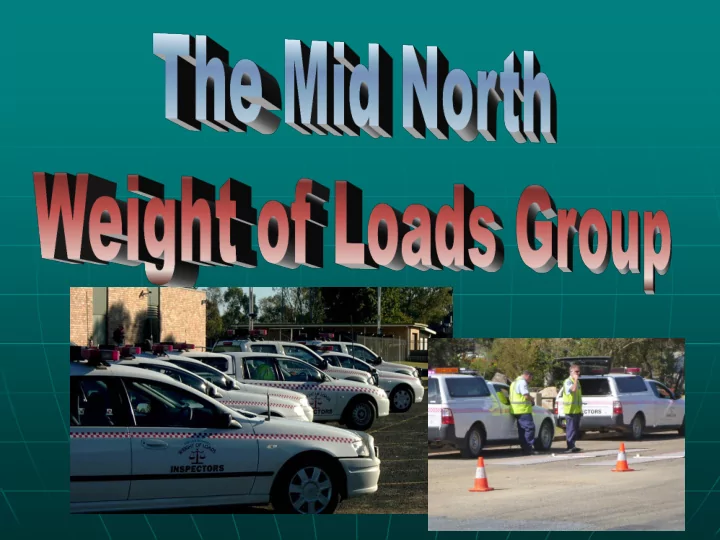
OBJECTIVES REDUCE THE COST OF MAINTAINING ROADS, BY PREVENTING THE - - PowerPoint PPT Presentation
OBJECTIVES REDUCE THE COST OF MAINTAINING ROADS, BY PREVENTING THE DAMAGE CAUSED BY OVERLOADED VEHICLES. Mid North Weight of Loads Member Councils Armidale Regional Bellingen Coffs Harbour Dungog Kempsey Port Macquarie/ Hastings
OBJECTIVES
REDUCE THE COST OF MAINTAINING ROADS, BY PREVENTING THE DAMAGE CAUSED BY OVERLOADED VEHICLES.
Armidale Regional Bellingen Coffs Harbour Dungog Kempsey Port Macquarie/ Hastings Liverpool Plains MidCoast Muswellbrook Nambucca Tamworth Regional Upper Hunter Uralla Walcha
Mid North Weight of Loads – Member Councils
WHAT WE DO?
Liaise with Operators to assist with legislative
compliance.
Work in conjunction with the NSW Department of
Transport (previously RTA) to ensure that the following Acts (& regulations) are complied with:- Road Transport Act 2013 with associated Road Transport (General) Regulation 2013 but also Road Regulations 2008, Road Rules 2008, Road Transport (Vehicle Registration) Regulation 2007, Road Transport (Mass, Loading & Access)Regulation 2005 (only partially repealed) and also Heavy Vehicle National Law (NSW), Heavy Vehicle (Mass Dimension Loading) Regulation and of course the Local Government Act(covers officer Authorisations from each LGA).
Patrol State, Regional and Local roads in the
participating council areas.
Conduct random mass checks on heavy vehicles to
ensure they operate within legislated mass limits
WHY?
Because overloaded vehicles cause excessive damage to roads and bridges and the cost to the community to repair the damage is extremely high Pavement damage can be a contributing factor in vehicle accidents Local government roads are low volume roads covering vast distances; because of limited funding these roads were built with limited pavement thickness and are most vulnerable to effects of overloaded vehicles.
Belltrees Bridge, Scone Shire Council March 1921 Anticipated vehicle use !
Belltrees Bridge, Scone Shire Council October 1996
Could a bridge designer of the 1920’s have foreseen a Super-Dog combination or a B-Double ?
WHAT IS THE EFFECT OF OVERLOADING ON THE ROAD ?
ESA
Single Axle transmitting a load of 80kN (or 8.2 tonne) to the pavement.
Standard Axle is 5.4 tonne on Single Axle Single Tyre 8.2 tonne on Single Axle Dual Tyre 13.8 tonne on Tandem Axle Dual Tyre 18.5 tonne on Triaxle Dual Tyre
The 4th Power Rule
4 No of Load on Standard = Axle Group Axle Standard Repetitions Load for Axle Group
Application of the 4th Power Rule
Effect of a 5% overload – 4th power rule increase in damage 1.05 x 1.05 x 1.05 x 1.05 = 1.22 i.e.22% Or, Reduction in pavement life 0.22/(1+0.22)=0.18 i.e. 18% The effect of 10% overload 1.10 x 1.10 x 1.10 x 1.10 = 1.46 Or 46% increase in damage and 32% Reduction in pavement life
Overloading vs Pavement Life
Note the effect of 20% overloading halves pavement life by fatigue loading Working life of % overload % increase 20 year pavement On “Standard Axle” in damage reduced to (years) 10 46 13.7 20 105 9.8 30 185 7.0 40 285 5.2
Designs are based on equivalent no. of standard axles.
kN Tonnes ESA Single Axle Single Tyre 53 5.4 1 Single Axle Dual Tyres 80 8.2 1 Dual Axle Dual Tyres 135 13.6 1 Tri Axle Dual Tyres 181 18.5 1 Equivalent No. Standard Axles = AXLE WEIGHT Exponent STANDARD Exponent: - Granular = 4 Sub Grade = 7.14 Asphalt = 5 Bound (Cement Stab)= 18 Example – Effects on Fatigue Life – Dual Axle – Dual Tyres
Load ESA Bound – (Cement Stabilised) Gravel Pavement Sub Grade Asphalt 1ESA 1.0 1.0 1.0 1.0 Current Legal Load (16.5) 2.17 3.98 2.63 32 Available Permits - up to (18.0) 3.07 7.4 4.06 155.3
Damaging Power of Overloads (Ex Wilks) Reduction in Pavement Life Due to Overloads
Car vs Truck
To help put in context
=
2 Tonne Car = 1/2250th ESA’s Ave Artic Truck = 2.65 ESA Artic Truck = 6000 Cars
82% of traffic on National Highways
are cars
Cars contribute 0.03% to pavement
loadings based on ESA – km travelled
Car vs Truck
“Road” Friendly Suspension ? ? ?
AIRBAGS VS STEEL SPRINGS RTA test conducted on a 4 short span reinforced concrete bridge on the Bucketts Way, in Great Lakes Council area.
Bridge 4 x 9.14m spans P/S Concrete
The GVM is the structural capacity as determined by the Manufacturer
Mass Limits Vs Gross Vehicle Mass
GVM may be found on the rego label or in the cabin And should be printed on right side of the vehicle
Mass Limits Vs Gross Combination Mass
The manufacturers GCM is the maximum structural
capacity of Prime Mover & Trailer Combination.
Mass Limits
The legal mass limits for each axle or axle group and gross weights.
Mass Limits
The posted weight
road or bridge.
Exceed 1:1 Ratio
The weight of trailer cannot exceed
the weight of the towing vehicle.
Truck must be heavier than the
trailer.
B – Doubles Off Route
B – Doubles must follow proscribed
routes.
This information is available on the
RTA website (www.rta.nsw.gov.au)
The Process
Stopping – Drivers are required to stop when an
not) bearing the words “STOP” or “RTA STOP”. A Fail to Stop breach report will be written if a driver fails to stop.
The Process
Safety – inspectors are able to direct the driver of a vehicle up to thirty kilometres away from the drivers direction of travel in order to utilise a safer, more suitable weigh site. Worksites are set out using approved Traffic Control Plans
Place Scales
Remove scales from boot of Weight of Loads Vehicle Place scales in front of all wheels
Establish the degree of the slope on the weigh site both laterally & longitudinally
Truck Drives Onto Scales
Place scales in front of all wheels
Scale Readings – Drivers are encouraged to view scale readings however due to OH&S requirements all directions relating to safety and the worksite must be strictly adhered
safety vests.
Check Weights
Calculate allowed weights Calculate axle weights Discuss any breaches Office will issue infringement if required
COST OF OVERLOADING TO GLOUCESTER SHIRE COUNCIL
ANALYSIS BASED ON WILKS
= 100 x (% increase in damaging power) x % of vehicles overloaded Pavement Life (100 + % increase in damaging power) = 100 x 60) x 7.3 (100 + 60) 100 = 2.7 %
20
POTENTIAL SITUATION IF NO WEIGHT OF LOADS GROUP
(compared with legal loads) with a corresponding reduction in pavement life of 55% if all vehicles overloaded.
100 x ( 150 ) x 25 = 15% 100 + 150 100
= $3.95m x 15% = $592,500 pa
Benefit of MNWOL Membership
$ 13,800