Objectives Discuss current barriers in achieving an effective and - - PDF document

objectives
SMART_READER_LITE
LIVE PREVIEW

Objectives Discuss current barriers in achieving an effective and - - PDF document

Chasing Zero Infections November 16, 2017 Connecting the Dots to Reduce Patient Harm: Hot Topics in Infection Prevention SOAP- UP : Improving Hand Hygiene as a Comprehensive Infection Prevention Strategy Linda R. Greene, RN,MPS,CIC, FAPIC


slide-1
SLIDE 1

Chasing Zero Infections Connecting the Dots to Reduce Patient Harm: Hot Topics in Infection Prevention November 16, 2017 Mission to Care | Florida Hospital Association Hospital Improvement Innovation Network 1

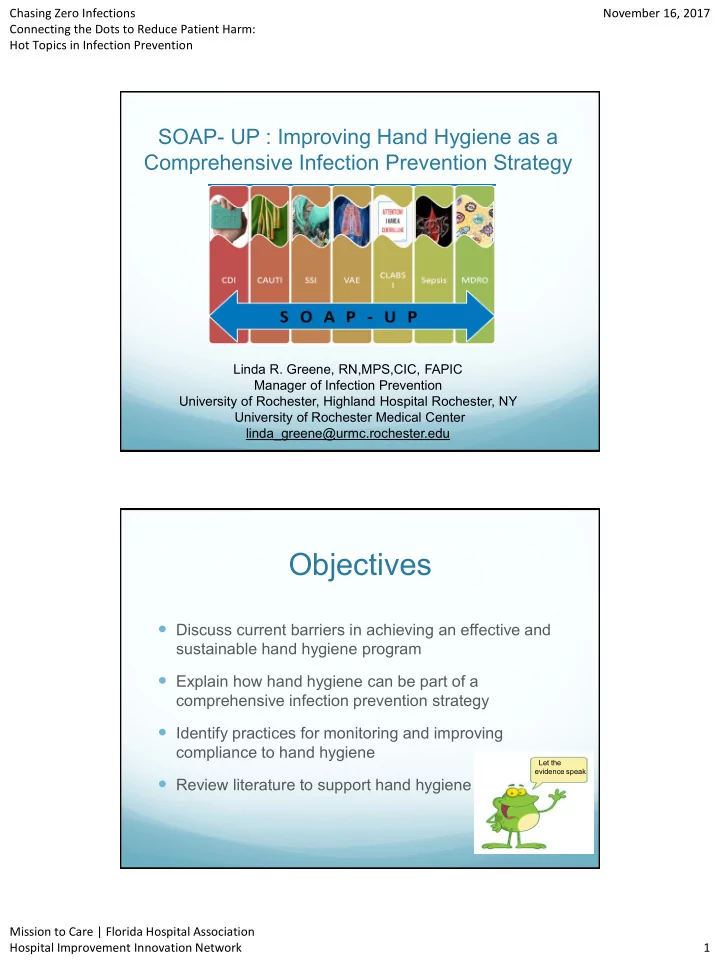
SOAP- UP : Improving Hand Hygiene as a Comprehensive Infection Prevention Strategy

Linda R. Greene, RN,MPS,CIC, FAPIC Manager of Infection Prevention University of Rochester, Highland Hospital Rochester, NY University of Rochester Medical Center linda_greene@urmc.rochester.edu

Objectives

 Discuss current barriers in achieving an effective and

sustainable hand hygiene program

 Explain how hand hygiene can be part of a

comprehensive infection prevention strategy

 Identify practices for monitoring and improving

compliance to hand hygiene

 Review literature to support hand hygiene

Let the evidence speak

slide-2
SLIDE 2

Chasing Zero Infections Connecting the Dots to Reduce Patient Harm: Hot Topics in Infection Prevention November 16, 2017 Mission to Care | Florida Hospital Association Hospital Improvement Innovation Network 2

Why is this initiative different?

Refreshes the thinking- new twist “Connects the dots” to harm Decreases complexity Cross Cutting Engages the front line

slide-3
SLIDE 3

Chasing Zero Infections Connecting the Dots to Reduce Patient Harm: Hot Topics in Infection Prevention November 16, 2017 Mission to Care | Florida Hospital Association Hospital Improvement Innovation Network 3

SOAP UP Must Do’s

 Prompt Peer Performance  Track Quietly and Trend Loudly  Drive Drift Down

Top 10 Checklist

slide-4
SLIDE 4

Chasing Zero Infections Connecting the Dots to Reduce Patient Harm: Hot Topics in Infection Prevention November 16, 2017 Mission to Care | Florida Hospital Association Hospital Improvement Innovation Network 4

Where it all began Background

slide-5
SLIDE 5

Chasing Zero Infections Connecting the Dots to Reduce Patient Harm: Hot Topics in Infection Prevention November 16, 2017 Mission to Care | Florida Hospital Association Hospital Improvement Innovation Network 5

The How and the When Key Points

slide-6
SLIDE 6

Chasing Zero Infections Connecting the Dots to Reduce Patient Harm: Hot Topics in Infection Prevention November 16, 2017 Mission to Care | Florida Hospital Association Hospital Improvement Innovation Network 6

4 Components of Good Hand Hygiene

slide-7
SLIDE 7

Chasing Zero Infections Connecting the Dots to Reduce Patient Harm: Hot Topics in Infection Prevention November 16, 2017 Mission to Care | Florida Hospital Association Hospital Improvement Innovation Network 7

Literature Findings

slide-8
SLIDE 8

Chasing Zero Infections Connecting the Dots to Reduce Patient Harm: Hot Topics in Infection Prevention November 16, 2017 Mission to Care | Florida Hospital Association Hospital Improvement Innovation Network 8

slide-9
SLIDE 9

Chasing Zero Infections Connecting the Dots to Reduce Patient Harm: Hot Topics in Infection Prevention November 16, 2017 Mission to Care | Florida Hospital Association Hospital Improvement Innovation Network 9

Face to Face interviews with 13 senior managers at a large university hospital Seven distinct themes:

Culture change starts with leaders

Refresh and Renew the message

Connect the 5 moments to the whole patient journey

Actionable audit results

Empower patients

Reconceptualize non compliance

Start the hammer

slide-10
SLIDE 10

Chasing Zero Infections Connecting the Dots to Reduce Patient Harm: Hot Topics in Infection Prevention November 16, 2017 Mission to Care | Florida Hospital Association Hospital Improvement Innovation Network 10

Participants All affiliated nurses of the nursing wards. Wards were randomly assigned to either the team and leaders-directed strategy (30 wards) or the state-of-the-art strategy (37 wards). Methods The control arm received a state-of-the-art strategy including education, reminders, feedback and targeting adequate products and facilities. The experimental group received all elements of the state-of- the-art strategy supplemented with interventions based on social influence and leadership, comprising specific team and leaders-directed activities. Strategies were delivered during a period of six months

Results 10,785 opportunities for appropriate hand hygiene in 2733 nurses. The compliance in the state-of-the-art group increased from 23% to 42% in the short term and to 46% in the long run. The hand hygiene compliance in the team and leaders-directed group improved from 20% to 53% in the short term and remained 53% in the long run. The difference between both strategies showed an Odds Ratio of 1.64 (95% CI 1.33–2.02) in favour of the team and leaders-directed strategy. Conclusions Our results support the added value of social influence and enhanced leadership in hand hygiene improvement strategies. The methodology of the latter also seems promising for improving team performance with other patient safety issues

slide-11
SLIDE 11

Chasing Zero Infections Connecting the Dots to Reduce Patient Harm: Hot Topics in Infection Prevention November 16, 2017 Mission to Care | Florida Hospital Association Hospital Improvement Innovation Network 11

slide-12
SLIDE 12

Chasing Zero Infections Connecting the Dots to Reduce Patient Harm: Hot Topics in Infection Prevention November 16, 2017 Mission to Care | Florida Hospital Association Hospital Improvement Innovation Network 12

Other Strategies

Hand Hygiene

UC insertion and maintenance

Prevention of MDRO Surgical scurb

Prevention

  • f c difficile

Prevention

  • f diarrheal
  • utbreaks

Central line insertion and Maintenance

slide-13
SLIDE 13

Chasing Zero Infections Connecting the Dots to Reduce Patient Harm: Hot Topics in Infection Prevention November 16, 2017 Mission to Care | Florida Hospital Association Hospital Improvement Innovation Network 13

Connecting the Dots C difficile Monitoring

slide-14
SLIDE 14

Chasing Zero Infections Connecting the Dots to Reduce Patient Harm: Hot Topics in Infection Prevention November 16, 2017 Mission to Care | Florida Hospital Association Hospital Improvement Innovation Network 14

Preventing CAUTI

Milisa Manojlovich, PhD, RN, CCRN Associate Professor University of Michigan School of Nursing.

Study purpose:

Determine if changes (in the hospital and nationwide) have contributed to improved catheter insertion practices

Explore barriers and facilitators to adherence of urinary catheter insertion guidelines Manojlovich et al. Infect Control Hosp Epidemiol. 2015

Methods

 2 teams of nursing students  0630 – 2100, in 4 or 8 hour blocks of time  January 29 – June 30, 2014  Observation, checklists, field notes

slide-15
SLIDE 15

Chasing Zero Infections Connecting the Dots to Reduce Patient Harm: Hot Topics in Infection Prevention November 16, 2017 Mission to Care | Florida Hospital Association Hospital Improvement Innovation Network 15

Results

 No hand hygiene prior to 74% of insertions  No hand hygiene in 91% post insertion  59% of insertion attempts were associated with a major

break in sterile technique

30

Hand Hygiene

UC insertion and maintenance

Prevention of MDRO Surgical scurb

Prevention

  • f c difficile

Prevention

  • f diarrheal
  • utbreaks

Central line insertion and Maintenance

slide-16
SLIDE 16

Chasing Zero Infections Connecting the Dots to Reduce Patient Harm: Hot Topics in Infection Prevention November 16, 2017 Mission to Care | Florida Hospital Association Hospital Improvement Innovation Network 16

Engaging Patients

Hand Hygiene – those we care about deserve no less!

slide-17
SLIDE 17

Chasing Zero Infections Connecting the Dots to Reduce Patient Harm: Hot Topics in Infection Prevention November 16, 2017 Mission to Care | Florida Hospital Association Hospital Improvement Innovation Network 17

33

I have all these powers, but no one listens to me!

It takes a village

an engaged

Conclusions

Hand Hygiene must be part of an overall strategy

We must “connect the dots” to other HAI events

Front line staff must be engaged

Healthcare worker must trust our data

When possible immediate feedback is important