Objectives 1 - understand the spiritual component in the disease - - PDF document

objectives
SMART_READER_LITE
LIVE PREVIEW

Objectives 1 - understand the spiritual component in the disease - - PDF document

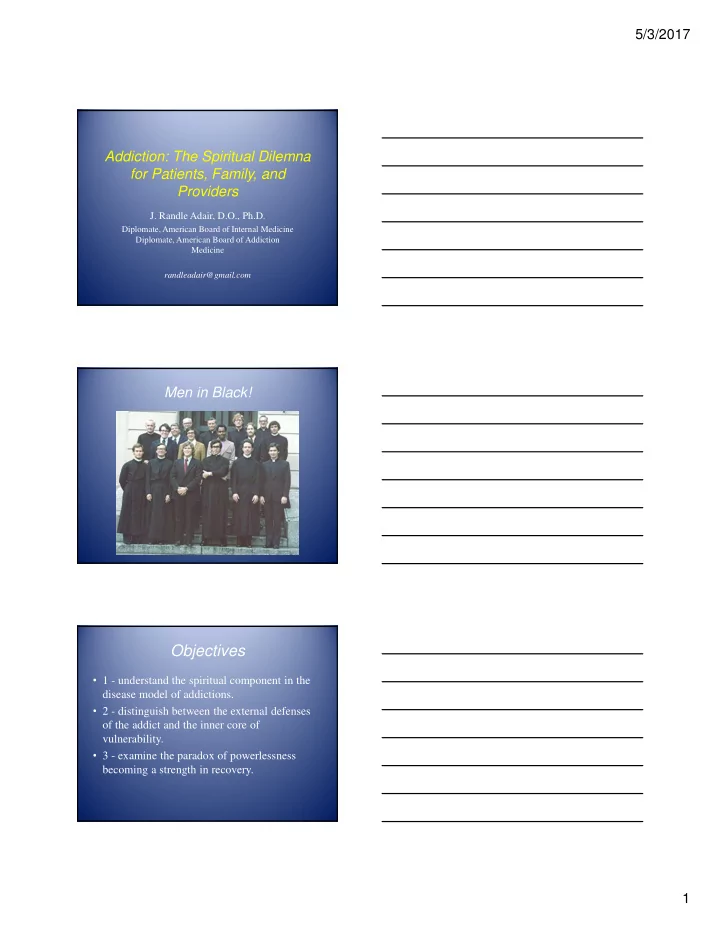
5/3/2017 Addiction: The Spiritual Dilemna for Patients, Family, and Providers J. Randle Adair, D.O., Ph.D . Diplomate, American Board of Internal Medicine Diplomate, American Board of Addiction Medicine randleadair@gmail.com Men in Black!


slide-1
SLIDE 1

5/3/2017 1 Addiction: The Spiritual Dilemna for Patients, Family, and Providers

  • J. Randle Adair, D.O., Ph.D.

Diplomate, American Board of Internal Medicine Diplomate, American Board of Addiction Medicine randleadair@gmail.com

Men in Black!

Objectives

  • 1 - understand the spiritual component in the

disease model of addictions.

  • 2 - distinguish between the external defenses
  • f the addict and the inner core of

vulnerability.

  • 3 - examine the paradox of powerlessness

becoming a strength in recovery.

slide-2
SLIDE 2

5/3/2017 2

Addiction: The History

Addiction: The History

  • Genesis 9: 20-25

– Noah, a tiller of the soil, was the first to plant the vine. He drank some of the wine, and while he was drunk, he uncovered himself inside his tent. Ham, Canaan’s ancestor, saw his father’s nakedness, and told his two brothers

  • utside. Shem and Japheth took a cloak and they both put

it over their shoulders, and walking backward, covered their father’s nakedness. When Noah awoke from his stupor he learned what his youngest son had done to him, and he said: – “Accursed be Canaan. He shall be his brothers’ meanest slave.”

ASAM Definition of Addiction 2011

  • Addiction is a primary, chronic disease of brain reward,

motivation, memory and related circuitry. Dysfunction in these circuits leads to characteristic biological, psychological, social and spiritual manifestations. This is reflected in an individual pathologically pursuing reward and/or relief by substance use and other behaviors.

  • Addiction is characterized by inability to consistently abstain,

impairment in behavioral control, craving, diminished recognition of significant problems with one's behaviors and interpersonal relationships, and a dysfunctional emotional

  • response. Like other chronic diseases, addiction often involves

cycles of relapse and remission. Without treatment or engagement in recovery activities, addiction is progressive and can result in disability or premature death.

slide-3
SLIDE 3

5/3/2017 3

The Pastoral Challenge The Pastoral Challenge Addiction: The Family

slide-4
SLIDE 4

5/3/2017 4

Alcoholic Family Rules

  • Don’t Talk
  • Don’t Trust
  • Don’t Feel

Families in Stress: Their Problems

  • Non-Alcoholic

Identifiable – know the source of their distress or at least admit it when the source is brought to their attention.

  • Alcoholic

Denied – members show sincere delusion. “Alcohol has nothing to do with it.”

Families in Stress: Their Feelings

  • Non-Alcoholic

Painful, unexpressed and may be repressed

  • Alcoholic

Acutely painful and totally

  • ut of awareness – part of a

larger pattern of denial and delusion.

slide-5
SLIDE 5

5/3/2017 5

Families in Stress: Their Defenses

  • Non-Alcoholic

Highly developed to protect individual members from even greater pain and low self-worth.

  • Alcoholic

Rigid and compulsive, repressed feelings locked in as attitudes: Anger becomes resentment Fear becomes withdrawal Guilt becomes avoidance

Families in Stress: Their Self-Worth

  • Non-Alcoholic

Low

  • Alcoholic

Even lower, because all the worth-destroying factors in the family are more intense, coupled with no insight into those factors.

Families in Stress: Their Behavior

  • Non-Alcoholic

Fixed in predictable patterns, assuming an array

  • f defensive roles in an

unconscious effort to survive, both individually and as a family unit

  • Alcoholic

Rigidly fixed and

  • compulsive. Defensive

roles are the same but members become locked into them because of the denial and compulsion that has set up.

slide-6
SLIDE 6

5/3/2017 6

Families in Stress: Their Communication

  • Non-Alcoholic

Restricted by family rules.

  • Alcoholic

Similarly restricted by family rules, but blocked totally in many areas by denial and delusion.

Families in Stress: Their Recovery Programs

  • Non-Alcoholic

Educational efforts can be effective. In spite of impaired communication, pain often motivates the family to be

  • pen enough to accept

information from an

  • utside source and so move

toward change

  • Alcoholic

Education alone ineffective. More formal treatment is required. New information cannot penetrate the denial & delusion systems present. Members deny both their personal contribution to the pain and that alcohol is at the bottom of the problem.

Alcoholic Family Roles

  • Dependent
  • Enabler
  • Hero
  • Scapegoat
  • Lost Child
  • Mascot
slide-7
SLIDE 7

5/3/2017 7

What you

  • bserve at

bedside vs what is going on inside Effective strategies

Alert!

  • The addicted person may not be the person

you are called upon for ministry…….

– The long lost family member who shows up at bedside – The missing child – The ex-spouse ……..Remember, the Family Rules rule!!!

slide-8
SLIDE 8

5/3/2017 8 Who has the answer? Who has the answer? Who has the answer?

Everyone knows the Devil wears Prada, right?

slide-9
SLIDE 9

5/3/2017 9 Do they have the answer?

Alcoholics Anonymous, Chapter 4, “We agnostics” Spirituality as power struggle

  • “Lack of power, that was our dilemma.”
  • “When, therefore, we speak to you of God, we

mean your own conception of God.”

  • “We, who have traveled this dubious path, beg

you to lay aside prejudice, even against

  • rganized religion.”

So how do we approach and manifest spirituality at bedside?

slide-10
SLIDE 10

5/3/2017 10 Are doubt and despair permissible? Are they contrary to the spiritual life?

Whose despairing words are these?

  • I am told God loves me – and yet the reality of darkness &

coldness & emptiness is so great that nothing touches my soul.

  • When I try to raise my thoughts to Heaven – there is such

convicting emptiness that those very thoughts return like sharp knives and hurt my very soul. Love – the word – it brings nothing.

  • There is so much contradiction in my soul. Such deep longing

for God – so deep that it is painful - a suffering continual – and yet not wanted by God – repulsed – empty – no faith – no

  • love. Heaven means nothing – to me it looks like an empty

place.

Whose despairing words are these?

slide-11
SLIDE 11

5/3/2017 11

So how do we approach and manifest spirituality at bedside?

  • Validate the obvious
  • Acknowledge the feelings
  • Be hopeful without giving false hope
  • Be authentic
  • Know yourself!
  • Facilitate and be present – don’t rescue
  • Remember the rules of the Addicted Family
  • Go to Al-Anon?

So how does this modify our practice of our chaplaincy?