Object-Relational Mapping Consider a typical business scenario - - PowerPoint PPT Presentation

object relational mapping
SMART_READER_LITE
LIVE PREVIEW

Object-Relational Mapping Consider a typical business scenario - - PowerPoint PPT Presentation

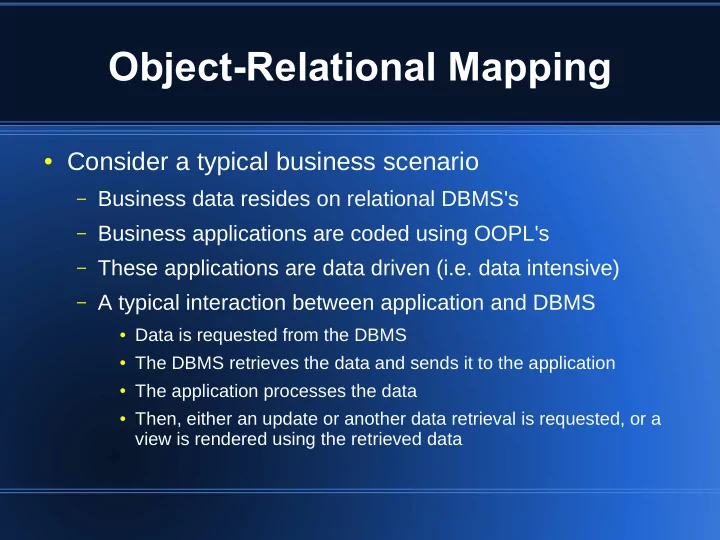
Object-Relational Mapping Consider a typical business scenario Business data resides on relational DBMS's Business applications are coded using OOPL's These applications are data driven (i.e. data intensive) A typical interaction


slide-1
SLIDE 1

Object-Relational Mapping

  • Consider a typical business scenario

– Business data resides on relational DBMS's – Business applications are coded using OOPL's – These applications are data driven (i.e. data intensive) – A typical interaction between application and DBMS

  • Data is requested from the DBMS
  • The DBMS retrieves the data and sends it to the application
  • The application processes the data
  • Then, either an update or another data retrieval is requested, or a

view is rendered using the retrieved data

slide-2
SLIDE 2

Object-Relational Mapping

  • Details of the interaction

– Data request (application)

  • Uses an API to send SQL strings to the DBMS
  • API: DBMS specific (e.g., libpq.so) or agnostic (e.g., JDBC)

– Data retrieval (DBMS and application)

  • The DBMS sends data back to the application
  • The application uses the API to process the returned data

– Updates (DBMS and application)

  • The application uses the API to send SQL strings to the DBMS
  • The DBMS executes the updates and returns status and/or data
  • The application uses the API to check the result of the update
slide-3
SLIDE 3

Object-Relational Mapping

  • Object-Relational Impedance Mismatch

– Design goals (data vs behavior) – Building blocks (tables/rows/fields vs classes/instances) – Type systems (e.g. BLOB vs PDFDocument) – Data retrieval (query based vs navigational access) – Data modification (DML vs setters) – Error handling (no recovery vs structured error handling) – Other

  • DBMS: referential integrity, transactions, concurrency control, etc
  • OOPL: inheritance, interfaces, relationships, reflection, etc
slide-4
SLIDE 4

Object-Relational Model

  • What is the optimal solution?

– A single data model across PL and DBMS

  • What is does a sub-optimal solution look like?

– Bring the PL and DBMS data models as close as possible – Make this procedure as automatic as possible – Effectively isolate all this plumbing from the business layer – Allow freedom for choice (PL and DBMS)

slide-5
SLIDE 5

Object-Relational Mapping

  • ORM as one solution (not “the” solution)

– Natural programming model

  • You program OOP, the mapping layer does the data plumbing

– Classes can be used and tested independently of application – Minimize DBMS trips with optimized fetching strategies

  • A good tool is expected to do better than average programmers

– Coding

  • Reduced coding time and total code size
  • Code is easier to read and maintain

– Error frequency is significantly decreased

slide-6
SLIDE 6

Object-Relational Mapping

  • ORM Desirable Features (not exhaustive)

– Transparency (POJOs/Beans) – Transitivity (relationships) – Persistent/transient instances (attached/detached) – Automatic dirty instance detection – Inheritance strategies (single table, class per table, etc) – Fetching strategies (lazy/eager) – Transaction control – Flexible, “sensible defaults” based configuration – Availability of development tools and learning resources

slide-7
SLIDE 7

Object-Relational Mapping

  • Other solutions

– Native OODBMS's

  • db4o is a Java/.NET open source OODBMS (go check it out!)
  • Ozone is a Java open source OODBMS (older but advanced)

– MS LINQ

  • LINQ stands for Language Integrated Query

– Persistent Programming Language

  • No discrete boundary between program and database objects

– Others...

slide-8
SLIDE 8

Object-Relational Mapping

  • Further reading

– There are good books on the subject and a number of (very)

decent resources online

– Ireland, C. et al. A Classification of Object-Relational

Impedance Mismatch. DBKDA'09. (download if from IEEE Xplore, accessible via the UB Libraries subscription)

– Minnaar, Douglas. Object-Relational Mapping as a

Persistence Strategy. http://tinyurl.com/yeao2fq.

slide-9
SLIDE 9
slide-10
SLIDE 10