OBESITY HYPOVENTILATION Nothing to disclose SYNDROME David - - PowerPoint PPT Presentation

obesity hypoventilation
SMART_READER_LITE
LIVE PREVIEW

OBESITY HYPOVENTILATION Nothing to disclose SYNDROME David - - PowerPoint PPT Presentation

2/15/2014 Disclosures OBESITY HYPOVENTILATION Nothing to disclose SYNDROME David Claman, MD UCSF Professor of Medicine Director, UCSF Sleep Disorders Center COMPLICATIONS OF OSA Obesity Hypoventilation (OHS) Defined as


slide-1
SLIDE 1

2/15/2014 1

OBESITY HYPOVENTILATION SYNDROME

David Claman, MD UCSF Professor of Medicine Director, UCSF Sleep Disorders Center

Disclosures

Nothing to disclose

COMPLICATIONS OF OSA

Cardiovascular

HTN, CHF, CVA, arrhythmia, Pulm HTN

Excessive daytime sleepiness Polycythemia Obesity hypoventilation syndrome (OHS) “Overlap” syndrome – COPD & OSA together

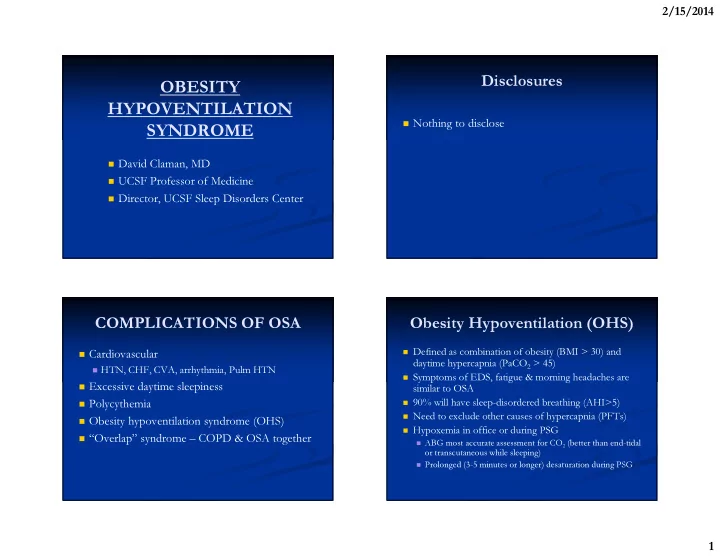
Obesity Hypoventilation (OHS)

Defined as combination of obesity (BMI > 30) and

daytime hypercapnia (PaCO2 > 45)

Symptoms of EDS, fatigue & morning headaches are

similar to OSA

90% will have sleep-disordered breathing (AHI>5) Need to exclude other causes of hypercapnia (PFTs) Hypoxemia in office or during PSG

ABG most accurate assessment for CO2 (better than end-tidal

  • r transcutaneous while sleeping)

Prolonged (3-5 minutes or longer) desaturation during PSG

slide-2
SLIDE 2

2/15/2014 2

INCREASED MORTALITY IN OHS

If untreated, approx 23% mortality at 1-1.5 yrs Treated with NPPV: mortality 3% at 1.5 yrs

  • Mokhlesi B et al. Proc Am Thorac Soc 2008(5):218-225

HYPERCAPNIA IN OSA

French Multicenter Study; n=1141 from database Excluded those with FEV1<80% Overall prevalence of 11% with PaCO2 >45 BMI < 30 – prevalence 7.2% BMI 30-40 – prevalence 9.8% BMI > 40 – prevalence 23.6%

Laaban J-P et al. Chest 2005;127:710-715

Increased Risk with Higher BMI

Data from USA, France and Italy

Mokhlesi B et al. Chest 2007;132:1322-1336

Oxygen in OHS

Patients treated with

NIV + O2 had higher mortality than NIV alone, possibly due to worse underlying disease

(Priou; Chest 2010;138:84) Experimentally, 100%

Oxygen while awake causes 5 mm Hg increase in TcCO2 (Wijeinghe Chest

2011;139:1018)

slide-3
SLIDE 3

2/15/2014 3

DDx of Hypercapnia

  • Limitation to ventilation – CAN’T BREATH

Restrictive lung disease from morbid obesity Chest wall diseases Neuromuscular diseases Obstructive lung disease

  • Central Control - WON’T BREATH

Congenital Central Hypoventilation (Ondine’s curse)

PHOX2B mutation on chromosome 4p12

Brainstem lesions Carotid body disease Metabolic alkalosis

  • Combined defect

COPD Hypothyroidism Sleep Apnea

Olson AL & Zwillich C; Am J Med 2005;118:948- 956

OHS: A SPECTRUM OF RESPIRATORY ABNORMALITIES

OSA with apneas and hypopneas Sleep hypoventilation especially in REM Prolonged obstructive hypoventilation due to

partial upper airway obstruction

Overlap of pulmonary disease with ventilatory

sleep disturbance

Berger KI et al. Chest 2001;120:1231-1238

slide-4
SLIDE 4

2/15/2014 4

TREATMENT OF OHS

Weight loss – consider bariatric surgery CPAP for OSA patients with only mildly

elevated PaCO2

Bilevel or non-invasive ventilation essential if

significant hypercapnia is present

Improved ventilation control in 4-6 days

Berthon-Jones M et al. Am Rev Respir Dis 1987;135:144-7

Progesterone treatment remains inconsistent

CPAP & BILEVEL FOR OHS

Spanish retrospective analysis of 54 patients (18 women)

with OHS; mean BMI 44 (Perez de Llano LA et al. Chest 2005;128:587-594)

OSA (AHI > 5) present in 87% Overall, all patients had improved PaCO2 and PaO2 on

treatment; 5 weaned from treatment after weight loss

Modality

When discharged Outpt f/u

CPAP

3 16

Bilevel

49 30

Volume ventilator

2 3

Oxygen

47 31

RCT of NPPV for Mild OHS

One month of NIV improved sleep and blood gases, but did not

change inflammatory (hsCRP, Leptin, RANTES, MCP1, IL6, IL8, TNFα), metabolic (adiponectin, IL1-RA) and cardiovascular markers (Borel J-C et al. Chest 2011;10:2531)

CONCLUSIONS

OHS complicates 10-15% of OSA patients OHS has higher mortality risk if untreated Risk of OHS increases with higher BMI OHS represents a spectrum of ventilatory

disturbances

Basic treatment should usually focus on weight

loss and bilevel treatment with oxygen if needed