
SLIDE 1
Illinois Nutrient Loss Reduction Strategy
Nutrient Monitoring Council
15th Meeting/Zoom Conference Call, June 18, 2020
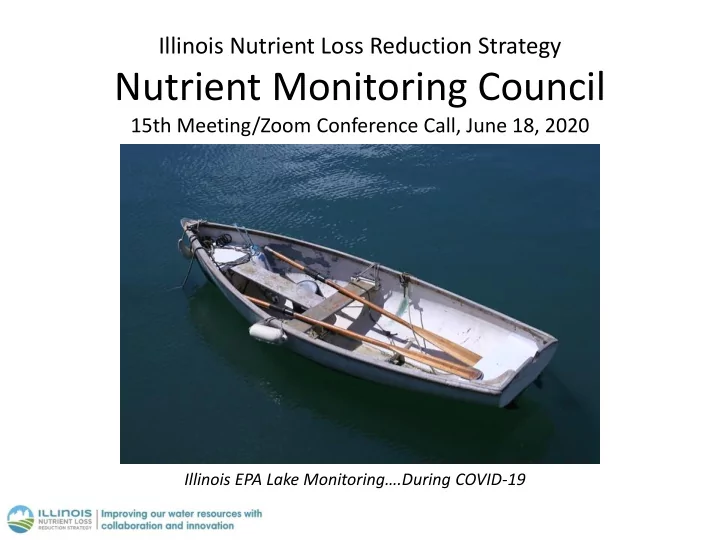
Illinois EPA Lake Monitoring….During COVID-19
Nutrient Monitoring Council 15th Meeting/Zoom Conference Call, June - - PowerPoint PPT Presentation
Illinois Nutrient Loss Reduction Strategy Nutrient Monitoring Council 15th Meeting/Zoom Conference Call, June 18, 2020 Illinois EPA Lake Monitoring.During COVID -19 Welcome/Housekeeping Important Stuff bathrooms, lunch, other
15th Meeting/Zoom Conference Call, June 18, 2020
Illinois EPA Lake Monitoring….During COVID-19
Illinois EPA Gregg Good, Rick Cobb Illinois State Water Survey Laura Keefer Illinois Natural History Survey James Lamer Illinois Dept. of Natural Resources Brian Metzke
Biological Engineering Paul Davidson Sierra Club Cindy Skrukrud
MWRDGC Justin Vick Illinois Corn Growers Association Laura Gentry U.S. Army Corp of Engineers-Rock Island Nicole Manasco U.S. Geological Survey Kelly Warner National Center for Supercomputing Apps Jong Lee
Environmental Sciences (Emeritus) Greg McIsaac NLRS Coordinator – Illinois EPA Trevor Sample
1. Coordinate the development and implementation of monitoring activities (e.g., collection, analysis, assessment) that provide the information necessary to: a. Generate estimations of 5-year running average loads of Nitrate-Nitrogen and Total Phosphorus leaving the state of Illinois compared to 1980-1996 baseline conditions; and b. Generate estimations of Nitrate-Nitrogen and Total Phosphorus loads leaving selected NLRS identified priority watersheds compared to 1997-2011 baseline conditions; and c. Identify Statewide and NLRS priority watershed trends in loading over time using NMC developed evaluation criteria. 2. Document local water quality outcomes in selected NLRS identified priority watersheds, or smaller watersheds nested within, where future nutrient reduction efforts are being implemented (e.g., increase in fish or aquatic invertebrate population counts or diversity, fewer documented water quality standards violations, fewer algal blooms or offensive conditions, decline in nutrient concentrations in groundwater). 3. Develop a prioritized list of nutrient monitoring activities and associated funding needed to accomplish the charges/goals in (1) and (2) above.
Gregory McIsaac, Associate Professor Emeritus University of Illinois at Urbana Champaign Adjunct Research Scientist Agricultural Watershed Institute
Load (lb/yr) = water flow (volume/time) x concentration (mass/volume) Yield (lb/ac-yr) = Load/drainage area USGS provides daily water flow IEPA and USGS provide sample concentrations approximately monthly Daily Load = daily water flow x estimated daily concentration Daily concentrations estimation methods Nitrate: Linear Interpolation over time between measured samples Phosphorus: Weighted Regressions on Time, Discharge and Seasonality (WRTDS)
1980- 1996
baseline Avg. value
2013-17 (Biennial Report) 2014-18 2015-19 Avg. value % change from 1980- 1996 Avg. value % change from 1980- 1996 Avg. value % change from 1980-1996 Water Yield (in/yr) 13.0 14.7 +13% 14.1 +9% 16.3 +25% Nitrate-N Load (Million lb N/yr) 397 425 +7% 380
448 +13% Total P Load (Million lb P/yr) 33.7 42.2 +25% 40.8 +21% 46.2 +37%
New update 2013-17 TP loads are slightly lower here than in the 2019 Biennial Report because WRTDS calculates loads based on relationships over a 7 year
annual, 5 year moving average, and 1980-96 average
6 8 10 12 14 16 18 20 22 1979 1984 1989 1994 1999 2004 2009 2014 2019
water yield (in/yr)
water yield 1980-96 avg. 5 per. Mov. Avg. (water yield)
Statewide average precipitation and water yield 1980-2019
water year basis (Oct 1 to Sept 30)
29 31 33 35 37 39 41 43 45 6 8 10 12 14 16 18 20 22 24 1979 1989 1999 2009 2019
precipitation (in/yr) water yield (in/yr)
water yield precipitation 5 yr avg water yield 5 yr avg precip
Statewide estimates of annual nitrate loads (black), water yield (blue), 1980-96 baseline average (solid red line), and five year moving average values (dashed lines)
5 7 9 11 13 15 17 19 21 23 100 200 300 400 500 600 700 1978 1988 1998 2008 2018
water yield (in/yr) Statewide annual nitrate-N load (million lb N/yr)
NO3-N load Baseline avg. water yield (in/yr)
Statewide estimates of annual TP loads (green), water yield (blue), 1980-96 baseline average (solid red line), five year moving average values (dashed lines)
6 8 10 12 14 16 18 20 22 15 25 35 45 55 65 75 1979 1984 1989 1994 1999 2004 2009 2014 2019
water yield (in/yr) Total P load (million lb P/yr)
1980-96 TP baseline avg TP load water yield
2 4 6 8 10 12 14 16 18 20 Embarras Little Wabash Big Muddy Kaskaskia Illinois Rock (inc. Kishw) Green Vermilion
Million lb P/yr
1980-96 2013-17 2014-18 2015-19
+12% +77% +49% +86% +27% +34%
+10%
0.5 1 1.5 2 2.5 3 3.5 4 Embarras Little Wabash Big Muddy Kaskaskia Illinois Rock (inc. Kishw) Green Vermilion
Million lb P/yr
2013-17 2014-18 2015-19
Chan anges in Riverine TP Loads from 1980-96 to 2013-17 and 2014-18 for major rivers draining Illinois
+12% +77% +49% +86% +27% +34%
+10%
50 100 150 200 Embarras Little Wabash Big Muddy Kaskaskia Illinois Rock (inc. Kishw) Green Vermilion
Million lb N/yr
1980-96 2013-17 2014-18 2015-19
+24% +29% +4%
+3% +140% +35%
10 20 Embarras Little Wabash Big Muddy Kaskaskia Illinois Rock (inc. Kishw) Green Vermilion
Million lb NO3-N/yr
2013-17 2014-18 2015-19
+24 % +29%
+140% +35%
+4%
+3 %
0% 10% 20% 30% 40% 50% 60% Embarras Little Wabash Big Muddy Kaskaskia Illinois Rock (inc. Kishw) Green Vermilion 2013-17 2014-18 2015-19
Rockton Joslin
Illinois portion of the Rock River Watershed USGS and IEPA monitoring locations at Rockton and Joslin and Perryville on the Kishwaukee
Modified from ISWS Perryville
5000 10000 15000 20000 25000 30000 35000 1 9 19 21
Nitrate-N Load (Mg N/yr)
1980-96 2013-17
Joslin Rockton Perryville Rock-(Rockton+Perryville) Square miles: 9,549 6,363 1,099 2,087 1993-4 were excluded from all sites because
at Perryville and Rockton 8,500 Mg N/yr = 19 million lb N/yr
2 4 6 8 10 12 14 16 18 5 10 20 23
Nitrate-N yield (lb N/ac-yr)
1980-96 2013-17
Joslin Rockton Perryville Rock-(Rockton+Perryville) Green River 1980-96: 11.3 2013-17: 13.9 Why so low? 1993-4 were excluded from all sites because
at Perryville and Rockton Square miles: 9,549 6,363 1,099 2,087
long groundwater flow pathway?
flows, especially in June and July?
between 1978 and 2017 in Whiteside and Ogle Counties)
with irrigation
https://www.isws.illinois.edu/groundwater-science/groundwater-monitoring-well-networks/green-river-lowlands-monitoring
Green River Lowlands
Nitrate-N concentrations in public water supply wells located near the Rock River
From Daniel Abrams, Walton Kelly, Vlad Iordache and my proposal to NREC; data from ISWS Community Water Supply database.
10000 20000 30000 40000 50000 60000 70000 1975 1980 1985 1990 1995 2000 2005 2010 2015 2020
irrigated acres USDA Census of Agriculture data
Fraction of Whiteside plus Ogle Counties planted to corn
USDA National Agricultural Statistics Service 1979-95 avg: 0.47; 2012-16 avg: 0.53 increase of 41,500 acres of corn
0.3 0.35 0.4 0.45 0.5 0.55 0.6 1970 1980 1990 2000 2010 2020
fraction of countues planted to corn
Pot
impact of
irrigated ac acres an and in incr creased cor
acres
Rock-(Rockton+Perryville) average monthly water yield (48% increase in annual average water flow)
Jan and Feb. 2017 average flows estimated at Perryville and Rockton due to some missing daily data April through July water yield increased 80% (3.5 in/yr) July water yield doubled High flows in the growing season promote leaching losses; Higher flows in warmer months (May, June, and July) probably reduce in- stream denitrification losses and thereby increase riverine loads; A similar pattern can be seen at other locations, but the Lower Rock may be more suitable to denitrification at low flows.
0.5 1 1.5 2 2.5 Jan Feb Mar Apr May June July Aug Sept Oct Nov Dec
Monthly average water yield (in/mo)
1980-96 2013-2017
(avg of Dekalb, Dixon, Morrison, Mount Carrol, Rockford and Rochelle) Average April through July precipitation increased 3.8 inches
1 2 3 4 5 6 Jan Feb Mar Apr May Jun Jul Aug Sept Oct Nov Dec
precipitation (in/mo)
1980-96 2013-17
Concluding Thoughts about the Rock River Nitrate-N Loads If there is a large reservoir of groundwater nitrate discharging into the Rock River, there will probably be long lag times between reductions in leaching losses from cropland and reduced loads in the river. Practices that reduce nitrate concentrations in the river (e.g., side channel wetlands) may reduce loads more quickly. Irrigation water management efficiency is critical to efficient use of N fertilizer under irrigation.
Water Sub-Cabinet detailing a list of items for federal agencies to address to assist states in implementing their state nutrient strategies.
February 3-5, 2020 in Washington D.C.
working groups to address certain issues outlined in the states’ letter.
Quality Network Coordinator—Lawrence, Kansas
establishing a Mississippi River Basin monitoring network that would capture annual nutrient loads from each HTF state.
Center and Tetra Tech to determine existing water quality stations and to identify sites where new stations could be added.
Trends Working Group. Tetra Tech will review and compile the NGRREC data and identify sites for new stations.
federal databases.
regarding water/land resource issues (i.e., clean water, ecosystem health, commercial navigation, hazardous spills, flooding, and aquatic nuisance species).
IEPA (Gregg Good); WQTF – IEPA (Gregg Good)
nutrient reduction and resource monitoring goals!
and USEPA (much like GLNPO)
and Urban NPS components
CWA coordinated 305(b) assessment of the UMR)
strategy (i.e., status and trends, success stories, research, condition assessments)
Minnesota, Missouri, Wisconsin) to discuss holding a summit for states to gather to discuss successes and challenges in tracking progress of implementing state nutrient reduction strategies.
who should attend. Between 3-6 members from each state will be allowed, along with staff from USEPA and NRCS.
has been postponed to 2021 due to COVID-19 concerns
with priority topics chosen by the planning committee.
Real-Time Water Quality Monitoring: H2NOW Chicago
Nutrient Monitoring Council Meeting June 18, 2020
2
Current’s mission is to grow Chicago and Illinois' blue economy – the companies developing innovative water technologies and industries that use them – to build solutions that will solve the world’s water challenges.
Launched in 2016 as a nonprofit water innovation hub, Current is headquartered in Chicago, IL. We're a collaborative that leverages partnerships with the state’s world class utilities, research institutions, industries and innovation community for global environmental and economic impacts
As a cross-sector connector of local and global water sector stakeholders, we build networks, organize events and convenings, and help develop pilot projects in real- world settings to solve persistent local water challenges.
Needs: Broader impacts, test-beds, commercia l
y, networks, funding Needs: Customer s, networks, funding, marketing exposure, test beds, policies Needs: Pipeline, deal flow, growth for their portfolio companie s Needs: Water expertise, space, networks
Needs: Water cost reduction, regulatory complianc e Needs: Water cost reduction and improved technology to meet customer demand; regulatory compliance Needs: Water cost reduction, regulatory compliance Needs: Water cost reduction, tools to help
manage water use Needs: Pipeline of innovative solutions for their customers Needs: Water use and cost reduction tied to energy needs; regulatory compliance Food/Bev (MillerCoors, Beam Suntory, Kraft, Mars Wrigley, Pepsi, etc.) Utilities (MWRD, CDWM, GE, Peoples Gas, etc.)
The “Blue Economy” describes industries with demand for technology to manage water in some way, and the industries and sectors supplying those technologies. Current connects stakeholders with distinct but common interests in water innovation.
Built Environment (Ozinga, CBRE, Sterling Bay, etc.) Consulting Engineering (Greeley and Hansen, Darley, Carollo, CDM Smith, etc.)
Current is the connector
Hemp/Textile (Cresco Labs, etc.) Transportation (IDOT, CTA, Metra, etc.)
Supply
tech Demand for innovative tech
Universities / Research Centers Entrepreneurs Investors Incubators
Technology deployed to solve local and regional water needs New technologies and solutions generated and exported; companies, jobs and GRP grow Educational pipeline for skilled and diverse workforce is established Governing and regulatory bodies support innovation in water and respond to the sector needs Thriving ecosystem: supply/demand connected; stakeholders collaborate to establish business relationships and develop solutions
Foundation: understanding needs of stakeholders on both supply/demand sides of local water cluster, identifying persistent local and regional water issues, technological and commercialization gaps, regulatory environment as it pertains to innovation, and brokering resources to fill the gaps Pillar 1 Pillar 2 Pillar 3 Pillar 4 Pillar 5
10
13
16
correlated tryptophan reading and turbidity
traditional method
detection (TTD)
microbial count - this correlation can be developed by conducting traditional lab testing in parallel
the sensors
visualization platforms
data
Cellular network Low power wide area network (LPWAN) supplemented by cellular
purposes
conductivity, flow, CSOs, etc.)
19
0.0 5.0 10.0 15.0 20.0 25.0 30.0 35.0 40.0
Tryptophan, ppb/Rainfall, mm
TLF Sensor Readings (temperature-correlated) for Addison and Loomis Locations Addison Loomis CSOs Rainfall
21
Data Analysis Research Utilities Data Visualization / Transfer Funding Sensing Community Engagemen t
23
29
concentrations in the Illinois River Basin (workshop is coming in July)
contaminants, energy efficiency, and water reuse
30
30
33
Alaina Harkness: Aharkness@currentwater.org - @harknessa Svetlana Taylor: Staylor@currentwater.org George Brigandi: Gbrigandi@currentwater.org
Ted Kratschmer
NGRREC
integrates water quality data and analytical tools from multiple sources allowing a user to visualize and understand nutrient pollution and water quality conditions in the Mississippi River watershed.
and compare water quality data from the Mississippi River and its tributaries.
Data Data to Knowledge Knowledge to policy action
Monitoring, land use, cover crops, etc. etc. Choosing models, trend analysis etc.
Biennial Report
Visualizing Illinois NLRS Data
DRAFT PAGE
Visualizing Illinois NLRS Data
DRAFT PAGE
Explaining NLRS Data - Storyboards
watershed, state or for the entire MRB
reductions
management practices for each of the 12 MRB mainstem states in the Mississippi River Basin ( Reid Christianson – UIUC )
(Kaiyu Guan - UIUC)
New Initiative
Overall Trend in the Basin
DRAFT PAGE
Watershed Trends in the Basin
DRAFT PAGE
trends by watershed, state or for the entire MRB
management practices for each of the 12 MRB mainstem states in the Mississippi River Basin (Reid Christianson)
quality (Kaiyu Guan)
Main Stem