Numerical Methods for Ordinary Differential Equations (ODE) - - PDF document

numerical methods for ordinary differential equations ode
SMART_READER_LITE
LIVE PREVIEW

Numerical Methods for Ordinary Differential Equations (ODE) - - PDF document

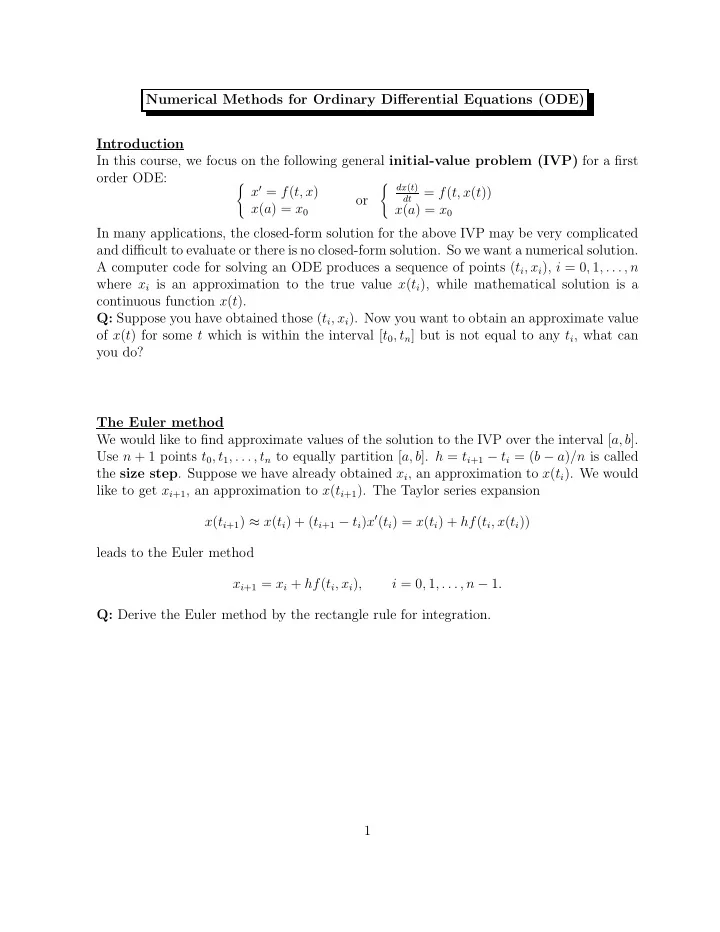
Numerical Methods for Ordinary Differential Equations (ODE) Introduction In this course, we focus on the following general initial-value problem (IVP) for a first order ODE: dx ( t ) x = f ( t, x ) = f ( t, x ( t )) or dt x ( a ) =


slide-1
SLIDE 1

Numerical Methods for Ordinary Differential Equations (ODE) Introduction In this course, we focus on the following general initial-value problem (IVP) for a first

  • rder ODE:
  • x′ = f(t, x)

x(a) = x0

  • r

dx(t)

dt

= f(t, x(t)) x(a) = x0 In many applications, the closed-form solution for the above IVP may be very complicated and difficult to evaluate or there is no closed-form solution. So we want a numerical solution. A computer code for solving an ODE produces a sequence of points (ti, xi), i = 0, 1, . . ., n where xi is an approximation to the true value x(ti), while mathematical solution is a continuous function x(t). Q: Suppose you have obtained those (ti, xi). Now you want to obtain an approximate value

  • f x(t) for some t which is within the interval [t0, tn] but is not equal to any ti, what can

you do? The Euler method We would like to find approximate values of the solution to the IVP over the interval [a, b]. Use n + 1 points t0, t1, . . . , tn to equally partition [a, b]. h = ti+1 − ti = (b − a)/n is called the size step. Suppose we have already obtained xi, an approximation to x(ti). We would like to get xi+1, an approximation to x(ti+1). The Taylor series expansion x(ti+1) ≈ x(ti) + (ti+1 − ti)x′(ti) = x(ti) + hf(ti, x(ti)) leads to the Euler method xi+1 = xi + hf(ti, xi), i = 0, 1, . . ., n − 1. Q: Derive the Euler method by the rectangle rule for integration. 1

slide-2
SLIDE 2

Algorithm for the Euler method (given f, a, b, x0, n). h ← (b − a)/n t0 ← a for i = 0 : n − 1 xi+1 ← xi + hf(ti, xi) ti+1 ← ti + h end Note: In the Euler method, we chose a constant step size h. But it may be more efficient to choose a different step size hi at each point ti based on the properties of f(t, x). An adaptive method can be developed. Example: Use the Euler method to solve

  • x′ = x

x(0) = 1

  • ver [0, 4] with n = 20. What did

you observe? How do you explain what you observed? Errors for the Euler method The Taylor series expansion gives x(ti+1) = x(ti) + hf(ti, x(ti)) + 1 2h2x′′(zi+1), zi+1 ∈ [ti, ti+1]. (1) the Euler method gives xi+1 = xi + hf(ti, xi). (2) From (1) and (2) x(ti+1) − xi+1 = x(ti) − xi + h[f(ti, x(ti)) − f(ti, xi)] + 1 2h2x′′(zi+1). x(ti+1) − xi+1 is the error at ti+1. This is called the global error at ti+1. It arises from two sources:

  • 1. the local truncation error:

1 2h2x′′(zi+1). Notice if xi = x(ti), then the local trun-

cation error at ti+1 is just the global error at ti+1.

  • 2. the propagation error: x(ti) − xi + h[f(ti, x(ti)) − f(ti, xi)]. This is due to the

accumulated effects of all local truncation errors at t1, t2, . . . , ti. When we perform the computation on a computer with finite precision, there is an addi- tional source of errors: the rounding error. Note: There are a few techniques to determine the step size h according to error analysis results. 2

slide-3
SLIDE 3

The trapezoid-Euler method

    

ˆ xi+1 = xi + hf(ti, xi), xi+1 = xi + 1

2h[f(ti, xi) + f(ti+1, ˆ

xi+1)] ti = a + ih In the literature, this is also called the improved Euler’s method or Heun’s method. The midpoint-Euler method

    

xi+1/2 = xi + 1

2hf(ti, xi),

xi+1 = xi + hf(ti + 1

2h, xi+1/2)

ti = a + ih General Taylor series methods Taylor series expansion gives x(ti+1) ≈ x(ti) + hx′(xi) + 1 2!h2x′′(ti) + · · · + 1 m!hmx(m)(ti) From x′ = f(t, x), we can compute x′′, . . . , x(m). Define x′

i, x′′ i , . . ., x(m) i

as approximations to x′(ti), x′′(ti), . . . , x(m)(ti), respectively. Then we have the Taylor series method of order m: xi+1 = xi + hx′

i + 1

2!h2x′′

i + · · · + 1

m!hmx(m)

i

, x0 is known. Remarks:

  • 1. The Euler method is a Taylor series method of order 1.
  • 2. If f(t, x) is complicated, then high-order Taylor series methods may be very compli-

cated. Runge-Kutta methods of order 2 xi+1 = xi + (1 − 1 2α)K1 + 1 2αK2 where K1 = hf(ti, xi), K2 = hf(ti + αh, xi + αK1), α = 0. 3

slide-4
SLIDE 4

When α = 1, we obtain the trapezioid-Euler method, and when α = 1/2, we obtain the midpoint-Euler method. The local truncation error of Runge-Kutta methods of order 2 is O(h3). Runge-Kutta methods of order 4 The classical fourth-order Runge-Kutta method xi+1 = xi + 1 6(K1 + 2K2 + 2K3 + K4) where K1 = hf(ti, xi), K2 = hf(ti + 1 2h, xi + 1 2K1), K3 = hf(ti + 1 2h, xi + 1 2K2), K4 = hf(ti + h, xi + K3). This method is in common use for solving IVPs. The local truncation error of Runge-Kutta methods of order 4 is O(h5). MATLAB tools

  • 1. ode23: based on a pair of 2nd and 3rd-order Runge-Kutta methods.
  • 2. ode45: based on a pair of 4th and 5th-order Runge-Kutta methods.

4